Monday, August 12, 2013

amaBooks in Kenya for a Feast of Literature


In June, we, Jane Morris and Brian Jones, the two directors of ’amaBooks, a small independent publisher based in Bulawayo, visited the bustling city of Nairobi, to participate in a workshop for those involved in promoting literature, as well as a series of literary events.

Luckily when we arrived we didn’t have to battle through rush-hour traffic as this is a foolhardy pursuit if you want to reach your destination in a reasonable time, with matatus zigzagging crazily through the long traffic jams.

The programme in Kenya was devised to celebrate the British Council’s partnership with Granta, the UK’s leading literary magazine on their recent announcement of the “Best of Young British Novelists 4”.

For three consecutive decades Granta has selected 20 young writers who have shown exceptional promise on the British literary scene. As well as the British Council in Kenya, the other local partner in the programme was Kwani Trust, a Kenya-based literary network dedicated to developing quality creative writing.

Running in parallel with our workshop on “Promoting New Writers” was a fiction writing workshop. Novuyo Rosa Tshuma, the Zimbabwe representative, joined writers from Kenya, Nigeria, South Africa and Uganda.

The young writers were able to interact with award-winning British writers Adam Foulds and Nadifa Mohamed (two of Granta’s ‘Best of Young British Novelists’), Granta’s Deputy Editor, Ella Allfrey and Kwani’s Managing Director Billy Kahora.
 Attending the workshop gave us the opportunity to interact with others involved on the literary scene from other African countries and we were particularly pleased to meet up with two of the co-publishers of our next book. Femrite from Uganda and Kwani in Kenya are also publishing the latest collection of short stories from the Caine Prize for African Writing 2013 – “A Memory This Size”. The book has just arrived from the printers and will be in Zimbabwe outlets shortly.

Another highlight was exchanging ideas with the representatives from the Port Harcourt Book Festival, a literary event that takes place every October in the city, referred to as the Garden City, in the Niger Delta. Port Harcourt has had the honour bestowed on it of being elected as the UNESCO World Book Capital for 2014, the first city in sub-Saharan African to be chosen. The organizers of the festival are actively involved in promoting a reading and writing culture.

The workshop gave each participant the opportunity to talk about their experience of events and one of the examples we shared was the launches we had organized for the most recent book in the short writings series “Where to Now? Short Stories from Zimbabwe”, which seemed to fit in well with the theme of the workshop of promoting new writers.

We have used each of the five books in the short writings series to introduce new writers to the Zimbabwean reading public, through including their work with those of more established writers. Because of the scattering of Zimbabwean writers, we, for the first time, launched the book in South Africa as well as in Zimbabwe.

The venue for the launch was the Writers’ Centre at Wits University, where three of the writers featured in the collection, Thabisani Ndlovu, Novuyo Rosa Tshuma and Sandisile Tshuma, read from their pieces and answered questions from the audience. The Zimbabwe launch of the anthology, during the Intwasa Arts Festival koBulawayo and held at the National Gallery of Zimbabwe in Bulawayo, featured readings, as well as a live drawing by the artist Owen Maseko, based on the short story “Snapshots” by NoViolet Bulawayo.

The growing emphasis on the use of social media in attracting and maintaining audiences for literary events was a key part of the workshop. Kwani gave the example of publicizing their events using Twitter and the innovative method of people buying a book prior to a launch by using Mpesa, an East African payment method via cell phones.

After the workshop, we were treated to a variety of literary events organized to celebrate Granta’s Best of Young British Novelists, featuring readings and discussions with Adam Foulds, Nadifa Mohamed and Kenyan writers. Adam Foulds read from several of his books, including his narrative poem, “The Broken Word”, set in Kenya about the Mau Mau uprising.
Nadifa’s readings were mainly from “Black Mamba Boy”, her fictionalized account of her father’s early life in the Horn of Africa. The literary week ended with Granta, Kwani and British Council combining to stage the ‘Best of Young British Novelists 4 Sunday Salon’; on a balmy Sunday afternoon it was a fitting end to what had truly been a literary feast. 
The picture shows Ellah Allfrey, Nadifa Mohamed, Zukiswa Wanner, Adam Foulds and others.
– By Jane Morris and Brian Jones © Panorama Magazine 2013.


from Panorama Magazine (http://www.panorama.co.zw/index.php/archives/115-pan-news/616-a-feast-of-literature)

Tuesday, August 6, 2013

The Caine Prize Anthology 2013 - A Memory This Size - published in Zimbabwe


'amaBooks has co-published the 2013 Caine Prize anthology. A Memory This Size, with six other African publishers - Jacana Media in South Africa, Cassava Republic in Nigeria, Kwani? in Kenya, FEMRITE in Uganda, Sub-Saharan Publishers in Ghana and Bookworld in Zambia - and with New Internationalist in the United Kingdom. The winner of the 2013 Caine Prize for African Writing was Tope Folarin of Nigeria with the story Miracle.

A chronically shortsighted young man finds himself the target of a preacher’s miracle cure… Despite his American street phrases and his fistful of dollars, a prodigal son’s visit to his Sierra Leone home does not go quite as planned… A medical student blinded in an accident seems to lose everything but soon learns what he has gained… Life on the edge for a gang of street boys paid to disrupt an election… An oil spill opens a path for a Nigerian teacher to join the woman she loves in the US…


The shortlisted stories for the 2013 Caine Prize – Africa’s leading literary prize – offer five arresting, diverse, provocative snapshots of a continent and its descendants captured at a time of accelerating change.
The shortlisted authors are:

Tope Folarin (Nigeria) for Miracle
Pede Hollist (Sierra Leone) for Foreign Aid
Abubakar Adam Ibrahim (Nigeria) for The Whispering Trees
Elnathan John (Nigeria) for Bayan Layi 
Chinelo Okparanta (Nigeria) America

In addition, 12 writers from six different African countries took part in the Caine Prize Writers’ Workshop, held this year in Uganda, where they each produced a special story for this volume. 

These 17 stories show yet again the richness and range of current writing on the continent. They underline the primacy of the short story, with its oral antecedents, at the very heart of African literature.

Africa’s most important literary award.’  International Herald Tribune
‘Dazzling and splendidly diverse.’  The Times, London


Tuesday, July 30, 2013

Where are they now? - some winners of the Intwasa Short Story Competition


Reproduced, with permission, from the Intwasa Arts Festival koBulawayo Newsletter July 2013

https://docs.google.com/file/d/1-O6cSLtg9P_YfZfh0o_5dPJoSI_eSQ64Lcn0UGH-t5AfBFBesMjr93NxL2EE/edit

Tuesday, July 23, 2013

Novuyo Tshuma's Flirtations with Nairobi


from www.panorama.co.zw


It's a sepia tinted afternoon as we speed from Nairobi's Jomo Kenyatta Airport, headed for the Fairview Hotel, situated near the city-centre. There seems to be a lot of activity here; construction everywhere, the skeletons of buildings in progress. Nairobi has the writhing vibrancy of Harare; the hum of traffic, the post-colonial ambitions of glossy architecture and inhabitants who throng the streets with urgent purpose.
The coming week is any writer's treat; five days of literary events organised by The British Council, Kwani, the innovative East African literary initiative, and GRANTA, UK's leading literary magazine.

I am grateful to British Council for sponsoring my trip, and my stay at the sparkling Fairview Hotel; I have flown in from South Africa and am to meet, among others, fellow Zimbabweans Jane Morris and Brian Jones of amaBooks. Jane and Brian are part of the Programmers' Workshop, which runs concurrently with our Writers' Workshop. This literary feast includes the launch of the latest GRANTA Issue 'Best of Young British Novelists 2013', a three-day fiction writing workshop, a lecture by visiting writers Nadifa Mohamed and Adam Foulds as well as a 2013 elections symposium put together by Kwani Trust.

There is a tingling feeling of having been here before, an intimate sense of having experienced this space and its people before; was it in Kenyan writer Binyavanga Wainaina's evocative memoir 'One Day I Will Write About This Place'?

The fiction workshop begins on the morning of the 19th, with Ellah Allfrey, Deputy Editor of GRANTA, chairing the proceedings. With her is Billy Kahora, Managing Editor of Kwani, and the two guest writers, UK based Nadifa Mohamed and Adam Foulds, both of whom are on GRANTA's 2013 Best of Young British Novelists list.

There are 19 workshop participants; 15 Kenyan writers and four visiting writers from Zimbabwe, South Africa, Nigeria and Uganda, myself included. The interaction with high profile editors and experienced writers is like a chipping away from a young writer of the crusty parts, a refining that sharpens writing focus. The workshop hones the craft of building a story, much in the same way one builds a house, building upon the foundation of plot a slab of setting, sturdy walls of language, cemented by effective research and airy windows for that clear-eyed characterisation. The gabbled roof is decorated by a writer's distinct style.

The symposium on Kenya's 2013 elections reminds me of Zimbabwe's own upcoming Presidential elections. Kenya and Zimbabwe seem to follow intersecting trajectories in the history of their elections; in 2008, when Zimbabwe spent an inordinate time without a President, it was dubbed “another Kenya”, seeing as Kenya had had a similar experience.

What is a space for a writer without a taste of its culture? Lunch at Campia, an Ethiopian restaurant - the tongue introduced to new tastes; injera (bitter pan-cake dough, which is eaten like sadza), tibtib (spicy meat dish) and zilzil (roasted meat dish). An evening at a dinner hosted by Kwani spent as a Maasai Woman, in a Kanga and a beaded bracelet which I am told Maasai women never take off; it is a marriage gift, much like a wedding ring. And a bag plump with books; intersections with the cultures of the world, any writer's delight.

What does one take away from the experience? Invaluable teachings, fresh ways of telling stories, new friendships, animating interactions with space... All of these beaded in memory, to one day embroider a fictitious truth.
The musky air, farting traffic and yellow lights as we drive to the airport on the evening of the 24th, remind me of a place called home. Strange, this, as I'm no longer sure where that is. - By Novuyo Rosa Tshuma.

*Novuyo Rosa Tshuma (pictured) is the author of Shadows. Her stories have won the Yvonne Vera Award and been published in various collections, including Where to Now? Short Stories from Zimbabwe.  She has been a participant in both the Caine Prize and Farafina Trust Writing Workshops. 

She holds a BComm in Economics and Finance from the University of Witwatersrand, and is a Maytag Fellow for MFA Creative Writing at the University of Iowa.

NoViolet Bulawayo makes Booker long list


from www.parthianbooks.com

Congratulations to all of this year's Booker longlisted authors. We're excited to see NoViolet Bulawayo, a Zimbabwean author whose work previously appeared in Parthian's anthology of Zimbabwean short stories Where to Now? Short Stories from Zimbabwe, recognised for her first novel We Need New Names.

Her longlisted novel, We Need New Names (Chatto and Windus) follows Darling and her friends, living in a shanty called Paradise, which of course is no such thing. They dream of the paradises of America, Dubai, Europe, where Madonna and Barack Obama and David Beckham live. For Darling, that dream will come true. But, like the thousands of people all over the world trying to forge new lives far from home, Darling finds this new paradise brings its own set of challenges - for her and also for those she's left behind.

NoViolet was born in Tsholotsho, a year after Zimbabwe's independence from British colonial rule. When she was eighteen, she moved to Kalamazoo, Michi­gan. She earned her MFA at Cornell University, where she was also awarded a Truman Capote Fellowship, and she is currently a Stegner Fellow at Stanford University in California. In We Need New Names she writes 'To play the country-game, we have to choose a country. Everybody wants to be the USA and Britain and Canada and Australia and Switzerland and them. Nobody wants to be rags of countries like Congo, like Somalia, like Iraq, like Sudan, like Haiti and not even this one we live in - who wants to be a terrible place of hunger and things falling apart?'

A previous winner of the Caine Prize for African Writing (the 'African Booker') and also shortlisted for the South Africa PEN Studzinsi Award, judged by JM Coetzee, NioViolet's work has appeared in magazines and in anthologies in Zimbabwe, South Africa and the UK.

Seven different countries are represented on the Booker longlist, and while there is a strong hand of established authors selected (Tash Aw, Jim Crace, Jhumpa Lahiri, Colum McCann, Charlotte Mendelson and Colm Tóibín) there is also a good representation for first timers.

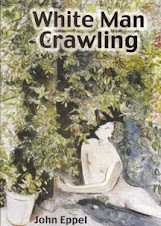
NoViolet's story 'Snapshots' appeared in Parthian's anthology of Zimbabwean writing Where to Now?, alongside work by Bryony Rheam and John Eppel. Complied by Zimbabwean publishing house 'amaBooks, Where to Now? was printed in the UK by Parthian in 2011.

Sunday, July 21, 2013

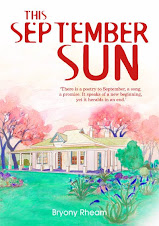
Wild Thistle reviews This September Sun


This September Sun by Bryony Rheam


http://www.wild-thistle.net/this-september-sun-by-bryony-rheam/


Ellie, a shy girl growing up in modern Zimbabwe, has a close attachment to her grandmother Evelyn. However, when Ellie is an adult living in England, she receives the news her beloved grandmother has been brutally murdered, apparently without reason. Ellie returned to Zimbabwe where she finds some old letters and diaries chronicling the life of her grandmother as she arrives in Rhodesia as a young war widow and has a longstanding affair with a married man.
This September Sun is the heartwarming story of Ellie, a white girl born in Zimbabwe, the former British colony of Rhodesia, which is now an independent and a predominantly black society. Ellie is a child in the first part of the book so we learn about her family and the changes taking place in society through her eyes, and since she is too young to understand what is really going on, the author lays the groundwork for a lot of the mystery concerning the life of Ellie’s grandmother, Evelyn. Ellie’s family used to live under the same roof but an explosive argument between her grandparents lead to Evelyn moving into her own flat where Ellie visits her once a week.
While visiting her grandmother, Ellie meets Miles, a friend of Evelyn’s, who makes her feel uneasy although she’s not sure why but we can see that Miles is Evelyn’s lover and it is the first hint we have that Evelyn is a passionate woman with secrets. No one else in the family is aware of Miles’s existence and Ellie begins to realise she is slowly being drawn into her grandmother’s web of lies. As Ellie grows up, she continues to be close to her grandmother but doesn’t really understand some of the decisions Evelyn begins to make and she is increasingly confused by it.
While Ellie is growing up, the familial events are mirrored by what is going on in Bulawayo with the changing political climate in Zimbabwe. Although there are no specific events described, the sense of unease is very prevalent as Ellie reveals many of her classmates are leaving the country to begin new lives in South Africa, England or Australia. The sense of displacement is very evident in Ellie as she struggles to find her own identity and yearns to go to England, believing Zimbabwe is no longer where she belongs.
When Ellie is studying in England, she continues to correspond with her grandmother and she is devastated when she receives a call in the middle of the night telling her Evelyn has been murdered. Ellie returns to Bulawayo where she finds Evelyn’s diaries chronicling her life in Zimbabwe and this is when the book really came alive for me. The impact of Evelyn’s murder on the family is interspersed with extracts in her diary which slowly reveal the answers to the mysteries raised in the first part of the book, including her grandmother’s lifelong affair with a married man. The diary extracts aren’t revealed in chronological order but jump back and forth through the decades as the story unravels but it is done in a fairly logical way so there is no confusion. When the events of Ellie’s life described in the first few chapters begin to appear, we gain a different perspective on what happened which enriches our understanding.
Reading about her grandmother’s life as a young woman is also a learning experience for Ellie as she begins to question the choices she’s made and realises she’s been deceiving herself. Once Evelyn’s story is concluded, it dawns on Ellie that she has been settling for second best and her heart really does yearn to return to Africa which has always been her home.
Rating: 

Friday, July 12, 2013

African Violet: The Caine Prize for African Writing 2012 to be discussed at the Harare Book Cafe


The Book Club @ Book Café in Harare will next meet on Tuesday 16 July at 6 pm to discuss African Violet. 

Please come along, even if you haven't read the book, and even if you haven't come to the book club before.

For information please call 0864 406 6015

Venue: Book Cafe 139 Samora Machel Ave, corner 6th Street, Harare

What is this book club about ?
Books are better appreciated when we're able to share our experience of the writing through discussion and exploration of the text. We get ideas through learning from how others see the same story. At the book club we will read an agreed book in advance and then meet at a set time to talk about it. Our aim is to enjoy the book and discussion. This is not meant to be a study group or an academic exercise.


African Violet features the shortlisted stories from the 2012 Caine Prize for African Writing, as well as stories from those attending the Caine Prize workshop.

Copies of the book are available at the Book Café bookshop, as well as the National Gallery shop, Blackstone Books and Avondale Books in Harare. In Bulawayo, copies can be found at the National Gallery shop, Induna Arts, Tendele Crafts, Best Books and Z&N bookshop.

African Violet is published in Zimbabwe by 'amaBooks. The 2013 collection, A Memory This Size, will be published by 'amaBooks in the near future.