Showing posts with label Drew Shaw. Show all posts

Monday, December 19, 2022

Bulawayo's Reading Africa Panel Discussion


Bulawayo writers discuss their writing, Zimbabwe's reading culture and their new projects as part of Catalyst Press' Reading Africa Project.

The recording is available through the link below:

Bulawayo's Reading Africa Panel 

Thursday, September 9, 2021

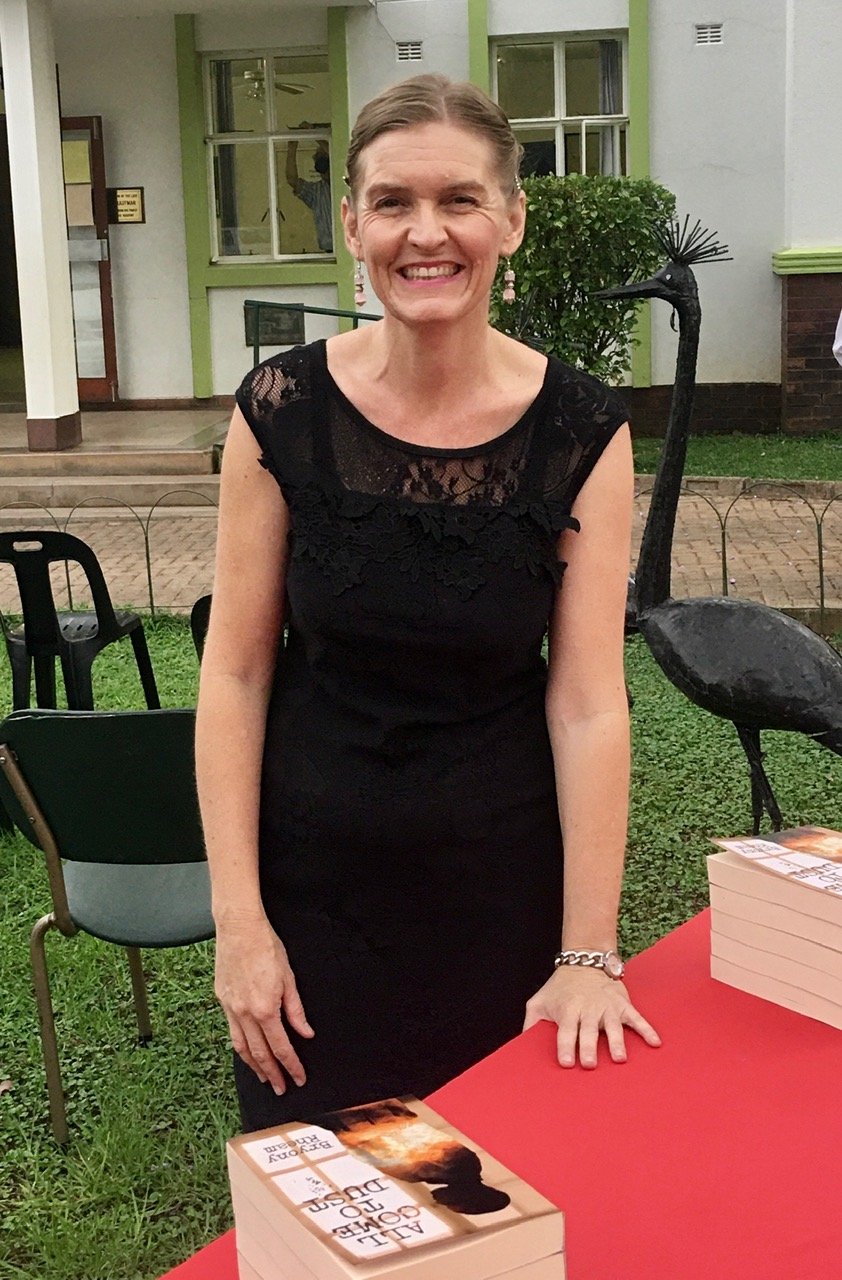
Video of the online UK launch of All Come to Dust


For those who weren't able to attend the launch of the novel on 8 September, the video contains the interview of Bryony Rheam by Drew Shaw about her murder mystery novel All Come to Dust. It includes a discussion of the book as 'more than simply a standard murder mystery, but set in Zimbabwe', the process of writing and readings from the novel by Bryony.

All Come to Dust is now available in the UK through https://www.parthianbooks.com/products/all-come-to-dust , as well as through good bookshops and websites; in North America through https://www.africanbookscollective.com/books/all-come-to-dust and, as an ebook, Amazon.com; as an ebook in Australia/New Zealand through Amazon.com.au; and in Zimbabwe through Bindu Books in Harare (sales@bindu.co.zw) or the Orange Elephant in Bulawayo.


Tuesday, September 7, 2021

Invitation to the online launch of Bryony Rheam's All Come to Dust


This Wednesday at 7pm BST, join Bryony Rheam in conversation with Drew Shaw to celebrate the launch of her fabulous detective novel All Come to Dust.


Parthian Books of Wales and amaBooks of Zimbabwe are proud to present the UK launch of All Come to Dust, by award-winning Zimbabwean author Bryony Rheam.

Join us for the online launch of this fantastic new murder mystery, as Bryony Rheam discusses her writing, characters and practice, and reads extracts from All Come to Dust. This event will premier on the Parthian YouTube channel on Wednesday 8th September at 7pm BST. Reserve your free ticket to receive a link on the day. There will be a live chat for audience interaction during the event screening. 

FREE tickets are available on this link:

https://www.eventbrite.co.uk/e/book-launch-all-come-to dust-by-bryony-rheam-tickets-168285669969


All Come to Dust is available to order from Parthian Books: https://www.parthianbooks.com/products/all-come-to-dust


Wednesday, June 9, 2021

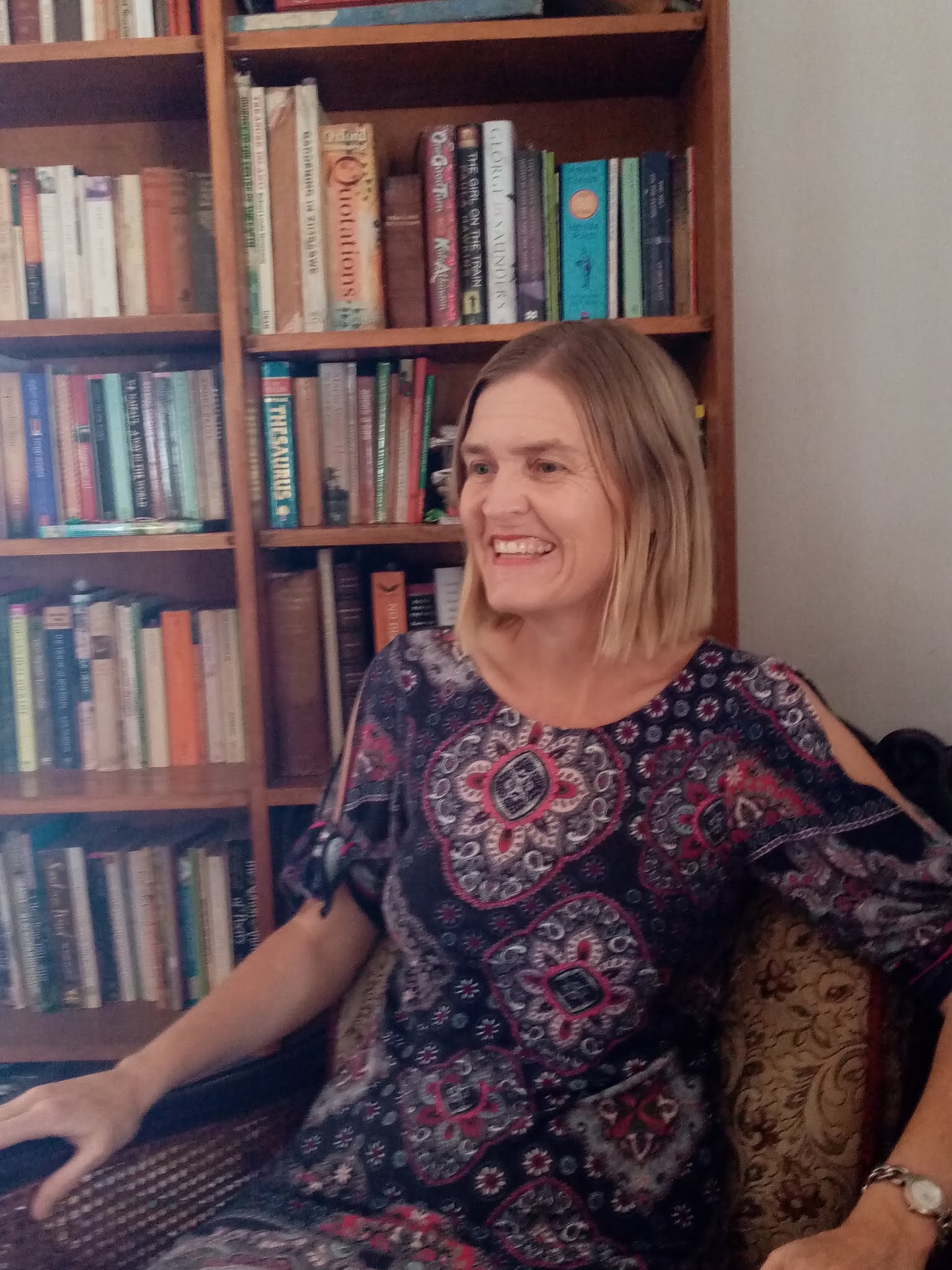
Bryony Rheam in conversation with Drew Shaw

 Reproduced from https://www.centre-for-english-excellence.com/articles/bryony-rheam-in-conversation-with-drew-shaw-in-bulawayo-may-2021


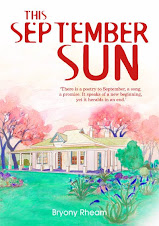
Congratulations, Bryony, on the launch of your latest novel, All Come to Dust (which was published by amaBooks in 2020)! It’s an intriguing, markedly different follow-up, in many ways, to your acclaimed debut novel This September Sun (published by amaBooks in 2009), which topped the Amazon UK charts, won the Best First Book at the Zimbabwe Publishers Awards, and later became an A-level English text in Zimbabwe. Both novels have also been published by Parthian in Wales. In 2006 you won the Intwasa Arts Festival Short Story Competition, and more recently you won a ‘Write your own Christie’ award and a Morland scholarship, so you have an accumulated list of achievements.  In addition to writing, you teach at Girls’ College where you are the head of the English Department, and I know you have a partner and two daughters and numerous other commitments. When do you find time to write, and have you got any tips for aspiring writers?

There is never enough time to write, but somewhere along the line, I manage to fit it in. I don’t do as much as I would like though. I think time is a funny thing – the more you have of it, the more you waste. I didn’t realise this until my eldest daughter was born. I used to write when she was asleep, and I really made use of the time. It’s surprising how much you can do in twenty minutes if you put your mind to it. There is a lot of wasted time in the day. At one time, I used to write while I was cooking. I’d sit at the kitchen table and just write whatever came to me in the few minutes it took for a pot to boil! I think you just have to do it. Don’t think: I have to sit down and write a novel; think, I have to write something. Even a couple of lines is a start.


I know you were born in Kadoma in 1974, moved to Bulawayo when you were young and attended Whitestone Primary School then Girls’ College, and you’ve lived in England, Singapore and Zambia before returning to Zimbabwe. Can you tell us about your journey to becoming an author. What was your earliest inspiration?

I have always wanted to be a writer and can remember putting together little books I had made when I was about six. They were about three tiny pages long! My biggest inspiration, I think, was Enid Blyton. I know some people don’t think much of her writing, particularly these days, but I loved her books. When I was about 13, I read her biography. She may not have been the nicest of people, but she was a very astute businesswoman. She was the first writer, never mind woman, to trademark her signature and her book sales made her into a very wealthy person.

You have written several short stories in addition to your novels: for example, in the Short Writings from Bulawayo series - stories such as ‘The Queue’, ‘Something about Tea’, ‘The Rhythm of Life’, ‘Miss Parker and the Tugboat' and ‘The Piano Tuner'. Then there is ‘The Reunion', for which you won the Intwasa Arts Festival competition in 2006, and also ‘Christmas’ in Weaver Press’s Laughing Now collection. Are there any plans to publish these as a collection? And do you prefer the short story or the novel form: is the writing process similar or quite different?

Parthian and amaBooks want to publish a collection, probably next year. I like writing short stories, especially if you just want to capture a particular moment or idea. It is still quite a lengthy process though, although sometimes I just get an idea and write it really quickly.

This September Sun is a novel about two main characters Ellie and Evelyn, a granddaughter and grandmother who form a close bond and have overlapping stories from different eras. The lives of both are lived mostly in Zimbabwe yet partly in the UK. Although it is fictional, many have remarked on how ‘real’ This September Sun reads - almost like a memoir. Who or what inspired Ellie and Evelyn, and were you able to draw on your own or other people’s real-life experiences in any way?


Yes, everyone thinks it is an autobiographical novel – and it is in many ways, but it also isn’t. I drew on many incidents from real life, for example the fact that Ellie doesn’t like swimming and doesn’t feel she fits into Zimbabwean society. That was very much me. Some of the incidents, I exaggerated or changed in some way.
My real grandmother was a lovely lady who had had a fairly troubled life. She was funny and clever, but had never really been given the chance to develop herself and her talents. Her son was killed in a car accident when he was 21 and she was, understandably, totally devastated by his death. This happened five years before I was born, but it dominated the early part of my life. I remember lots of tears, heated arguments, and various people trying to help her. I didn’t realise until I started writing This September Sun how much I had been affected by my uncle’s death and I had never met him. Sometimes I found myself crying whilst writing. It was the overwhelming sadness of the situation and the fact that, as a child, there was so much I didn’t understand.
Evelyn is quite different to my grandmother, yet I felt that in some way I was giving my grandmother an alternative story to live. It was a ‘what if she had done this instead of that?’

I’m sure you were delighted when This September Sun was chosen to become a set book in Zimbabwean schools, which means a wide spectrum of pupils are now reading it. 
Have you got any thoughts on why it was chosen; and what do you hope young readers will get out of it?

It's funny, I don’t actually know why it was chosen. I didn’t think that it would the kind of book ZIMSEC would like, but I am glad they did. A young reader once wrote to me and thanked me for writing This September Sun as it gave them an insight into white Zimbabwean society. I feel that in many African novels, white people are portrayed as ‘bad’ or, at best, very hard, unemotional people. What I hope readers will see is a common humanity, a life that we all share whatever our skin colour. People suffer loss, love, joy and hatred whoever they are and wherever they are.

Your two novels are quite different in terms of genre, yet there is some overlap in terms of Mystery. This September Sun is part epistolary, part Bildungsroman, Romance and Mystery, as John Eppel has described it. On the other hand All Come to Dust is mostly Murder Mystery, within the category of Crime Fiction. Did you always want to write a Whodunnit, and can you explain the transition to this genre?


I have always loved crime fiction. I don’t like violent crime or plots concerning psychopaths and that sort of thing! I enjoy the puzzle – working out a character’s motivation and trying to decide which clues are meaningful and which are red herrings. I therefore thought I would like to try writing my own. When I finished it, I thought ‘never again’, but now I have a couple of plot ideas for other mysteries. I think in future I would make them shorter though and more specifically ‘crime’. All Come to Dust is a crime novel, but it is also a comment on Zimbabwean society. I think I might be tempted to leave that out next time.
 
In fact both your novels are ‘two in one’ type stories. In This September Sun we have the separate yet linked narratives of Ellie and Evelyn. In All Come to Dust we have the mystery of ‘Who killed Marcia Pullman?’ but also the strange disappearance of Chief Inspector Edmund Dube’s adoptive parents. What attracted you to this ‘two-pronged’ approach? And was it hard to do?

I like the idea of different perspectives, how different people can view the same incident differently. I also like exploring the idea that the past is always with us, and that often, in order to understand the present, we need to go back to the past. I didn’t find it difficult to do, although with Ellie and Evelyn I had to always be aware of creating two different characters.

Why did you decide to set your fiction, most of it, in Bulawayo? Does the city hold special significance for you?

I think it’s always easier to write about a place you know and have a connection with. Some of This September sun was set in the UK, and I felt I could do that because I had lived there. I don’t know if I would be so confident about doing that now, having been away from it so long. Bulawayo is an interesting place, a real mix of people and different attitudes. When I was growing up, there were a lot of very strict, no nonsense, school teacher types. Many of them had come out to Africa at the end of the Second World War and they embodied the way of thinking of that time. However, as I got older, there was a growth in quite an arty, different sort of crowd. There was an influx of expats after 1980 and I think they influenced Bulawayo society which was generally very conservative. Bulawayo has always attracted rather different types. If you are looking for an expert on anything, from butterflies to 5th century Japanese architecture, you don’t have to go very far!

In This September Sun you explore travelling and belonging: Ellie can’t wait to ‘escape’ overseas, then ends back in Bulawayo, re-examining where she really belongs. In All Come to Dust, your diverse set of characters all struggle, to varying extents, to establish their place and purpose in a Bulawayo community. But it’s Chief Inspector Edmund Dube who perhaps grapples most with his own identity and sense of belonging - an outsider in so many respects. I’m very interested in these themes. Were you consciously exploring them?

Until I wrote This September Sun, I don’t think I appreciated how many people consider themselves to be outsiders – I thought I was the only one! I suppose it’s inevitable in a way when you have a mix of people from different countries and cultures in one place. I always found white society very narrow and one where you were expected very much to fit in. If you didn’t fit in, you were out. Simple. It was only when I came back to Bulawayo after being away for about eight years, that I began to realise that, in my own way, I had been equally as narrow. This is what Ellie discovers after her grandmother’s death. She had always thought Miles, Evelyn’s boyfriend, was a typical ‘Rhodie’, but actually he is the one who reads Shakespeare.
In All Come To Dust, all the main characters struggle with a sense of loss and a feeling of not being on the inside. Here, I was more open to the idea that even people who appear to fit in – Craig, the archetypal Bulawayo man, Edmund, the police officer – don’t. Marcia Pullman is the kind of person who lets you know whether you belong or not according to whether you are invited to her book club and bridge parties. Nobody particularly likes her, but they will never challenge her because they are afraid of being left out. I feel this is very relevant in Zimbabwean society. The people with money call the shots, even socially.
Edmund has never felt he really fitted in, but he does not appreciate this as a strength, which, of course, it is. He was the only black boy in a white school just before Independence, and he’s also determined to fight crime without getting involved in corruption. I think his early experience of being isolated prepares him to be able to stand alone as an adult.

I think you have a trademark style, in terms of Zimbabwean literature at least. Your descriptions of time and place, mood and character are incredibly detailed. There is a carefully-observed picture of what’s on the street or in a house, or what characters had for supper, a focus on every-day minutia - and one might call this a classic realist style. At the same time, your protagonists engage in quite detailed interior monologues - reflections, observations, and heightened self-reflexivity (Ellie, most notably, in This September Sun) that might be called modernist. So there’s a simultaneous exploration of the external and internal in your work. How did you develop this style and was it a conscious choice? It also seems you write longer books than most Zimbabwean authors - a joy for your reading fans, but probably time consuming on your part. What are the challenges, and were you inspired by any authors in particular?

Thank you for saying I have a trademark style – that is quite a compliment! There are times when I look at the size of my books and think, ‘Bryony, you need to stop writing.’ To me, a setting is very important – that and atmosphere. I like little details because I think they can tell the reader so much, and when I write I have a picture in my mind. I can see the person stirring the tea and the tea whirling round. I don’t know if I could write differently. It may take more time, but I don’t think I would feel it was me if I didn’t write like this. I have taken parts out though when editing. An author I love is Scott Fitzgerald. I wouldn’t claim to write like him, but he has definitely been an influence. Another writer is Virginia Woolf – I like the attention she gives to the small, everyday details that are part of our lives.

All Come to Dust has struck chords with a wide age range in Bulawayo. I met an eighty-nine-year-old lady who loved it, as did my twelve-year-old nephew who commandeered his mother’s copy and got similarly engrossed. Do you have any thoughts on why the detective genre has a broad appeal? What appeals about the Whodunnit and does it allow you to explore society in a particular way?

I met someone once who told me she had no interest at all in murder mysteries. She said she really did not care who ‘did it’. I believe she is the exception to the rule; so many people enjoy trying to work out who ‘the murderer is’. There are those who can just read or watch something for pure entertainment and never think about twists and turns and how you as a reader/viewer are being manipulated, and there are others who enjoy the challenge of trying to work it out. Once you get into a habit of reading crime, you realise you are also actively involved in the novel. Your understanding and interpretation of events is part of the novel’s success or failure. I think that can be quite fun.
As a writer, I think crime does allow you to explore society in a different way. What I love about Agatha Christie is that she creates these beautiful quaint English villages that are seething with murderers. She believed everyone is capable of murder, and that’s a very frightening thought. Modern crime suggests that murderers are psychopaths and easily identifiable as such. That’s where it all goes wrong. You finish the book and feel separate from the murderer: he was just some nut case who had an unhealthy relationship with his mother. It’s much more unsettling to discover the nice old lady who serves tea and biscuits every Sunday at church has been slowly knocking off members of the congregation because she didn’t want her past to come to light.

Who or what was the inspiration for Chief Inspector Edmund Dube in All Come to Dust and are we likely to see him again?

I was drawn to the idea of a policeman who wanted to do a good job. He wanted to solve a crime and was tired of the police force being something of a laughing stock. I also like the idea of a policeman with his own issues, his own darkness that needs healing. A couple of people have asked me if I would write another book with him in it, and initially I said no, but now I am thinking he could go out on his own as a private investigator. That might be an idea.

The hapless Craig Martin, in All Come to Dust, my nephew’s favourite character, provides a certain amount of comic relief. Who or what inspired him?

I love Craig! I am so glad I gave him a haircut at the end. Craig was initially in a short story I was developing. He wasn’t as lonely in the story as he did have friends, but they were all married with children and he couldn’t seem to get his life together. I had a boyfriend when I was about 18, who drove a Renault. It was a slightly different model to Craig’s. He also had a mullet (but it was OK then because it was 1992!) He had a very different character to Craig though.

Both your novels are about solving mysteries and uncovering secrets, which seems to drive the plot. Can you talk about your interest in mysteries and secrets, and how easy or difficult is it to structure a novel around them?

I have always absolutely loved mysteries and secrets. I think it all started with reading The Secret Garden as a child, and all those Famous Five books where they discovered treasure and secret passageways!
I think every family has secrets, and those secrets only come out over a period of time. You get different versions of the truth from different people and, of course, the very idea of an absolute truth is flawed. Memories change, feelings change, motivation changes. We all have family myths, stories that are handed down as truths, but have inevitably been changed. However, it is important to know these. I think they are part of who we are.

Can you tell us about what you are working on at present? What’s it called and what will it be about?

Earlier on in the year, I finished The Dying of the Light, a novel set in Bulawayo in the late 1930s, which involves around an incident at a place called Bisset Hall, an institution moulded loosely on Ingutsheni. I have now started a novel which I think will be more for young adults, although I hope it is the type of book that everyone will enjoy. It is about a young man who has ruined his life through drink and drugs. His very well-off grandfather gives him a challenge which is to manage a very big, old departmental store in Bulawayo that is currently divided into little shops. He is told he can do anything with it, as long as he clears everyone out. What he doesn’t know is that his grandfather is essentially using him to empty the building, which he has other plans for. Meanwhile, the young man sets about restoring the shop to its former glory, even going as far as trying to recruit some of the old staff or their family members.

Have you got any thoughts about other Zimbabwean writers and writing at the present moment?

I think Zimbabwean writing has been a bit in the doldrums and needs some sort of boost. One of the most promising writers at the moment is Siphiwe Ndlovu. I just loved her book, The History of Man. I find it frustrating, however, that the best writing often comes from outside the country. It’s hard to be a writer here. It’s impossible to make enough money to live on. I really feel we need things like competitions with big prizes, scholarships and sponsorship.

That would be nice. I think there's nevertheless a lot of excellent writing coming out of Zimbabwe as well as the Diaspora. Conventional publishing opportunities seem to have shrunk here... But it's nevertheless nice to see award winners such as Siphiwe Ndlovu coming back to Bulawayo to work on new writing. It was a real achievement for you both to win Morland Scholarships to continue your work, and I very much enjoyed our discussion about the City of Kings as a character in your novels. It's wonderful also that you yourself returned from several years in the Diaspora, and I have an idea there's symbiotic overlap and interchange between those writing from within Zimbabwe and without (a topic perhaps for another discussion). Let’s hope we can continue promoting the value of literature in Bulawayo and beyond. Bryony, thank you very much for the conversation.




Monday, November 9, 2020

All Come to Dust in Zimbabwe


Bryony Rheam's novel All Come to Dust is now available in Zimbabwe - it will be launched in Bulawayo at the Zimbabwe Academy of Music at 6.00pm on Wednesday 11 November.

As many projects across the world, the  publication of All Come to Dust in Zimbabwe has been held back by the Covid-19 pandemic. Two days before the launch, copies are rolling off the press at Directory Publishers of Bulawayo following the installation of up-to-date digital printing equipment there - that installation having been delayed by the travel restrictions caused by the pandemic.

Joining Bryony Rheam at the launch will be fellow Bulawayo writer Mzana Mthimkhulu and academic Drew Shaw. All are welcome to come along, free admission.

Bryony Rheam, a winner of the international ‘Write Your Own Christie’ competition, is an enthusiast for the writing of Agatha Christie, and All Come to Dust is written in the style of a Christie detective story. 


Bryony Rheam

In All Come to Dust, Marcia Pullman has been found dead at home in the leafy suburbs of Bulawayo. Chief Inspector Edmund Dube is onto the case at once, but it becomes increasingly clear that there are those, including the dead woman’s husband, who do not want him asking questions.

The case drags Edmund back into his past, to his childhood to when his mother's employers disappeared one day and were never heard from again, an incident that has shadowed his life.

As his investigation into the death progresses, Edmund realises the two mysteries are inextricably linked and that unravelling the past is a dangerous undertaking threatening his very sense of self.

The novel is set in modern day Zimbabwe, but it also looks back to the time just before Independence.


This is Bryony Rheam's second novel, her first novel This September Sun having gained critical acclaim.


The co-publication of All Come to Dust in the United Kingdom by amaBooks and Parthian Books has also been delayed by the pandemic, but the novel will be available there in 2021. The book is being translated into Arabic and will be published out of Egypt by Al Arabi Publishers.

Hot off the press


Thursday, February 11, 2016

Eppel and Muzanenhamo's 'Textures' reviewed in The European English Messenger

John Eppel and Togara Muzanenhamo 2014. Textures.
Bulawayo: 'amabooks, 91 + viii pages
ISBN 9 780797 494985 (soft cover).
John A Stotesbury
University of Eastern Finland, Joensuu, Finland
The European English Messenger, 24.2 (2015)

In material terms this small volume of poetry by two Zimbabwean poets, John Eppel and Togara Muzanenhamo, appears modest in its scope. Its title is unpretentious: simply “Textures”, which both Eppel and Muzanenhamo explain in the Introduction in terms of its etymological and metaphorical links with weaving. There are a fair number of poems, 43 in all, numerically speaking a majority of them by the elder poet, Eppel, in contrast to the sixteen by Muzanenhamo, although they vary in length, and several of Muzanenhamo’s are more expansive and perhaps more demanding than Eppel’s.

Inevitably, a number of too easy contrasts can be drawn up between the poets themselves. Eppel is a Zimbabwean whose South African roots were transplanted in early childhood into Bulawayo soil, a city – and its gardens – a location that has grown and sustained him for many decades, a place where he continues to teach literature in English to a schoolboy clientele whose ethnicity is now 90 per cent black. As other commentators have noted, Eppel’s rootedness in Bulawayo has given him access to a full range of references to the natural environment, in particular the abundant flowers and birds that frequently find their place in his poetry.

Muzanenhamo, for his part, is a full generation younger, and grew into young adulthood along with the emergence after 1980 of the liberated Zimbabwe. To some degree, in contrast to Eppel, his subsequent education has been acquired in the First World, and unlike Eppel’s, his writing has more readily achieved recognition both within Southern Africa and also further afield – although since the 1960s Eppel has undoubtedly produced a wider range of poetic and prose writing, much of the latter subtly satirical, that would deserve wider recognition from an international audience, including one that has sometimes resorted to over-simplistic categorizations.

The generational shift represented in this collaborative volume of poems through the voluntary yoking together of two such poets – one ostensibly bearing the memory of the world of white, colonial and post-colonial “privilege”, the other perhaps a voice of contemporary Zimbabwe, with its all-too-familiar litany of implicit fractures – has been nicely subverted by the layering, or interweaving, of their poetry into eight alternating sections, although none of them is headed, and there is no clear progression or comparison to be inferred from the selections of poems, other than the final “Epilogue” of Muzanenhamo’s fourth section.

The volume itself has been usefully introduced by a fellow Zimbabwean, Drew Shaw, who points out that both poets are “dedicated to excellence in form” and to a “meticulous attention to the craft of poetry” (ii); Shaw also points out the domestic, inward-looking quality of much of Eppel’s writing, in contrast to “the more international Muzanenhamo” (iii).

It might also be of value to consider the ways in which such a volume of poetry by two poets can be read: my own approach was initially to read each poem and each alternating poet consecutively, noting small details of composition and thematic focus, and considering the similarities and differences predicted by Dash. But a later reading of each poet’s work in its entirety, first Eppel’s and then Muzanenhamo’s, more strongly emphasized some of the craftsmen’s brush-strokes that make up their connections and differences.

Eppel’s writing is very much that of an older generation, and for a reader of similar age (as this reviewer is) there is the pleasure of recognizing Eppel’s subversion of over-quoted “classics”, such as the sonnet titled “Beauty is Truth, Truth Death” (“So: put down your pen and take a deep breath”) (9), and the melancholic recognition of the failure of so many hopes for a better postcolonial world, contained in the echo of Doris Lessing’s first novel: “grass has forgotten to sing” (“Giving up on the Rains in Curious Rhyme”) (10). In somewhat more mischievous vein, in “Dorothy Recollects [a pastiche]”, he has the physically degenerating Dorothy Wordsworth repeatedly distracting her brother away from his newly-acquired bride Mary Hutchinson on their wedding-day: “I gave him the wedding ring …/from my forefinger where I had worn it the whole of the night before” (48).

Eppel’s poetic vision is also shaped by an accumulated awareness of ageing and the failure of the individual voice; poem after poem rests on an awareness of this failure – “I put down my pen, give up on the rains” (10), and “I chose to solve it, not by talking/but … by walking” (“Solvitur Ambulando”) (3). From the very start of Eppel’s selection, relationships fail (“A Suburban Night in August”), and even when walking his dog he notes: “At the Upper Dam we’ll rest/where the dead bodies of platanna bloat,/and two discarded beer bottles float” (“Looking for You”) (11).

Muzanenhamo’s work draws on a range of reference that, whilst also meticulously crafted, expresses a bitterness and a tenderness that are more generalized than Eppel’s. “Gondershe”, for instance, depicts simultaneously the innocence and unwitting victimhood of a child soldier: “Having never fired a gun before, he held the rifle/as though the weapon were a dying child about to say something/only they could share”, a poem that ends with the inevitability of the child’s death: “Come the dawn there would be no escape./He would die. Even the sea would burn.”(13). The world is a place that victimizes the young. But some, in their innocence, resist: in “The Battle of Vågen, Bergen, Norway – August 3, 1665” a young Dutch soldier who has “never seen real war,/and had no will to die”, recalls “fucking/a shy local girl”, a youthful vision that motivates him to desert his national army despite “the shame of running, the fear/of loving” (36-37).


Muzanenhamo’s writing is, if anything, more conscious of suffering, physical corruption, and death than Eppel’s. His “Zvita” invites the reader to “Study the bone” of a corpse, “The waxed coat stiff with flies./… The back’s awkward/arch parting rigid legs, pushing the pelvis forward/to give birth to death’s black oozing grease” (63). A vision of something of the horror that seemingly inevitably accompanies the struggle for both love and freedom.

Thursday, February 26, 2015

John Eppel and Togara Muzanenhamo's 'Textures' available as an ebook


'Textures' is now available as an ebook, as well as a paperback, through the African Books Collective, Amazon and many other websites.

'Textures' contains new poems by Eppel and Muzanenhamo, including Eppel's Hillside Dams in Bulawayo sonnet sequence, Christmas in Bulawayo and a section of poems about Zimbabwean birds. As well as having an international flavour,  Muzanenhamo also has poems set in his homeland of Zimbabwe including Savannah Chapel, Engine Philosophers and All the Good Help. The collection has an introduction by Dr Drew Shaw.

The book is to be launched in Bulawayo on 19 March at CBC, with follow-up readings on 20 March at Indaba Book Cafe. The Harare launch will take place at a later date.


http://www.africanbookscollective.com/books/textures

http://www.amazon.co.uk/Textures-John-Eppel-ebook/dp/B00TQBXMS6

Within Zimbabwe, copies of the book are available in Bulawayo at Induna Arts, the Orange Elephant, Phenduka Supplies, Indaba Book Cafe, Book&Bean and the National Gallery, in Harare at Avondale Bookshop, Blackstone Books, the Book Cafe and the National Gallery.


Tuesday, December 16, 2014

Textures, poems by John Eppel and Togara Muzanenhamo published


The collaboration between two of Zimbabwe's foremost poets, John Eppel and Togara Muzanenhamo, has been published.

Textures weaves together poems from the two poets, "weaving words, making some sort of music.” Drew Shaw in his introduction to the collection notes that 'To read Textures is to see how Eppel and Muzanenhamo are in many ways similar yet also interestingly different. What connects them is meticulous attention to the craft of poetry, particularly to its musical elements. As Eppel explained, “there’s this kind of paradox with lyric poets where they actually want to get rid of words, but the only way they can get rid of words is by using words. So there’s this movement away from sense dominating to sound dominating.”'
 
Muzanenhamo's 'Engine Philosophers' begins:


The smell of steel and oil is the incense of our labour.
In fields shot green with growth, brittle with grain,
or bare as anvils – we extend our hands over the iron altar.
Sometimes visions are lost through the slip of a spanner,
a misplaced nut collapses a thought like a faulty jack.
But no real workman worth his salt jumps in straight off the bat
to rotate a shaft or turn a bolt. Down to changing a wheel,

a moment’s silence honours an established principle.

Aptly one of Eppel's poems is titled, 'Christmas in Bulawayo':

A hallelujah of Heughlin's robins

wakes me from a troubled sleep, troubled not

by regrets or misgivings but by hymns,

hymns of mosquitoes, high-pitched; prick

of crickets, strident cicadas, squirrels

bickering; and the blessing of soft rain

on a tin roof.


Textures is available at outlets in Harare and Bulawayo, as well as online through www.african bookscollective.com, and, soon, through megabooks.co.za in South Africa.

Wednesday, September 25, 2013

NoViolet Bulawayo Comes Home to Bulawayo


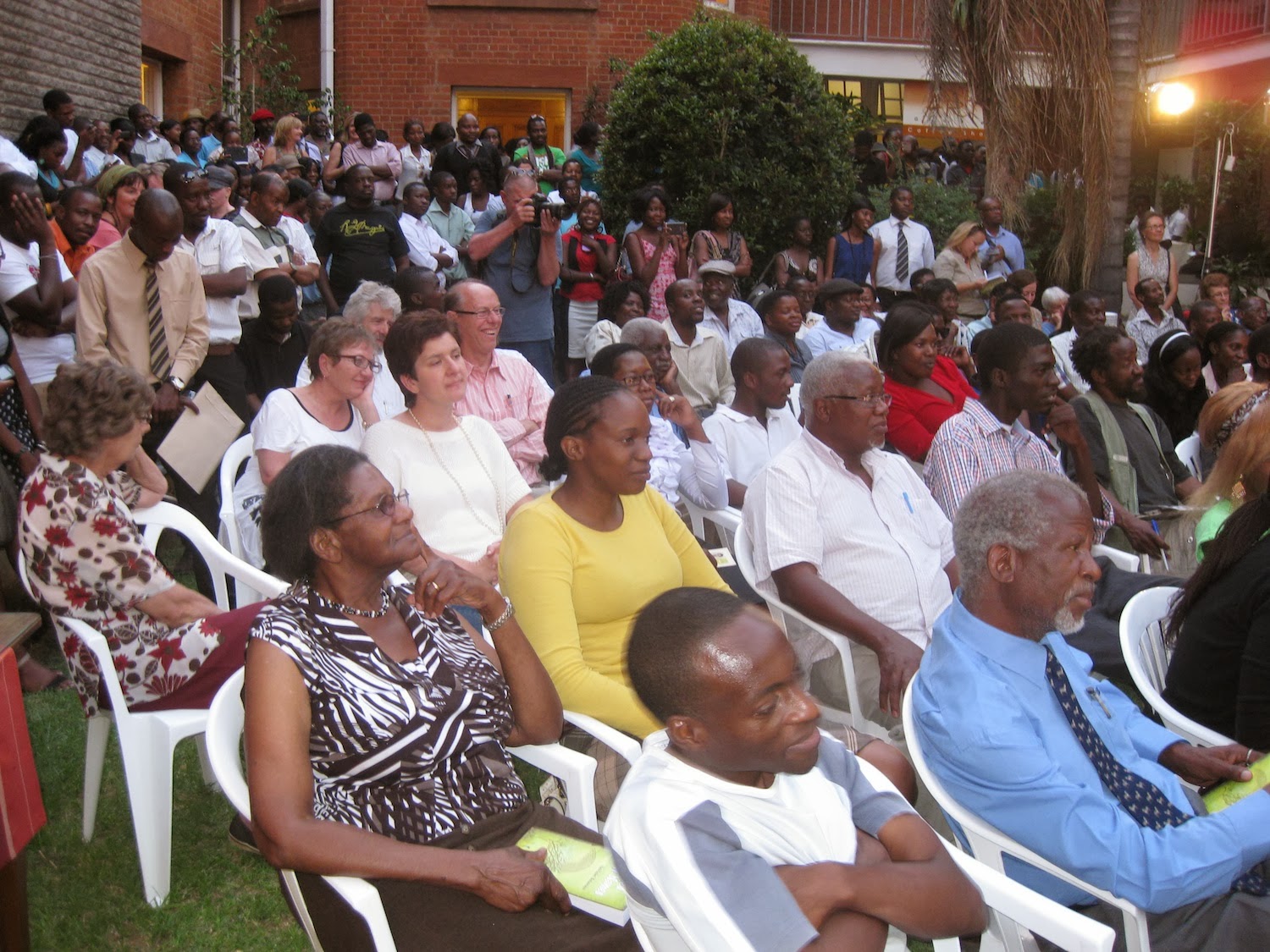
The launch of NoViolet Bulawayo’s debut novel ‘We Need New Names’ at the National Gallery of Zimbabwe in Bulawayo on September 17 was a memorable occasion. It had been a long while since the gallery had hosted such a crowd, with over 300 people packing into the courtyard to welcome NoViolet home and to hear her in conversation with Dr Drew Shaw of the National University of Science and Technology. To use NoViolet’s words:
'Bulawayo came out proper with a crowd of close to 300, i'm made to understand, and gave me the launch of my dreams even as i had been told that folks in the City of Kings don't come out much anymore. very honored by the presence of many people i admire, and the many i do not know, who saw me worthy of their time and ears and hearts. then there was Ericah Gwetai (mother of the late Yvonne Vera, who found me in a room before the launch and sang me a song, dlala nkazana ). if you see me walk like i own the earth, forgive me because i'm suffering from too much love, from a small, proud place that came out big to show me who they were, and who i was. that was not a launch, it was a baptism, and Bulawayo, blue eyed city you, home of my girlhood you, you Bulawayo, ngiyazendlala on your feet with gratitude, thank you kabanzikazi.'

The launch was organised by ’amaBooks Publishers, the British Council – Zimbabwe, the Intwasa Arts Festival koBulawayo and Bulawayo Agenda. The book is published by Weaver Press in Zimbabwe and distributed by ’amaBooks in Bulawayo.


The link to the soundcloud recording of NoViolet Bulawayo's conversation with Drew Shaw during the Bulawayo launch of We Need New Names is below.

https://soundcloud.com/drew-shaw-6/noviolet-bulawayo-in?utm_source=soundcloud&utm_campaign=share&utm_medium=twitter


Photographs courtesy of Lene Lauritsen and Intwasa Arts Festival koBulwayo

Saturday, September 14, 2013

A busy week for literary Bulawayo


NoViolet Bulawayo at the Indaba Book Cafe in Bulawayo
The big event of the week is the hometown launch of NoViolet Bulawayo’s debut novel ‘We Need New Names’, at 5.30pm on Tuesday 17 September in the courtyard of the National Gallery in Bulawayo. The book has been long-listed for the Guardian First Book Award and short-listed for the Man Booker Prize. NoViolet is the first Zimbabwean, and the first Black African woman, to be shortlisted for the Man Booker, which has been one of the most prestigious literary awards for 42 years. The event, open to all, will feature readings by NoViolet as well as a conversation between NoViolet and Dr Drew Shaw of the National University of Science and Technology. The event is supported by amaBooks, British Council Zimbabwe, Bulawayo Agenda and Intwasa Arts Festival koBulawayo.
Earlier that day, NoViolet will facilitate a workshop for promising Bulawayo writers. The participants have been selected from those who have entered the Intwasa Short Story competition for the Yvonne Vera Award.
The next day, on Wednesday 18 September, there will be another literary event, at 5.30pm in the John Knight Cinema at the National Gallery. This time it will be a slide show presentation by Dr Drew Shaw, titled 'Looking back / Looking forward: Zimbabwean literature of the GNU period, 2009-2013', to be followed by discussion about whether or not we can see discernible trends in the national literature and critical studies of it in the last four years. As the title suggests, some literature casts its gaze back to earlier times, while other writing considers the contemporary situation or 'Where to Now?' (which is the title of one short story collection under discussion, published by amaBooks). On 29th June, Dr Shaw gave this presentation at the Britain Zimbabwe Society's 'Culture Without Borders' Research Day in Oxford and got interesting responses from Zimbabweans in the Diaspora. Now the idea is to get Zimbabwe-based perspectives as we continue the discussion.
At the same time on Wednesday, Susan Hubert will be launching her novel ‘Sabi Star’ at Déjà vu.

On Friday 20 September, at 5.30pm in the National Gallery, Styx Mhlanga will launch ‘Acting Exercises & Games for Drama Plays in Schools & Colleges’.


Wednesday, September 11, 2013

NoViolet Bulawayo comes home


NoViolet Bulawayo comes home to Bulawayo to launch her debut novel We Need New Names.
The launch will take place on Tuesday 17 September at 5.30pm at the National Gallery of Zimbabwe in Bulawayo. The event has been organised and supported by 'amaBooks Publishers, British Council Zimbabwe, Intwasa Arts Festival koBulawayo and Bulawayo Agenda. All are welcome to attend the launch, there is no admission charge. The book has been longlisted for the Guardian First Book Award and has just been shortlisted for the prestigious Man Booker Prize. We Need New Names is published in Zimbabwe by Weaver Press and distributed in Bulawayo by 'amaBooks.
NoViolet was in Bulawayo a couple of weeks ago, meeting with Jane Morris and Brian Jones of 'amaBooks to discuss arrangements for her launch and other activities to promote an interest in literature in Bulawayo. Before the launch, NoViolet is to facilitate a workshop for promising writers from the city.
Her short story, Snapshots, was published in 2011 by 'amaBooks in the anthology Where to Now? Short Stories from Zimbabwe. The anthology was co-published with Parthian Books in the UK. The collection is being translated into isiNdebele and will be published by 'amaBooks later this year.
NoViolet is a past winner of the Caine Prize for African Writing and, for the last two years, 'amaBooks have published the Caine Prize anthology in Zimbabwe.


Friday, October 12, 2012

Narrating the Zimbabwean nation: a conversation with John Eppel


John Eppel interviewed in Scrutiny2: Issues in English Studies in Africa

Volume 17. Issue 1, 2012

Abstract


In this interview, John Eppel, a veteran of Zimbabwean writing, confirms his reputation as an “angry jester”, determined to expose what he describes as “humbug”, wherever he sees it. With his satires, Eppel has stirred the national literature with subversive laughter, ridiculing both Rhodesian society under Ian Smith and post-independence society under Robert Mugabe. With his poetry, he innovatively marries European forms with southern African content. During the crisis of the 2000s he refused exile and has been consistently critical of political and social corruption and injustice from within Zimbabwe's borders.


The full interview with Drew Shaw of the National University of Science and Technology in Bulawayo can be found at:

http://www.tandfonline.com/doi/abs/10.1080/18125441.2012.706082

Wednesday, October 26, 2011

Where to Now? reviewed on www.mazwi.com


Where to Now? Short Stories from Zimbabwe was launched by ‘amaBooks at the National Gallery on 24th September 2011 in conjunction with the Intwasa Arts Festival koBulawayo. It will also be published by Parthian Books in UK in 2012. Editor Jane Morris and ‘amaBooks of Bulawayo began publishing anthologies of Zimbabwe-themed short writings in the early 2000s. The current volume follows the success of Long Time Coming: Short Writings from Zimbabwe (2008), where thirty-three writers chronicle ‘the lost decade’ of political crisis, forced removals, mass migration, joblessness, starvation, hyperinflation, AIDS, cholera and other hardships. Where to Now? Short Stories from Zimbabwe is a slimmer volume with half as many pieces. The photograph of a stone sculpture by Arlington Muzondo graces the book cover; and its roaming cracks suggest a myriad of tentative and uncertain routes – as if in answer to the question posed. In this transition period – where national crisis continues in slow motion – Zimbabwe’s writers clearly grapple for a new sense of direction. Jane Morris said submissions slowed considerably from 2009. Even so, there are some excellent pieces. Fifteen of the sixteen short stories catch the socio-political impasse and tell of its far-reaching effects. The exception is Bryony Rheam’s The Piano Tuner, a Zambian story with a distinctly different mood. Though Rheam is a displaced Zimbabwean herself, the setting for her story is a hot and dry Ndola, where Thomas Jenkins Piano Tuners is now fronted by Mr Leonard Mwale who delights his client, a shy woman of Indian heritage, with a light piece of Beethoven. The characters literally connect on a positive note. But this stands in contrast to the other stories overshadowed by Zimbabwe’s fraught politics, which they cannot seem to transcend. Mzana Mthimkhulu’s I am an African, am I? is exemplary. Accused by an anti-Western colleague of betraying African identity, a troubled company manager finds affirmation and gratitude for delivering mealie-meal to his needy rural relatives, but this will not ultimately resolve the deeper existential dilemma. Five stories address political violence and dispossession, and are noticeably downbeat. Raisedon Baya’s Her Skin is a Map details police brutality during a teachers’ protest in Bulawayo. In The Accidental Hero, Murenga Joseph Chikowero tells the fate of young ‘Comrade Advance’ who distributes free eggs to the Party faithful during food shortages and gets a groundswell of support. But as crowds surge he falls to his death from a ladder; and absurdly becomes a martyr of the anti-colonial struggle – a ‘HERO OF THE PIOPLE’ [sic]. Christopher Mlalazi’s They are Coming is a snapshot of troubled township life before an election, when the Green Bombers (Zimbabwe’s Youth Brigade) rampage though a community, splitting a family and leaving a path of destruction. In Nyevero Muza’s The Poetry Slammer, a ‘closet writer’ creates an alter-ego poet named X, who leads a crowd of protesters against tyranny, but takes a bullet in his chest. X becomes a martyr, identified by his blood-stained poem of resistance. But the closet writer’s own creative/populist aspirations fall flat. Tomato Stakes, by John Eppel, exposes Zimbabwe’s land grab and its human cost. War veterans, youths, and the Deputy Director of Youth Brigades drive a desperate white farmer to hang himself. Also his Malawian foreman is murdered and left with the word BLANTYRE carved into his chest to mark him, like his white boss, as one who does not belong on Zimbabwean land. The white farmer’s surviving family find refuge in New Zealand, which ends their 350-year history on the African continent. Political violence, dispossession, and forced relocation still weigh heavily on the national consciousness, as the above five stories show. On the theme of exile there are four thought-provoking pieces. In Crossroads, Novuyo Rosa Tshuma tells about starting a new life in South Africa – the hard choices and shattered dreams. She excellently catches the nervous anticipation, lonely struggle, self-sacrifice, unwanted dependence on relatives and bloody-minded determination that has characterised so many journeys across the Limpopo. If disillusionment is the dawning reality in Crossroads, fear of xenophobic violence is the theme in Sandisile Tshuma’s The Need. Visualizing an illegal immigrant set ablaze in a Johannesburg slum not long after the Football World Cup, the narrator fears ‘the collective brain that told you that foreign is bad, that foreign steals jobs, that your brother is your enemy and that ‘they’ all deserve to die.’ The Need explores the psychology of xenophobia, how friends can suddenly become murderous enemies, how it feels to be cast as an outsider in the so-called ‘Rainbow Nation’. In Sudden Death by Blessing Musariri, we meet two enterprising Zimbabweans working as carers for the elderly in the UK. Agnes is not really Agnes at all: that is her fake ID. Simba, her partner, also poses as someone else to get through UK Immigration. After months of hard work, they believe they have finally sent enough money to Zimbabwe to build a house – but betrayal by a thieving relative wrecks their dream. Trans-continental tragedy also figures in Diana Charsley’s Mr Pothole, which focusses on a hit and run victim with dementia, found face-down in a pothole. His Bulawayo funeral is attended by his next of kin, who abandoned him for a life in London. The exile-themed stories express sadness and expose the huge social and psychological cost of Zimbabwe’s mass exodus. Moving to gender, several stories challenge female subordination. Mapfumo Clement Chihota tells of emasculation versus female empowerment in A Beast and a Jete. A jete is ‘A woman who kicks her husband’s bum around … who defeats her husband mentally and outwits him at every turn.’ In this case Vanyemba cuckolds her husband with one of the villagers but is acquitted of adultery through lack of evidence, by the village headman, to the great amusement of all. She is also paid damages for what is judged a false accusation. Barbara Mhangami-Ruwende continues the theme of female assertiveness in Christina the Colourful. Here Kudu, the young narrator, greatly admires her transgressive aunt, criticised for ‘jumping from town to town’ and disgracing her extended family. Cornered into an arranged marriage, Christina nevertheless outwits her forceful patriarchal matchmakers, becoming a strong role model for her young niece in a bitter-sweet resolution, which necessitates their separation. A child narrator also tells Thabisani Ndlovu’s story Making a Woman, which exposes appalling patriarchal violence, conducted casually within a small rural community. The young boy’s Aunt Mongi is beautiful but deaf, unmarried and childless. Grandpa, aggrieved for having a disabled daughter, decides to ‘make her a woman’ which means organising her rape and impregnation by a chosen suitor. But Aunt Mongi defiantly chooses abortion. Abortion also figures in NoViolet Bulawayo’s Snapshots. (She won the 2011 Caine Prize for Hitting Budapest). Previously published in 2009 in New Writing from Africa, this is the sad story of a young girl who does not stand a chance against cruel patriarchal customs that drive her onto the street after the death of her father, away from a mother who is compelled to disown her, into the arms of a sexual predator when she has nowhere else to turn, and finally to a back-street abortionist, who seals her fate with a jabbing coat-hanger. Though the piece is exceptionally well-written, it is depressing to think a young girl’s fate can be so thoroughly determined by circumstances over which she has no control. By contrast the other female characters in this collection, Vanyemba, Christina, and even Aunt Mongi, are not stifled or snuffed out by patriarchal forces. Alone, by Fungai Rufaro Machirori, also examines strength and resilience in the reflections of a single woman moving into middle-age without needing a man in her life. While all of the content in this collection is engaging, my one criticism is that the quality is uneven. The short story is possibly the most difficult prose form to master; and it is apparent that some writers are more attendant to issues of structure and style than others. Some pieces are more sketches than short stories. On the other hand, the inclusion of writing that is somewhat rough around the edges, in juxtaposition to that of a more polished quality, lends the collection an authentic appeal. This is a rewarding read for anyone following the Zimbabwe story, for anyone concerned about Zimbabweans and their collective destiny.

Reviewed by Drew Shaw