Showing posts with label Tinashe Mushakavanhu. Show all posts

Thursday, August 28, 2025

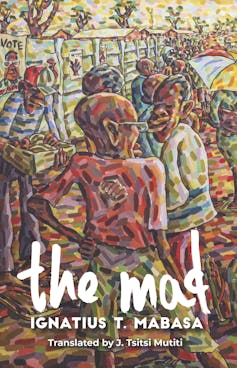
African novels are being translated to English in a bold new trend: Ignatius Mabasa's The Mad reviewed.

Reproduced from The Conversation
 https://theconversation.com/african-novels-are-being-translated-to-english-in-a-bold-new-trend-we-review-ignatius-mabasas-the-mad-263958

A figurative oainting of African men talking on the street.


When it comes to African literature, translation has mostly meant translating work from European languages into African ones. Translation from African languages into English has been long overdue.

Now it appears that a shift in the movement of stories across languages is underway. Works first written and published in African languages are increasingly being translated into English for a broader readership.

As a scholar of African literature and publishing, I am optimistic about the launch of a new book series called African Language Literatures in Translation by the University of Georgia Press. The series is edited by US-based literary scholars Christopher Ouma and Alexander Fyfe.

The Mad is one of the inaugural titles in the series. It’s a translation of Zimbabwean author Ignatius Mabasa’s much loved novel Mapenzi. The Mad is being jointly released in the UK and Zimbabwe by Carnelian Heart Publishing and amaBooks.

Mapenzi is written in Shona, but the ambitious series aims to translate a range of significant African works from other languages too, including Kiswahili and Sesotho.

This helps shift the terrain of African literature. It allows English readers to encounter African novels as they were first imagined, in the rhythms, idioms, and sensibilities of African languages. It helps counter the erasure of African languages in world literature.

Mapenzi

When Mabasa’s debut novel Mapenzi appeared in 1999, it was recognised as a landmark text in Shona literature. Shona is a Bantu language widely spoken in Zimbabwe.

Mapenzi tells the story of a disillusioned young war veteran who becomes the uncensored witness to the false promises of independence in Zimbabwe. He witnesses the collapse of social values, and the madness of a society trapped between hope and despair.

The novel’s daring style and unruly humour drew comparisons with Dambudzo Marechera, Zimbabwe’s literary provocateur. And with the stylistic innovations of Charles Mungoshi, the great craftsman of both Shona and English prose.Mapenzi was quick to win accolades and was adopted as a school text for a generation that came of age at the turn of the millennium. Since then, Mabasa has become a central figure in the promotion of indigenous African writing.

His commitment and investment was shown when he became the first scholar to write and submit a PhD in Shona at Rhodes University in South Africa. Mabasa is also a translator in his own right. He most recently helped translate Zimbabwean novelist Tsitsi Dangarembga’s Nervous Conditions into Shona.

His career has been a reminder that languages such as Shona are not minor, but vibrant mediums for complex thought and artistic innovation.

Now, more than two decades later, Mapenzi can be read in English for the first time.

The Mad

The Mad has been translated by J. Tsitsi Mutiti. Unfortunately, there is no information about the translating author in the book. Even a cursory internet search yields little to nothing.

In works like this, that cross language, culture and geography, the translator plays a crucial role, not just in the text’s language but in shaping its tone, context and accessibility. A translator’s note would have provided insight into the challenges and decisions involved in the process. Instead, the translator and the process of translation remain invisible.


This lack of acknowledgement overlooks the labour and interpretive skill required to bring such a work to life in another language. The hope is that future editions will correct this omission. Leaving it unaddressed risks diminishing the very cross-cultural understanding that translation seeks to foster.

Translating Mapenzi is no small task: Mabasa’s prose brims with poetry, satire and linguistic play. Its cadences are deeply rooted in Shona idiom. The novel’s innovative structure includes chapters titled after characters, abstract concepts, places and song lyrics, pushing the boundaries of form and style in Shona literature.

In her translation Mutiti meets this challenge with remarkable skill, sustaining Mabasa’s lyricism and rhythm without smoothing out its texture. The result is a translation that feels alive, attentive both to the sense and the spirit of the original.

That said, there are occasional lapses into flatly literal translation, particularly in the dialogue. These moments feel more like direct transpositions from the Shona than deliberate stylistic choices in English. As a result, the translation at times struggles to assert a voice of its own.

Translation as decolonisation

Nonetheless, the publication of The Mad highlights how translation in African literature is not just a tool for accessibility. It is also a critical, interpretive and archival practice that reshapes the canon, its circulations and readerships. The Mad contributes to African literature’s global visibility and intellectual vitality.

For decades, the global image of African literature has been shaped largely by writers who chose or were compelled to write in colonial languages.

Kenyan author and academic Ngũgĩ wa Thiong’o, who recently passed away, has been one of the most famous advocates for writing in African languages. He insisted that the struggle for decolonisation could not be separated from the struggle over language. Yet, as he himself often admitted, African-language writing has remained marginal in the circuits of publishing and translation.


A series like this aims to help change that. Other forthcoming titles include Zanzibari writer Ali Hilal Ali’s Mmeza Fupa (translated as The Swallowers of Bones by Meg Arenbeg), Kenyan novelist and sociologist Katama Mkangi’s Walenisi (translated as They Are Us by Richard Prins), Lesotho writer and teacher Ntšeliseng ’Masechele Khaketla’s Left Behind (translated by Makafane Tšepang Ntlamelle), and Halfani Sudy’s Kirusi Kipya (translated as New Virus by Jay Boss Rubin).

In this context, The Mad is more than an English version of a Shona classic. It is part of an invitation to rethink what African literature is and where it comes from. Mabasa’s novel, in Mutiti’s supple translation, demonstrates how much vitality lies in the vernacular imagination, and how translation can open doors without erasing the local textures of language.

With The Mad, a new and vital moment begins.


Tinashe Mushakavanhu

Assistant Professor

Harvard University

Thursday, February 12, 2015

'The Maestro, The Magistrate & The Mathematician' reviewed in Harare News

I first went to Edinburgh, Scotland to visit Tendai Huchu, with whom I had been buddies on social media, in 2012. He came to pick me at Waverley rail station, situated in a steep, narrow valley between the medieval Old Town and the 18th century New Town and we would traverse between the two.
Scotland’s capital city is a place of culture and literature. The heart of the city, a World Heritage Site, is packed with fascinating buildings and a remarkable history. The famous castle sits proud on its rock at the top of the Old Town, a warren of medieval streets and alleyways sweeping down to Holyrood Palace and the Scottish Parliament at the foot of the Royal Mile. And there is Holyrood Park, surely one of the most dramatic city parks I have seen, with the mini-mountain of Arthur’s Seat at its heart.
The opening of Huchu’s new book, The Maestro, The Magistrate & The Mathematician, vividly reminds me of this visit. In hindsight, it is as if when we walked we were rehearsing some of the scenes in the book. With the turn of every page Edinburgh becomes real.
The story is told in three voices which are emotionally distant, ruminative, and sometimes intellectual. Its principal characters are known by the titles of their current pursuits or former professions. Collectively the trio has some absences to fill, personal histories to recover.
Set during the decade of crisis, the novel zooms into the too often agonising life of Zimbabwean emigrants and also provides some valuable insight into the political and economic issues currently afflicting Zimbabwe.
Bindura and Edinburgh simultaneously move in the magistrate’s mind. Like many emigrants, he becomes an “in-between” person who does not belong here nor there. He remembers the man he was before Edinburgh took away his dignity.
Somehow it is the magistrate’s wanderings and their connections to personal histories — both his own and those of the people he meets that form the driving narrative, allowing him to reflect on his adopted country of Scotland and the Zimbabwe of his youth.
He is the character around which the whole narrative revolves – his dysfunctional family, his dalliance with opposition politics and his emasculation dominate most of the story. Indirectly he connects the other characters in the book by association.
Also embedded in the narrative are references to old Zimbabwean music. Music is used to map memories of identity and being. After all nostalgia has a playlist. In fact, Zimbabwean music is used to connect the narrator’s past with his present.
Immigration and exile are not new literary subjects, but Huchu’s treatment of them has a quiet clarity and surprising force. In fact, the book reads so much like a sequel to Brian Chikwava’s Harare North – the overseas territory of Zimbabwe is not limited to London but also extended to Edinburgh.
Edinburgh has a sinister side. Political turncoats and opportunists befriend the Zimbabweans, pretend to be a political agitators yet spy for the Zimbabwe government. In the Zimbabwean political discourse there is currently a rhetoric war between zvipfukuto, corrosive insects known as weevils, and gamatox, a poisonous pesticide.
After the walk about we stopped at a bookshop, I don’t recall its name, but it was a bargain bookshop that Huchu frequented. He bought me a copy of Brave New World by Aldous Huxley. Brave New World is an unsettling, loveless and even sinister place. In its patient, cumulative way, The Maestro, The Magistrate & The Mathematician paints a startlingly dim picture of Zimbabwe’s present moment. And the past is no refuge.

Review by Tinashe Mushakavanhu

Reproduced from Harare News, February 2015


The publication of The Maestro, The Magistrate & The Mathematician was supported by the Culture Fund Trust of Zimbabwe.

Tuesday, April 8, 2014

A Memory This Size: The Caine Prize for African Writing 2013

From: Harare News, Issue 9, April 2014

Review by Tinashe Mushakavanhu

Tinashe is a writer and editor. He read for a PhD in English at the University of Kent


The quality of the Caine Prize anthologies is always mixed but the gift of the Caine Prize to Africa has been to create a platform to share the continent’s rich terrain of stories and contradictions.

The book is in two sections. The first part comprises of the shortlisted stories and the eventual winner. Considering that these went through a rigorous judging process, they are certainly of high quality. The second section contains workshop stories.

What is quite intriguing on the list is the dominance of Nigeria. Are Nigerian writers far ahead of their African peers? And is Nigerian literature blooming while other African literatures are struggling?

The 2013 Caine Prize shortlist also highlights the fact that the African diaspora is increasingly shaping African literature, whereas before African literature grew out of the streets and bushes of the continent. What happened? Is it a shift of power? Or is it simply that the African narrative now has huge global demand? Whatever the case may be, thanks to the African diaspora for injecting life to an ailing literary culture. Our literature, African literature, is better off.

The creeping presence of America on the African imagination ties three of the stories together. Tope Folarin’s story Miracle touches on the issues of faith religion. Pede Hollist's Foreign Aid is a tale about the folly of a ‘Been-to’ who imagines he can return to his native land (in this case Sierra Leone). Elnathan John’s Bayin Layi unravels the violence in northern Nigeria. Chinelo Okparanta's America is, as the title suggests, a story about America as the longed-for-utopia. And Abubakar Adam Ibrahim’s The Whispering Trees is a magic realism narrative of a young man crippled by an accident that killed him, but didn’t.There is something particularly striking about African literature as reflected in these five shortlisted stories. Three of the stories are directly concerned with diaspora life in America. It points to a geographical extension of the African imagination in most of the new writing. The literature is a window into the African experience beyond Africa, its global interactions with other cultures though not always pleasant.The second section of the collection, the workshop stories, holds some brilliant work and some of a less polished standard. As outlined in the Ernest N. Emenyonu edited volume, Writing Africa in the Short Story, the short story genre is not an easy form despite its urgency and potency. A lot of the struggling stories in the volume have weak endings. It could be that African literature has for a long time been fed with long and elaborate tales in the form of folktales or in the form of novels.However, the stories in the second part of the anthology cover a wide range of topics and encompass a variety of styles representative of the diverse pool of writers from various African countries. There is irony and dark humour (Melissa Tandiwe Myambo); pathos (Hellen Nyana); satire and magic realism (Rotimi Babatunde); haunting and topical (Stanley Onjezani Kenani) among many other sensations. It’s a book worth reading simply because it provokes and challenges.

A Memory of this Size is published in Zimbabwe by 'amaBooks. It is available at the Book Café bookshop, National Gallery and Avondale Bookshop in Harare and at the National Gallery, Induna Arts, Tendele Craft and Phenduka in Bulawayo.

Tuesday, April 9, 2013

A Conversation with Bryony Rheam


from www.panorama.co.zw


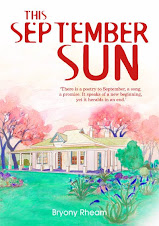
After a heated discussion about Bryony Rheam’s This September Sun at the Spanish Embassy book club in Harare, Panorama Magazine decided to extend the conversation by talking to the author.
This September Sun has been published in Wales (Parthian Books) and Zimbabwe (amaBooks) to critical acclaim. It is currently chosen by the Zimbabwe Examination Council (ZIMSEC) as one of the “A” Level English Literature set texts. Bryony Rheam currently lives in Zambia with her family.
Firstly, what is This September Sun all about?
It is about a young girl growing up in Zimbabwe and her relationship with her grandmother.  The relationship changes over time, but Ellie only moves towards a fuller understanding of Evelyn after the latter’s death.

What amount of research went into the writing of this novel? For instance, I am curious to know what new things you learnt in the process that you were not aware of before you embarked on this project.

I did a fair amount of research into the era of the 1940s.  More than anything, I had to find out what the social norms were – what was acceptable and what was not.  What did people do for entertainment, that sort of thing.  One thing that always amazes me about the past is how efficient some aspects of life seemingly were. 
Now we think we are clever because we can email and send text messages, yet there was a system of doing things then that was in some ways far more efficient – probably because it didn’t depend on electricity or computers!  The post, for example, was highly efficient, sometimes delivering twice a day and many shops would deliver – you could order over the telephone.  Nowadays, with all our technology, we are more than often told “Sorry, I didn’t get your message”.

Your book reads more like a memoir than a work of narrative led fiction. In other words, first novels are often seen as thinly veiled autobiography. How much do your personal experiences come into your fiction?

This is quite a difficult question to answer.  None of the events in the novel are “true” in the sense that they did actually happen exactly as they do in the storyline.  However, there is a lot of myself in the book, in many of the feelings and emotions. 

There are black readers who feel hard done by the fact that black characters in your book are marginal types – maids and gardeners, etc. Are those who read racial connotations in these skewed relations wrong?

I’ll begin to address this question by posing a similar question to those readers:  Would the same be asked of a black writer who either didn’t include white characters or kept them as marginal characters – white farmers, district commissioners and the like?  If a non-white writer set a novel in the UK or the US and didn’t make mention of white characters, would this be seen as racist, or would we say something like: “Oh, well, this novel obviously concerns the main character, who is black and their immediate family who live in an area of the UK with a high non-white population.”

This September Sun does not have a huge cast of characters and the main story revolves around the relationship between a young girl and her grandmother.  It’s not a story about black and white.  Yes, there is the political backdrop of a Zimbabwe going through much change, but at the heart of the story is a very personal relationship.  Why should I need to include x amount of black characters?  That would be political correctness gone mad!

Another point to consider is that at the time that Evelyn is a young woman, she wouldn’t have had much contact with black people except as servants.  It amazes me that no one has picked up on the significance of Samson.  Yes, he may be a cook, but he is an important character in the novel.  Evelyn identifies with him on a personal level.
Mr Patel is another character whom she identifies with.  I think it would have been totally unrealistic of me to have created a friendship between Evelyn and a black character that did not take into account the time she was living in.

I strongly believe Zimbabwean literature is a literature of two halves: black and white. I find that there is a serious disconnect. Black writers write mainly about the black experience. White writers write mainly about the white experience. Can it ever be one or the lines are just blurred and as readers we cannot just see it?

I think that you naturally write about things that are of interest to you and to which you can relate.  I don’t think there should be any pressure for any writer to write to meet some need; writing should be a natural process.  I also think that the strength of a story should be in its ability to appeal to a reader regardless of “the experience” that created it. 
Many people love Charles Dickens although they have never been to England or lived in the Victorian age.  I’ve read about people from all walks of life who absolutely love Enid Blyton and yet one of the criticisms leveled at her is that her work is too parochial: 1930s white middle class.  Do children pick up on this?  No, probably not. 
Surely as readers we identify with a character, whatever their colour or background, otherwise our reading scope would be incredibly limited?

There is now a large output of “white-writing” from Zimbabwe. Could comment on how you situate yourself within it?  I’m thinking of Peter Godwin, Alexandra Fuller and others. 

I really don’t like this term “white writer”.  Why can’t I just be a writer?  I wrote a book and that book is quite different from Peter Godwin’s work as he is a journalist; Alexandra Fuller is too.  I don’t see my work as trying to fit in or be different.  

The question of who belongs to the Zimbabwean nation has been extremely politicised in the last decade or more.  Do you ever feel disqualified or are you made to feel disqualified from writing and representing the Zimbabwean nation because of your ethnic origins (that is the fact that you are white, not black)?

I think the fact that I am asked this question in just about every interview I do shows that the colour of my skin is still an issue – but probably only to academics and interviewers!  I think the average reader probably doesn’t give a toss as long as they have enjoyed what they have read.  I’m sure the colour of my skin does count against me sometimes and I tempted to write something under a pseudonym to see if I get the same questions asked to me if people thought I was black!


Is there any significance to the opening of the book – April 18 is a day that carries a lot of emotional history for most Zimbabweans. What change does it signal?

I suppose this is an example of the influence of the political and private on our lives.  April 18 may have been the day that Zimbabwe got its independence from Britain, but it is also Ellie’s birthday.  As a six-year-old, that is her main concern, yet she is aware of these other changes going on around her, although she does not fully understand their significance.

Your book has since been adopted as an “A” Level text in the Zimbabwean education system. What do you hope these young readers will learn from This September Sun?
I don’t necessarily want anyone to learn anything.  I’d like them to enjoy it.

Do you keep abreast with other Zimbabwean writing and what do you have in common with other Zimbabwean writers?

Ironically, it isn’t always that easy to get hold of African novels in Africa!  I read what comes my way, and I think there is a move to write about things other than war, famine, AIDS, etc. 

- By Tinashe Mushakavanhu.  © Panorama Magazine 2013.