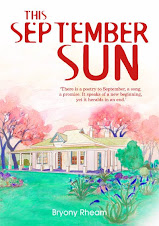
Bryony Rheam is to take part in a discussion session about her novel This September Sun, and its translation into Arabic, with the translator and others involved in the publication by Al-Arabi. She will also be available to sign copies of her book and to discuss it with those who have enjoyed the novel.
The event will take place at 3.00pm on Sunday 2 February at the Cairo International Book Fair.
Wednesday, January 29, 2020
Wednesday, January 8, 2020
This September Sun: The Novel with Legs
Bryony Rheam, whose debut novel, This September Sun, was first published in Zimbabwe in 2009, is set to travel to the 2020 Cairo
International Book Fair at the beginning of February as a guest of honour.
![]() |
| The amaBooks cover |
![]() |
| The Al-Arabi cover |
The novel was
launched at the Cairo International Book Fair at the beginning of 2019, having
been translated into Arabic and published by the Egyptian publisher, Al-Arabi. The
book fair is the largest and oldest book fair in the Arab world, held every
year since 1969, and Al-Arabi have exhibited at the fair for forty years. Last
year the fair attracted two and a half million visitors.
![]() |
| Cairo International Book Fair |
According to Al-Arabi publisher Sherif Bakr, This September Sun has travelled the
Arab world since the launch, from Morocco to the Arabian Gulf. In discussing last
year's Cairo International Book Fair in an interview with ahramonline, Sherif
Bakr said: “We did well;
our new titles of translated novels and books in general were very well
received with people being very happy to go through piles of books that bring
to them ideas from Finland, Serbia, Austria, Zimbabwe and many other
countries,” Bakr said.
"One of this year’s newly
translated titles for Al-Arabi is the Arabic version of Bryony Rheam’s This September Sun, the gratifying novel
that came out in late 2009, examining layers of the lives of the 'settlers' of
Rhodesia that continue to haunt Zimbabwe’s grandchildren."
![]() |
| Sherif Bakr |
This is the first Africa-centred
novel translation for Al-Arabi that has otherwise, over the past four decades,
brought to its readers a wide range of political readings on Africa.
The translation of the novel was
agreed at the Frankfurt Book Fair in 2016
when Brian Jones, co-director of amaBooks and a participant at the Frankfurt
Book Fair Invitation Programme, was introduced to Sherif Bakr by a colleague on
the Invitation Programme, Aly Abdel-Moneim of Daraj Publishing. Aly had been
enthralled by the description of This
September Sun and thought that Al-Arabi publishers would be interested.
Bryony Rheam is very excited to be invited to Cairo and
looks forward to meeting readers of her work based in the Arab world.
Previously she has appeared at a number of festivals, including the Intwasa
Arts Festival in Zimbabwe, the Ake Arts and Book Festival in Nigeria and Africa Utopia in the United Kingdom.
Saturday, October 26, 2019
Nine Books Set in Edinburgh - Zimbabwe links
adapted from: https://onestepwanderer.com/books-set-in-edinburgh/?fbclid=IwAR1xfDS3eQEZgGD7uXdIx3RHMGnPWHhkkoRJwoFXMKcNF-KtDqO0qY-JDT4
Edinburgh’s literary prowess runs deep.
Home to Sir Walter Scott, Robert Louis Stevenson, JM Barrie and JK Rowling,
there’s no shortage of literature that has come from the minds of this UNESCO
City of Literature. Edinburgh has not only provided the home to these literary
minds, but has also set the setting for many works of Scottish literature.
And three of the writers featured have Zimbabwe links: Alexander McCall Smith was born and educated in Bulawayo in 1948, before moving to Scotland aged 17 to attend university; Tendai Huchu is Zimbabwean, but is now based in Edinburgh; and Muriel Spark lived for several years in Bulawayo before and during the Second World War.
amaBooks published Tendai Huchu's novel featured here - The Maestro, The Magistrate and The Mathematician - as well as Shane Strachan's Nevertheless: Sparkian Tales in Bulawayo, which is a series of short fictions about Spark's and his own time in Bulawayo.
These 9 books set in Edinburgh explore a
range of different literary works that have been set in Scotland’s capital
city. From classic historical novels by Sir Walter Scott to modern literary
stories by Irvine Welsh this list covers titles that tell the stories of the
city itself.
1. 44 Scotland Street by Alexander McCall Smith
Welcome to 44 Scotland Street, home to some
of Edinburgh’s most colourful, yet ordinary, characters. There’s Pat, a 21-year-old
who has recently moved into a flat with Bruce, an athletic young man with a
keen awareness of his own appearance. Their neighbour, Domenica, is an eccentric
and insightful widow. In the flat below are Irene and her appealing son Bertie,
who is the victim of his mother’s desire for him to learn the saxophone and
Italian – all at the tender age of five.
These witty and very real portrait of
Edinburgh society brings out love triangles, a lost painting, intriguing new
friends, and an encounter with a famous Scottish crime writer. It feels like
you’re reading through a sitcom and you’ll leave the pages of the novel with a
soft spot for each of the characters.
2. The Fanatic by James Robertson
Andrew Carlin takes his job as a ghost very
serious. Part of one of Edinburgh’s famous ghost walks, Carlin is paid to play
the ghost of Covenanter Major Thomas Weir, who has been executed on charges of
witchcraft, in 1670. Carlin dives deep into the history of his ghost and the
period that he lived in, becoming entangled in deadly events of the past.
The Fanatic switches back and forth between
the 1990s of Carlin’s time and the events he becomes so obsessed with in the
late 17th century. This book set in Edinburgh marks an engaging and
enlightening historical read on a crucial time in Edinburgh’s (and Scotland’s)
history.
3. The Prime of Miss Jean Brodie by Muriel Spark
Miss Jean Brodie, a teacher at an elite
Edinburgh girl’s school is in her prime, make no mistake about it. Through her
prime she uses unorthodox teaching methods to mould the minds of young girls in
1930s in this book set in Edinburgh. Her prized pupils become known as the
Brodie Set and through the eyes of these six girls we learn about the downfall
of Miss Brodie.
The Prime of Miss Jean Brodie is a short,
but powerful novel that switches back and forth between past and future to
unfurl the complex events and personalities involved in the story.
4. The Heart of Mid-Lothian by Sir Walter Scott
It would be a crime to Scottish literature
to not include a novel from Sir Walter Scott (one of Edinburgh’s most
celebrated writers) on this list of books set in Edinburgh. Named after the
infamous Tolbooth Prison in the centre of Edinburgh, The Heart of Mid-Lothian
is one of his most popular novels.
The novel opens against the backdrop of the
infamous Porteous riots that rocked the city in the 18th century and through
its protagonist Jeanie Deans, explores the complex meanings of justice in
mid-1700s Edinburgh. When her sister comes to trial for infanticide, Jeannie
does everything she can to try to prove her sister’s innocence and bring
justice to her family. While the novel does get slow at times, it’s an
important look at Edinburgh’s lower classes in a time of immense change in the
city.
5. The Body Snatcher by Robert Louis Stevenson
You can’t go on a walking tour in Edinburgh
without hearing of the urban legend that surround the murderous body snatchers
that terrified the city – Burke and Hare. The pair lurked the dark alleys of
the Edinburgh slums, look for “bodies” to kill and take to Edinburgh physician
Robert Knox for practice.
Author of Dr. Jekyll and Mr. Hyde, Robert
Louis Stevenson, couldn’t resist taking this story and adapting this legend
into a short story about grave robbers. The Body Snatcher will keep you on your
toes throughout reading this horror story set in Edinburgh.
6. Knots and Crosses by Ian Rankin
The English have Detective Sherlock
(ironically, written by a Scottish author), the Scottish have Inspector Rebus.
Crime novels are a big deal in Scottish literature and Inspector Rebus is a
household name across the homes of Scotland.
Based in Edinburgh, Knots and Crosses is
the first in a long series of novels that follow the life and investigations of
this beloved Scottish detective. With the city of Edinburgh being terrorized by
a string of murders, Rebus must put his own problems to solve the crimes being
committed by someone connected to him by an invisible knot of blood.
7. The Maestro, the Magistrate and the
Mathematician by Tendai Huchu
Struggling to adapt to live after leaving
their homes in Zimbabwe, three men look for a place for themselves in
Edinburgh. There’s the Magistrate who one doled out justice in Zimbabwe now
cleans toilets for a living. The Mathematician holds onto the belief that he
want be here for long. And where the Maestro used to direct beautiful music, he
now directs shopping carts back into Tesco from the car park.
The Maestro, the Magistrate and the
Mathematician explores the complicated lives of immigrants in Edinburgh, diving
deep into the feels of love, loss, belonging and politics of being forced to
call a new city (and country) home.
8. Filth by Irvine Welsh
Irvine Welsh is well-known for his novel
turned movie Trainspotting, a story of Edinburgh youth coming out of the
darkness. Filth is very much the opposite type of story. Detective Sergeant
Bruce Robertson marks everything that could be wrong with a man – he’s a misogynist, a racist, a drug user, and
an abuser. He will lie, cheat, steal, manipulate and back-stab his way there if
he has to – an he’ll enjoy it the whole way there.
9. The Private Memoirs and Confessions of a Justified Sinner by James Hogg
The Private Memoirs and Confessions of a
Justified Sinner tells the story of the fervent and utterly self-righteous
young Calvinist Robert Wringham amidst the backdrop of Edinburgh. Raised in a
highly religious household, where the speakers of god’s truth could do wrong,
Wringham is easily corruptible by his mysterious companion, Gil Martin. He
manipulates Wringham, assuring him that God’s true elect are not to be held to
the law and his predestined place in heaven cannot be overturned by any of
Wringham’s actions on earth.
Monday, October 7, 2019
'Gonjon Pin' a must-read on a long journey
The Herald, 6 October 2019
https://www.herald.co.zw/gonjon-pin-a-must-read-on-a-long-journey

-->
https://www.herald.co.zw/gonjon-pin-a-must-read-on-a-long-journey

-->
by Memory Chirere
Published by amaBooks of Zimbabwe and
several other publishers, The Gonjon Pin and Other Stories is a collection of
short stories by African writers shortlisted for the Caine Prize 2014 and from
the Caine Prize annual writing workshop held in Vumba, Zimbabwe, during the
same year.
On receiving this anthology just before
the Harare launch, I quickly noticed that it was a massively solid book.
I was intimidated. I am used to reading
the usually thin volumes normally associated with short books in Africa. But
since these are stories from one of the most prestigious awards in African
literature today, I hoped that quality will pay for the volume.
I do not remember the last time I felt
like this about a book. I did not want to start with the shortlisted stories. I
wanted to make my priorities right. I had been invited to anchor the discussion
at the Harare launch, where some writers would also give readings.
I am attracted to the Zimbabwean stories.
Having been raised on the short stories
of Luis Honwana, Charles Mungoshi and other writers from the Southern African
sub-region, I find Lawrence Hoba’s “Pam Pam” a very comfortable landing pad.
Due to my background, this is the story that speaks most directly to me.
The sensitive child is snooping into the
seemingly unusual world of the grown-ups, who are also trying to come to terms
with the most “weird” in their midst. Muffled voice. Understatement. Power
play. A surprise ending. Hoba’s deft engineering- one soft word on top of the
other…and on top of the other, almost like bricks, tells me that this was not
easy to write.
“The Sonneteer” must be the “craziest”
story in this book! I am hoping that somebody will agree with me. I love the
deluge of sonnets towards the end because it is a clever way of flourishing out
after such a deep rendition on the tumultuous Zimbabwean condition. The story
ends in successive loud spurts like a gas canister unleashed onto a hapless
crowd.
I like stories like this one, driven by
silences — especially by what characters do not say to one another.
We are no longer reading, but are also
writing the story alongside Philani Nyoni. The language is vigorously God
forsaken and its rigours remind me of the late Dambudzo Marechera.
Later, at the launch itself, I was
impressed by Isabella Matambanadzo’s views.
Her “All The Parts of Mi”, just like
Abubakar Adam Ibrahim and Chinelo Okparanta’s stories, is about betrayal,
intimacy and courage. During the discussion, I asked Matambanadzo about what
she thinks about the use of the erotica in stories. Her candid answer sent the
audience roaring in approval. It took us a while to return to silence.
“The Intervention” by Tendai Huchu is
part of the Caine 2014 short list. It confirms my thoughts about his previous
stories, especially the one which I have been struggling to translate from one
language to the other. Here is a writer who has an eye for dramatic irony and
the incongruence of human character. His stories challenge the reader to work
from many points of view.
In “The Murder of Ernestine Masilo” by
Violet Masilo, the protagonist dies slowly from the first time you meet her.
Her death is not shocking, but why she dies is riveting.
You are left with a feeling that a flower
has withered before anyone could pluck it and place it in a vase. If only there
was enough love. Typical character in typical circumstances.
“Music From A Farther Room” by novelist
Bryony Rheam is a story filled with utmost colours and sounds and wide spaces.
It is a piece of painting or tapestry.
If it were a piece of cloth, this story
would flutter in the wind like a kite, landing on its nose until somebody picks
it and throws it back into the sky just in order to see it and shout like a toddler! I read it over and over for the sheer serenity that it gives me.
Barbara
Mhangami-Ruwende’s “Blood Work” is filled with
a delicate tension right from the statement “I don’t like black people” up to
the end and you are always on the edge. I hope I am not being prescriptive, but
this looks like my favourite story in this book, at least for now.
I then hurry to the winning story itself,
“My Father’s Head”. I had read elsewhere that it is a story filled with sad
memories. I do not disagree, but I discover that it is full of sweet sadness
with more of sweet. Sad but not depressing.
The kind of balance associated with
kopjes. On the second and even third reading, I begin to feel that this is
about a daughter’s celebration of a father’s not so happy life. The language is
syrupy, describing expanses of time and dwelling on tiny-tiny details of life
like the paw of a dog and the flutter of a butterfly. I agree with the judges.
It was right that this story won. Maybe it is not a story after all. It is
life.
Among the shortlisted stories, I also
have lots of respect for Billy Kahora’s “The Gorilla’s Apprentice”. Loneliness
of people, and of animals too?
A unique and unfulfilled camaraderie
between victims from different communities? This story could just have won.
However, in just a few of these stories
here, adjectives tend to pile on top of one another; adverbs trip over each
other. Colons clog the flow of even short paragraphs, and the plethora of
semicolons often cause the reader to throw up his hands in exasperation.
If you are able to forgive the very few
overwritten pieces, The Gonjon Pin and Other Stories is something to carry on
a journey.
The 2019 Caine Prize anthology, soon to be published in Zimbabwe by amaBooks, celebrates 20 years of the competition with the inclusion of all the winning stories, including those of the Zimbabwean winners Brian Chikwava and NoViolet Bulawayo. It includes an introduction by Ben Okri.
........................
Subscribe to:
Posts (Atom)