Monday, December 6, 2021

Michael Sears interviews Bryony Rheam about her new murder mystery


From: https: //www.timeslive.co.za/sunday-times/books/news/2021-12-06-michael-sears-interviews-bryony-rheam-about-her-new-murder-mystery/

Originally from The Big Thrill (1/12/21) Africa Scene: Bryony Rheam

Bryony Rheam is a Zimbabwean who lives in Bulawayo. Her debut novel This September Sun was named Best First Book in the Zimbabwe Book Publishers Association Awards and went to number 1 on the UK Kindle chart. She was one of the five Africans chosen for a Morland scholarship in 2018.


Rheam’s new book, All Come to Dust, was chosen as one of 10 top African thrillers in Publishers Weekly, who described it as a “stunning crime debut.” Paula Hawkins, author of The Girl on the Train, said it was “an intriguing, twisting murder mystery, a witty combination of old-fashioned detective story and keenly-observed portrait of life in suburban Bulawayo,” and chief inspector Edmund Dube was “a fictional detective as memorable as Hercule Poirot”.

In the story, Marcia Pullman is discovered dead in her Bulawayo home with a letter opener sticking out of her chest, but there’s not enough blood and it’s obvious that she was dead before she was stabbed. Edmund goes to the scene, having to wheedle a lift from Craig Martin, who is at the police station arguing a speeding fine. The pathologist, a friend of Marcia’s husband, says she died of natural causes, and the senior officers at the police station seem intent on thwarting Edmund’s efforts to get to the bottom of the case.

Superficially, the book seems to follow the tropes of the detective story genre, but soon we see it’s nothing like that. The rich characterisations and subtle surprises remind one more of PD James than Agatha Christie.

In this interview with The Big Thrill, Rheam shares further insight into her latest release and teases what she is working on next.


Bryony Rheam

Although your first book, This September Sun, also involves a murder, All Come To Dust is more of a murder mystery. Initially, the story seems to follow the framework of a typical detective story — the smart detective who is committed to the solution of the crime against the odds, the cast of suspects, the unreliable witnesses. It even has the final gathering of the suspects where everything is to be revealed. But you turn everything on its head. Was that always your plan, or did the context drive you in that direction?

I am a great Agatha Christie fan and always wanted to write a crime novel. Like Christie, I am not a great fan of a lot of violence; to me, unravelling the mystery is the most important thing. However, the classic Christie-type plot belongs very much to a time and a place, and it was obvious it would not work in Zimbabwe, despite our little English eccentricities that have survived 40 years after independence.

Many of the characters have some link to a type of crime writer: Craig, for example, reads an author called DP Radley (a fictional author) who chases fast cars and is surrounded by beautiful women; Mrs Whitstable reads Inspector Morse; Edmund reads The Saint. Yet none of these detectives seem to fit the location. They all seem to fall short in some way.

I suppose this is a reflection of the fact that I couldn’t use that same model of the detective story in the context of Bulawayo. The police are very unhelpful in Zimbabwe, and there is little in the way of forensic investigation, so I couldn’t rely on bringing in certain information in the same way. As I was writing, I became increasingly aware that the novel was not going to fit a certain model, and so I decided to undermine it instead.

Chief inspector Dube is an intriguing character. He’s smart and committed to solving the crime, but his back story suggests he has many deep issues of his own. We follow his childhood in Rhodesia as the son of a live-in maid whose apparently kindly white employers help him go to a good school and even with his homework every afternoon. How did you conceive him and his role in the novel?

A flame tree-lined street in Zimbabwe


The Zimbabwean police are not well-known for being either efficient or useful. During the Robert Mugabe days, they were synonymous with corruption. I thought there must be someone in the force who wanted to do a good job, someone who signed up with good intentions. That’s where Edmund came in.

The classic detective novel focuses on the crime at hand: who did it and why. There is not much detail about the investigator’s life. More recent crime novelists often present the investigator/police officer as a lonely person, someone who has given their life to solving crimes as an escape from the chaos of a dysfunctional family life, an unhappy marriage, or an inability to connect to others on a social level. In some ways, Edmund falls into this category as his marriage is not a happy one. However, he is also isolated at work, he is not taken seriously and is constantly put down. This forces him to go off on his own and work independently of the police force.

I am always drawn to the idea of an outsider. Edmund has never fitted in. He was one of a small group of black children who were let in to formerly white-only government schools in 1979. This was a very difficult time in the country’s history as it began to transition to majority rule. Edmund’s mother’s employers believe they are doing the right thing for Edmund by sending him there but are unaware of the challenges he faces. Later on in his life, Edmund again feels he does not belong when he joins the police force and is forced to take part in activities he does not agree with.

Edmund is intelligent and sensitive. He wants to do right in a country where everyone is very obviously doing wrong. He craves order and structure, hoping to put the world right by typing traffic offences and making sure forms are completed properly, yet outside is chaos and corruption. There is no room for people like him. It was very important for me to develop his back story and show how he came to be the sort of person he is. I liked the idea that he was solving a crime, and yet was also part of an unsolved mystery.

A house in Zimbabwe where the Pullmans may have lived


Marcia Pullman is the victim, but she and her husband are most unpleasant characters. Marcia dies in the first chapter, yet much of the book is about her and her impact on the people around her. By the end, we feel we know her well. Was it hard to build her character only through the eyes of the people who knew her?

I suppose in some ways I was unfair with Marcia, as, apart from the very beginning of the book, I don’t show her point of view. Everything the reader learns of her is through other people. However, I feel she is more symbolic than anything else. There is a new type of corruption in Zimbabwe which in some ways is quite difficult to explain. For years, people have pointed at the government as the main source of corruption, the implication being anyone else is not corrupt. I feel many white people in particular are like this. People fail to see how they themselves are drawn into the web of corruption. If they do acknowledge it, it is with the sense of “well, everyone else is doing it” or “how else are we supposed to survive?”

Perhaps ironically, there is no racism in this new type of corruption. Nigel Pullman teams up with the police, Marcia buys valuable antiques off old people (who would be mainly white) and gives them nothing for them.

Another view of the house

I based Marcia on someone I met who did this very thing. Back in 2000, when many people were leaving the country due to the farm invasions, she would buy up lots of valuable antiques and ship them to the UK. Many people had beautiful furniture that had been in their families for generations, but they did not really know what they were worth, tending to view them as old rather than antique. The same thing happened with old cars. You used to see lots of Morris Minors around, for example, typically driven by old ladies who had had them for years and years. Then buyers came from places like SA and bought them for a song. It was criminal.

Edmund identifies a cast of suspects: Marcia’s husband; the Pullmans’ maid and gardener; the peculiar neighbour; Janet Peters, who was bullied by her, and Janet’s invalid mother; a mysterious woman interested in her old records; and Craig Martin, who has threatened her. Each seems, in a way, to illustrate a different aspect of modern life in Bulawayo. Was that part of your plan for the novel?

Yes, it was. As well as writing a crime novel, I also wished to explore modern-day Zimbabwean society. We have all become increasingly isolated and lonely. This is due to politics and also the dire economic situation. There are those, like Marcia Pullman, who look after themselves at the expense of others, and there are those, like Dorcas, the maid, and like Janet Peters, who cannot stand up for themselves.

Craig is a handyman with poor business skills and low self-esteem. Edmund dragoons him to help with the investigation—staking out suspects, driving him around. Despite their wide differences, they seem to have features in common both in their adult lives and in their childhood pasts. Is this a yin and yang situation?

Craig and Edmund have much in common. They both had a traumatic event happen in their childhoods, and they are both essentially quite lonely characters, unable to connect to others.  However, Edmund is definitely much more organized and focused than Craig, who really is very lost. Somewhere along the line, they help each other. When Edmund asks Craig to do some investigating for him, it gives his life a sense of purpose, and he, in turn, can be of more practical help to Edmund.

Much of the story takes place in a historically white suburb near where the Pullmans live. Several of the inhabitants are hard up after the runaway inflation, but those that have access to hard currency—in one way or another—are doing much better. Did you set out to explore the effects of this modern dichotomy in the country?

Yes, definitely. Life in Zimbabwe has been very difficult over the last twenty years. Hyper inflation wiped out life savings and pensions for many people. The transition to the US dollar was very clumsily done as well, and many people lost money that way, too.  Sometimes it feels that almost everyone is doing something dodgy in order to earn US dollars! There is very little appeal in doing a conventional job as the salaries are so low. I think the older generation have been very badly hit. They struggle to survive on ridiculously small pensions, and really battle to understand the value of the currency as there is the official government rate of exchange and then the black market rate, which varies considerably. The divide between the haves and the have nots is widening considerably.

Would you tell us something about what you are working on now?

I have finished my third novel, The Dying of The Light, and it is at the editing stage. It is set in Bulawayo in the late 1930s and is told from the perspective of a house servant who works for a wealthy lawyer and his wife. I have started a book for young adults called Going Up.  It is set in modern-day Bulawayo and concerns a young man who has gotten into drinking and drugs. His wealthy grandfather gives him an ultimatum to get himself sorted out and hands him the responsibility of evicting vendors from an old department store that he owns and wishes to knock down. However, the young man soon begins to develop other plans for the building and sets out to restore it to its former glory.

Just lately, I have been thinking of another crime novel, and may even bring Edmund Dube back, this time as a private investigator. I think the crime genre is a perfect one in which to explore the decay at the heart of Zimbabwean society.


Michael Sears writes with Stanley Trollip under the name Michael Stanley. Their award-winning mystery series with Detective Kubu is set in Botswana, a fascinating country with magnificent conservation areas and varied peoples. The first book in a new series featuring Kubu as a young detective is Facets of Death, set when Kubu first becomes a detective and is faced with solving a diamond heist at the world’s richest diamond mine, Jwaneng. They also have a thriller Shoot the Bastards, which introduces Minnesotan environmental journalist Crystal Nguyen. Set mainly in South Africa, it has as backstory the vicious trade in rhino horn.

Michael has lived in South Africa, Kenya, Australia and the US.He now lives in Knysna on the Cape south coast of South Africa. 


All Come to Dust is published in Zimbabwe by amaBooks, co-published in the UK by amaBooks and Parthian Books and is available elsewhere throough the African Books Collective.


Wednesday, November 10, 2021

Bryony Rheam wins a 2021 Bulawayo Arts Award for All Come to Dust


All Come to Dust has won the Outstanding Literary Work – Fiction category at the 2021 Bulawayo Arts Awards. 


The Bulawayo Arts Awards are multi-disciplinary arts awards that recognise and honour exceptional individuals and collaborative artistic efforts in the city of Bulawayo, Matabeleland North and South, as well as those from the region who are practicing arts elsewhere in the world.

This year there were over 24,000 submissions across all the categories of the awards, and Bryony is especially delighted to win the outstanding fiction award given the strength of all four of the shortlisted writers in that category.


The novel is published in Zimbabwe by amaBooks and is available in Bulawayo at Inganu Bookshop at the Orange Elephant, 12th Avenue Extension and in Harare at Bindu Books, 37 Victoria Drive, Newlands.


In the United Kingdom, it is co-published by amaBooks and Parthian Books and is available through all good bookshops as well as through www.parthianbooks.com/products/all-come-to-dust and online book outlets.

In North America and Australia/New Zealand it is available through www.africanbookscollective.com or Amazon.


The Full List of Award Winners:

Outstanding Literary Work – Fiction: All Come To Dust by Bryony Rheam

Outstanding Literary Work – Non-Fiction: Our Food, Our Heritage, Our Culture by Makhosi Mahlangu

Outstanding Ndebele Literary Work: Ngubani Owabulalala uDube by Mihla Sitsha

Outstanding Song of the Year: ‘For Me’ – DJ Zandimaz

Newcomer of the Year (All Genres): Sandra Sibanda

Outstanding Male Artist of the Year: Msizkay

Outstanding Female Artist of the Year: Vuyo Brown

Outstanding Hip Hop Artist/Act: Awa

Outstanding Kwaito/House/Gqom Act: Mawiza

Outstanding Alternative Music: Thandy Dlana

Outstanding Gospel Artist/Act: Mai Mwamuka

Outstanding Imbube/Acapella Group/Act: Focus Accapella

Outstanding Tshibilika/Rhumba Act: Insimbi Zezhwane

Outstanding Music Producer: Nashville 

Outstanding Music Video: ‘Induku Enhle’ – X Mile

Outstanding Radio DJ: Nomalanga Nyathi – ZIFM

Outstanding Club DJ: DJ Mzoe

Outstanding Dance Ensemble: Geek Twins

Outstanding Female Dancer: Dorcas Ngwenya

Outstanding Male Dancer: Hebson Ncube

Outstanding Arts Journalist: Mthabisi Tshuma – The Chronicle

Outstanding Arts Photographer: Sadee LensWorks

Outstanding Online Media: Ekasi Magazine

Outstanding Theatre Actress: Musawenkosi Sibanda

Outstanding Theatre Actor: Cadrick Msongelwa

Outstanding Theatre Production: Bhalagwe Is Burning by Victory Siyanqoba

Outstanding Comedian: Zwe Hlabangana

Outstanding Poet: Desire Moyo

Outstanding Fashion Designer/House: A Tribe Called Zimbabwe

Outstanding Model: Ben Chest

Outstanding Ambassador (worldwide): Vusa Mkhaya

Outstanding TV Production/Programme: Mjolo FM – Byo Memes

Outstanding Short Film: Figure It Out – Nkosilesisa Ncube

Outstanding Film/TV Actress: Lee Mchoney – Wadiwa Wepamoyo

Outstanding Film/TV Actor: Leroy Mthulisi Ndlovu – Figure it Out

Life Achievement Award: Ebba Chitambo

People's Choice Award: Mai Mwamuka


Saturday, October 2, 2021

A Love Letter From Wales to Zimbabwe

Reproduced from https://nation.cymru/culture/a-love-letter-from-wales-to-zimbabwe/ 

by Ashley Eyvanaki

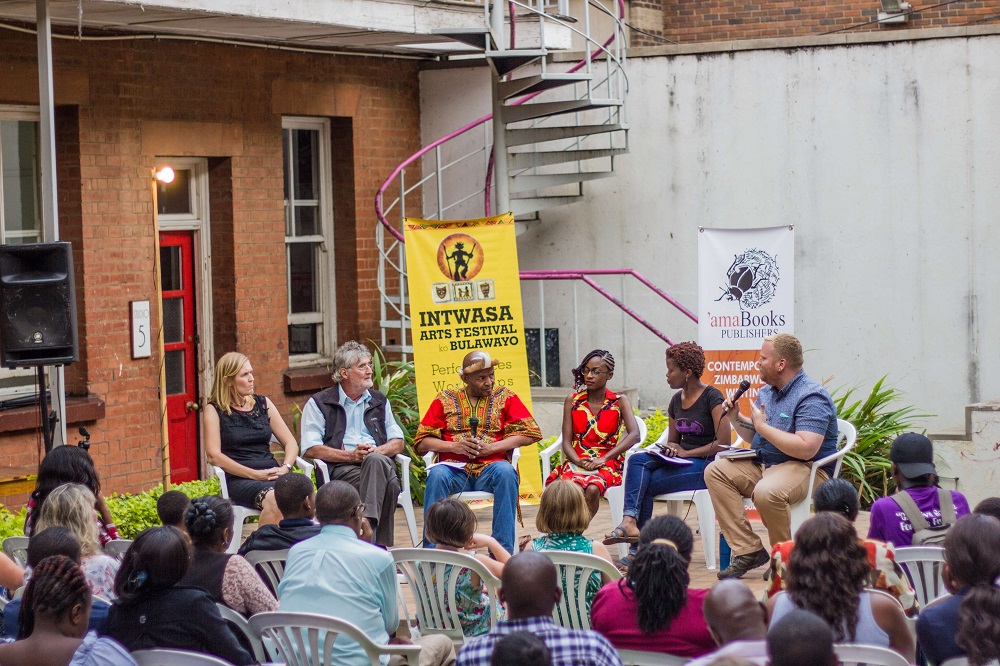
Authors Bryony Rheam, John Eppel, Mzana Mthimkhulu, and Tariro Ndoro, with interviewers Tinashe Tafirenyika and James Arnett, at Intwasa Arts Festival in the National Gallery of Zimbabwe. 

amaBooks is an independent publisher based in Bulawayo, Zimbabwe. They specialise in Zimbabwean poetry, short stories, and contemporary novels, as well as a selection of local history and heritage titles. In recent years its founders, Jane Morris and Brian Jones, have relocated to Wales – Jane having been born in Ebbw Vale.

Whilst continuing to publish in Zimbabwe, they have formed a working relationship with Parthian Books, to whom they have sold the rights to several of their titles: the short story anthologies Where to Now? and Moving On, and the novels The Maestro, The Magistrate and The Mathematician by Tendai Huchu, and This September Sun by Bryony Rheam. 

Their most recent venture together is to co-publish the novel All Come to Dust, also by Bryony Rheam, a Zimbabwean author whose mother was Welsh.

Sitting down to interview the pair, I am amazed by how passionate both are about African literature. Although amaBooks primarily publishes in English, there are sixteen official languages in Zimbabwe.

In the isiNdebele language, spoken in Bulawayo and the surrounding provinces of Matabeleland, “ama” placed at the start of a word is equivalent to an “s” at the end of a word in English. They chose the name amaBooks to indicate that they publish books in English in an Ndebele cultural environment.

When I ask the couple about their journey into publishing, they laugh fondly and explain that they “Just stumbled into publishing.” Jane, also a social worker and social work trainer, was working with volunteers for Childline, when raising funds locally was discussed. A local poet offered a selection of his poems, and Jane and Brian volunteered to organise the publication.

One thousand copies were sold by the group, with all proceeds donated to Childline, and so amaBooks began. amaBooks have been steadily publishing a selection of books since 2001, with many having won awards, and rights having been sold to publishers across the world. amaBooks, and other African publishers, are part of the African Books Collective, who print and distribute many of their publications outside of Africa.

Welshman

The couple go on to talk about the deep-rooted historic link between Wales and Zimbabwe. In the nineteenth century, several missionaries from Wales, including Thomas Morgan Thomas and Bowen Rees, travelled to Zimbabwe to set up mission schools in Matabeleland. These schools have been instrumental in educating people who have gone on to become significant figures in Zimbabwean society.

As a result, the first name “Welshman” is one you hear in Matabeleland. Thomas Morgan Thomas translated and published several books into isiNdebele, and his book Eleven Years in Central Africa, published in both English and Welsh in 1873, is rumoured to have become the second best-selling book, following the Bible, in Wales during that period.

The literary connection between Wales and Matabeleland was rejuvenated following a Wales Arts International visit to Bulawayo in 2006. The links created led to Welsh writers Owen Sheers, Lloyd Robson, Ian Rowlands, and Peter Finch visiting Bulawayo, and some of their work being included in amaBooks publications. Owen, Lloyd, and Ian went on to participate in the annual Intwasa Arts Festival koBulawayo.

There are also challenges to publishing in Zimbabwe. Brian and Jane explained that the state of the economy remains the major difficulty, with over 90% of the adult population not in formal employment, and the wages of the majority of those in work being too low for many potential readers to actually buy a book – especially if it is not a school text. Libraries rarely acquire books from local publishers, relying instead on book donations from international donors.

Problems

The couple commented that amaBooks started at “The wrong time, just as the economy began its steep decline to the total collapse in 2008, from which it has yet to recover.” That decline led to other problems for the population, including publishers – a lack of fuel in the garages resulting in queuing for up to a week for petrol, frequent cuts in electricity supplies and, after many breakdowns, the end of telephone communication from where amaBooks were situated.

The majority of bookstores closed or concentrated solely on school textbooks. The shortage of food in the stores at one point necessitated monthly overnight trips to neighbouring Botswana to buy basic supplies.

The political environment proved to be a challenge for all in the creative industries in Zimbabwe. Although publishing has been less affected than many other arts sectors, there were occasions when the ruling party press printed comments about publishers whose work they considered did not follow the government line, such as “If you see a snake in your house playing with your child, you first kill the snake and save your child.” However, it was worse for other sectors of the creative industries.

A rehearsal of a play, written by two amaBooks writers, was interrupted by ‘security officials’, with two backstage workers taken away to a remote area and threatened at gunpoint – the performances were then cancelled! An exhibition by a visual artist, who had contributed a painting for an amaBooks book cover, was shut down at the National Gallery of Zimbabwe in Bulawayo. The artist was then charged with undermining the authority of the President, which carried a twenty-year prison sentence, although charges were eventually dropped


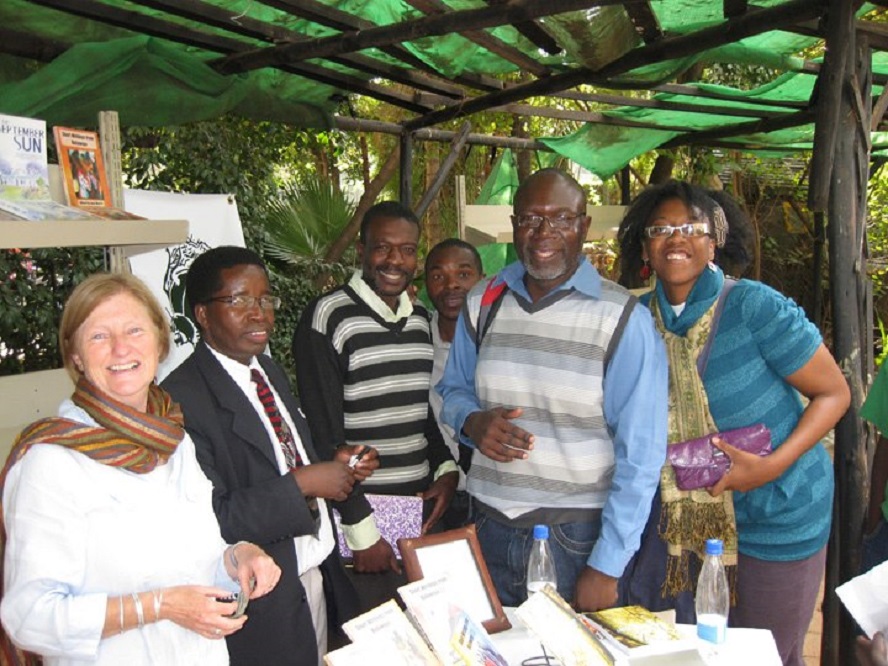
Jane with authors Hosea Tokwe, Beaven Tapureta, Ignatius Mabasa, and Fungai Machirori, at Zimbabwe International Book Fair, Harare. 

Joy

It is when we begin discussing the joys of publishing in Zimbabwe, that both Jane and Brian’s faces light up. “It was the smiles on the faces of writers when their first stories or poems had been accepted for publication, and the enthusiasm of the audiences at the launches – many couldn’t afford to buy a book, but they came to hear the readings and to just enjoy the occasion. And just being a part of a vibrant creative community.”

The book launches, attracting up to three hundred people at times, became celebrations across the arts, with both local music and the visual arts featuring. The couple go on to reveal that the majority of amaBooks’ publications use the work of Zimbabwean artists as the basis of their covers.

As our interview winds down and talk turns to what we plan to do with our weekends, I ask the couple one last question: What is their most cherished memory from working in publishing? For the first time in our almost two-hour long talk, they pause. Lost in their thoughts, both agree that one of their most cherished memories is of standing on the veranda of the National Gallery of Zimbabwe after a book launch, sipping glasses of wine and watching the people mingling below.

Both believe that publishing through amaBooks has opened up a whole new world within their lives, allowing them to experience the joy and laughter of publishing pieces and meeting the talented people behind them.

The murder-mystery novel All Come to Dust by Bryony Rheam, co-published by amaBooks and Parthian Books is available from Parthian now.

Bulawayo Arts Awards 2021 - Outstanding Literary Work -Fiction: The Nominees

The Bulawayo Arts Awards judges have shortlisted four books for the Outstanding Literary Work - Fiction category.

 Congratulations to: 

Bryony Rheam for All Come to Dust 

Ericah Gwetai for Where Were You

Nathaniel Mpofu for Novoric & Suri

Violette Kee-Tui for Mulberry Dreams

The Bulawayo Arts Awards are the leading awards in southern Zimbabwe - this year attracting over 27,000 entries from across the arts, with 36 different categories. The winners will be announced at the awards ceremony in Bulawayo's Large City Hall on 6 November.


All Come to Dust is published by amaBooks in Zimbabwe, Parthian Books and amaBooks in the United Kingdom, Al Arabi in Egypt, and is available in North America, Australia and New Zealand through the African Books Collective and Amazon.

Thursday, September 9, 2021

Video of the online UK launch of All Come to Dust


For those who weren't able to attend the launch of the novel on 8 September, the video contains the interview of Bryony Rheam by Drew Shaw about her murder mystery novel All Come to Dust. It includes a discussion of the book as 'more than simply a standard murder mystery, but set in Zimbabwe', the process of writing and readings from the novel by Bryony.

All Come to Dust is now available in the UK through https://www.parthianbooks.com/products/all-come-to-dust , as well as through good bookshops and websites; in North America through https://www.africanbookscollective.com/books/all-come-to-dust and, as an ebook, Amazon.com; as an ebook in Australia/New Zealand through Amazon.com.au; and in Zimbabwe through Bindu Books in Harare (sales@bindu.co.zw) or the Orange Elephant in Bulawayo.


Tuesday, September 7, 2021

Invitation to the online launch of Bryony Rheam's All Come to Dust


This Wednesday at 7pm BST, join Bryony Rheam in conversation with Drew Shaw to celebrate the launch of her fabulous detective novel All Come to Dust.


Parthian Books of Wales and amaBooks of Zimbabwe are proud to present the UK launch of All Come to Dust, by award-winning Zimbabwean author Bryony Rheam.

Join us for the online launch of this fantastic new murder mystery, as Bryony Rheam discusses her writing, characters and practice, and reads extracts from All Come to Dust. This event will premier on the Parthian YouTube channel on Wednesday 8th September at 7pm BST. Reserve your free ticket to receive a link on the day. There will be a live chat for audience interaction during the event screening. 

FREE tickets are available on this link:

https://www.eventbrite.co.uk/e/book-launch-all-come-to dust-by-bryony-rheam-tickets-168285669969


All Come to Dust is available to order from Parthian Books: https://www.parthianbooks.com/products/all-come-to-dust


Sunday, August 1, 2021

Reviews of Bryony Rheam's All Come to Dust


Wow!  I haven’t had a book captivate me like this one in a long time.  I intended to just read a chapter to get a feel for it and 100 pages in I was in heaven.

This is a great plot for me personally.  At its most basic, this is a murder mystery set in current day Zimbabwe.  It evolves into something so much more to include issues of repressed memories, trauma, racism, colonialism, family and mental health.  Instead of telling us about these issues, we are shown through narrative, the effects of past decisions and events on current everyday lives of the individuals and their families.  I love books where I’m entertained as I learn that this is very well accomplished here.   There is often a bit of a philosophical tone which I quite enjoyed.  

Our main investigator is not the typical hunky detective type, rather an insecure male who is very aware of his flaws and is consciously working on his self-confidence.  I loved Edmund for the first half of this novel as he proves himself not to be as pathetic as he would have led us to believe.  There are some unexpected twists to his story that I did not anticipate, and I ended the book not quite as enamoured with him.  Human beings are not perfect and none of the characters in this book is without fault.  I love how real and flawed they are.  

 The plight of a poor white man in a newly independent African nation was engrossing.  We get to know Craig pretty well and his back story is most intriguing.   Rheam gradually reveals each player to the reader when his/her that perspective is revisited, and they all grow in complexity and the reader grows in understanding.   Mrs. Whitstable was the biggest surprise for me.  We get to know a few of the “good” characters quite well but none of the bad guys.  I’d have liked to see some of the story from Marcia or Mr Pullman’s perspective.  Many subplots were woven together for a satisfying ending.  I do have a few questions though, especially regarding the plight of the women who were transported over the border.  

There is a wonderful sense of place; smells, sounds, sights transported me to Bulawayo.  The writing is amazingly easy to read, and it moves everything along every quickly.  The use of some local language is perfectly integrated so that I never felt I had to look something up.   

I loved this book and look forward to more from a highly talented author.  I will be checking out her other novel, This September Sun, as soon as I can.  (Mary S. Educator, Netgalley)


All Come to Dust is a novel by a Zimbabwean set in modern Zimbabwe. On the surface it is a classic—and very complex—mystery. But I felt throughout as though there was a literary novel behind the scenes attempting to show itself behind the screen of a conventional mystery. The writing is often quite lovely, and the story is told from various points of view, each one shedding light not only on the diverse characters but also on the details of living in Zimbabwe. Add to this the fact that much of the suspense concerns the characters’ pasts, not the present murders of a disliked middle-class white woman, and you have a book that feels much more like literary fiction than a genre novel.
The mystery suffers somewhat. Its resolution is extremely clever, with one of those endings where you discover that every character’s story is an interlocking piece of the puzzle; but the clues leading up to the resolution are somewhat murky, often requiring cultural knowledge the average reader may not have (I didn’t). It takes a plot strategist and practiced writer like Agatha Christie to pull off the sleight of hand of showing the clues in such a way as to make them ignored but present enough in the subconscious for an “Aha—that was it!” moment at the end. This was not such a mystery, though it has enough of the trappings of a mystery to make the reader wonder exactly what it is trying to be. The reader who wants to be sure of the clues may need to reread the book—and this is a book that would stand up to rereading, primarily because of the vivid picture of Zimbabwe.

I found myself highlighting often, because of the vivid passages about Zimbabwe. Bryony Rheam’s slow, observant, and graceful writing calls to life the dusty roads, the smell of grasses, and the blossoms tossing in the trees, while limning an elderly generation of impoverished British non-leavers, a sleazy group of exploitative whites, and a mixed race underclass attempting only to find a job and make a contented life in a country where not even the electricity and water can be relied on. Bryony Rheam writes of this country with authority and astuteness. In Zimbabwe, she has found her ordained setting. I am not certain that the mystery is her genre. But I am sure she is a writer to watch; and I look forward to her next book with considerable eagerness. (Helen Aristar-dry - Goodreads)


Initially assuming that All Come To Dust was a straightforward murder mystery, I was impressed to find that actually Rheam is doing something much more intricate and important here. Rather than a No 1 Ladies Detective Agency-style southern African comic romp of a mystery novel, All Come To Dust instead grapples with difficult issues of colonialism, racism, mental health, and memory. The insights into the lives of the remaining white population of Zimbabwe were fascinating while clear-eyed: the reader is encouraged to sympathise with certain of them, but also reminded of their privilege. Highly recommended. (Janet B, Netgalley)


All Come to Dust is a long-simmering stew, with the raw-ingredients of an old-fashioned detective mystery and the mélange of spices of post-colonial Zimbabwe breaking down and melding together to offer up something far more than you might have expected when you started. The writing itself is incredibly patient, only revealing itself slowly and at its own measured pace. But within it Rheam is able to slowly develop an assortment of characters. Each time we revisit someone we learn more about them, forcing us to be patient as they reveal themselves. Similarly, the sense of place is intense. I have never visited Zimbabwe, but the writing instantly brought me to Bulawayo, from the scent of the flowers in the trees to the piles of utterly useless bureaucratic paperwork at the police station. Without ever being heavy handed, the occasional use of vernacular language combined with really specific sensory descriptions to really make the setting its own character, and one that affects every other character in their own way.

The characters are well drawn out, if slowly, just playing on enough of tropes or archetypes to let the reader assume they know something prematurely. The story itself is both riveting and small, or enclosed, at the same time. It takes its time unspooling, and offers enough red herrings mixed with its clues along the way that you want to keep reading and don’t feel cheated out of a proper resolution. All the while it is a portrait of how class, race, and gender still function in contemporary Zimbabwe, not as much an indictment as it is just a laying bare of how injustice and privilege are still baked into everyday life, and the efforts different people take to escape such social shackles. 

If you’re interested in a compelling detective story, you can find that here, and although surely this novel wraps itself in that affectation it is more than that. It was a joy to read, even as it slowed me down and insisted I take it at its own pace. Every aspect, from characters, to story, to writing, was deliberate and nothing felt rushed or hackneyed. The latter third of the book did feel a little more rushed than the first parts, though that is part and parcel with whodunits. There were some things that wrapped up a little too neatly, or quickly, again common in the genre but it didn’t feel entirely fitting with the rest of the story. It wasn’t enough to feel unearned, though, and the incredibly memorable primary character, who himself was more than just a copy-and-paste genre detective but actually someone who experienced growth and development throughout the story, was more than enough to give this novel high marks and a hearty recommendation. (Gyalten Lekden, Netgalley and Goodreads)


All Come to Dust is available:

 In the UK for pre-order from www.parthianbooks.com/products/all-come-to-dust  (UK Publication Date is September 2021). 

In Bulawayo  through Inganu Bookshop at the Orange Elephant, River Estate, 12th Avenue Extension, Bulawayo (WhatsApp 0772 851 609 or 0733 781 246).


In Harare through Bindu Books, 37 Victoria Drive, Newlands (0242 782720 or sales(at)bindu.co.zw).

in North America through the African Books Collective: https://www.africanbookscollective.com/books/all-come-to-dust

As as an ebook in North America: https://www.amazon.com/All-Come-Dust-Bryony-Rheam-ebook/dp/B094RJHMCJ

and in Australia and New Zealand: https://www.amazon.com.au/All-Come-Dust-Bryony-Rheam-ebook/dp/B094RJHMCJ


NetGalley helps publishers and authors promote digital review copies to book advocates and industry professionals. Publishers make digital review copies and audiobooks available for the NetGalley community to discover, request, read, and review.

Goodreads is the world’s largest site for readers and book recommendations. Their mission is to help people find and share books they love.