Wednesday, October 21, 2015

Book reaffirms Zim's poetry status

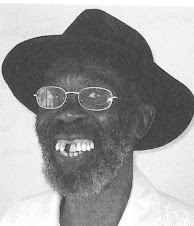
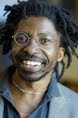
Textures, poems by John Eppel and Togara Muzanenhamo, reviewed in the Daily News, October 18, 2015


Textures, published by Bulawayo-based amaBooks, is an innovative new poetry collection from two intriguing Zimbabwean poets: John Eppel and Togara Muzanenhamo.  
   Both poets are gurus of the technical form, formal master craftsmen of the art of poetry, here displaying a familiar selection from the different types of poem: sonnets, sestinas, dizains, villanelles, etc. often only vaguely remembered from high school study of poetry and removed from the more familiar free form. This reviewer is a novice poetry reviewer, a reader of poetry rather than a poet, so this appraisal will focus more on content than form.
   While other countries express fears that poetry is dying, Zimbabwe, by contrast, has been described as ‘a country of poets’. Many forms of poetry exist alongside one another from the traditional to the performing to the activist poet. In Textures amaBooks has brought together two wordsmiths who decorate a literary landscape of personal love and longing, though this can by no means be described as a love anthology.
   Each poet speaks in his own distinctive voice: John Eppel’s first poem is the nostalgic ‘Suburban Night in August’, which begins ‘The distant all-night drums, a dripping tap…’ and ends expectedly with that pain of love lost so painfully shared ‘……unclasp your hair, give it a tousle, set it free, smiling at him the way you smiled at me.’
   Togara Muzanenhamo dramatically introduces himself with the shocking ‘Gondershe’ ‘Having never fired a gun before, he held the rifle as though the weapon were a dying child about to say something only they could share...’ ending with the revelation of the 12 year old soldier cradling his gun and awaiting a certain death.
   While Eppel can, at first reading, seem light hearted, less serious, he can also stun his reader as he does with the simple brilliance of ‘Only Jacarandas’.  His beautiful sequence ‘The Hillside Dams’ walks us into his head and heart as he reveals his innermost thoughts description intertwined with emotion.
   Eppel’s love of the Matopos, the birds, the plants are only a part of the everyday existence that he uses to paint the landscape of his own experience for the reader. His ‘Four Villanelles’ brings with it a rawness of the pain of his own experience of longing and loss. Sometimes regretful and jaded, other times light hearted and droll, Eppel provides us with a rollercoaster of emotions familiar to us all. He speaks with the sad voice of a sage, his still beating heart exposed for us all to see.
   While Eppel’s words can be brimming with satire, wry humour, self-deprecation, gentle self-teasing, by contrast, the landscape the younger Togara Muzanenhemo paints appears more mystical, more spiritual, more idealistic, more ardent: an enticing window we can only hope to look into but perhaps not enter, lacking as we undoubtedly do, the vision of this brilliant poet.
   Muzanenhemo’s poems and prose are memorable explorations of many worlds, home and abroad, his own intimate experiences and those learned from the books and photographs of the world of history. 
   At times he opens a time capsule as in ‘The Texan’ where he beautifully describes the rescue of an aviator ‘From Weeks Field the sun hangs uncertain, the air sharpened by the curse of razored winds -….’ Again in the ‘Bluegrass Country’ he unearths the story of the jockey Isaac Murphy who won the Kentucky Derby three times. Forgotten for many years we hear the painful story of his exhumation as he is reburied away from his wife who he lay buried alongside for decades ‘….my head in your arms forgotten…..the music of unwanted distance grating loud with what can only be the memory of an intimate age’. But Muzanenhemo’s voice resonates most where he writes of his own feelings, when his own sensuality becomes enmeshed with the characters he brings to life, as in ‘Peruvian Sunsets’, ‘He pressed his weight harder against her skin. His sweet smoky breath boiling deep in the atoll of her collarbone….Kissed him. Lips, hard against his. Mouth, flat against his mouth’.  
   Muzanenhemo gently moves from romantic longing as in 'Desire', ’But… he also thought of how her face would melt at the sight of him…..’ to the epic disturbing ‘Game of Twelve Moons’ where ‘…His tears fell silently. Sparkled. Moonlight glistened off grass. This is how our deepest miseries are made to shine, he thought.’  He slowly weaves his magic through the pages of this eclectic collection moving from observation to personal reflection, poetry to prose but always with the artistry of the esoteric expertise that few ever possess and even fewer share through poems.
   Textures is a celebration of life and love in all forms: its beauty and its cruelty. The exquisite fabric woven by Togara Muzanenhamo and John Eppel in this collection will remain to be enjoyed over and over by all those fortunate enough to buy this book.

  The feisty independent amaBooks are to be congratulated, together with two of the most outstanding protagonists from this country of poets. 

Reviewed by Pat Brickhill

Textures, by John Eppel and Togara Muzanenhamo
ISBN: 978-0-7974-9498-5      amaBooks, Bulawayo, December 2014

Monday, October 12, 2015

'Long after I read it, there are moments of stillness when I begin to think about the book and how much of myself I see in it.'

Bryony Rheam

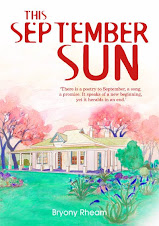
The day I finally finished reading Bryony Rheam's This September Sun, sometime in September, it was the one book I wondered about how I got to the end, why it ended, and why wasn’t I a little slower as I read it.

This September Sun is the most profound book I’ve read this year and for an author’s first book, I can only begin to think how this work can claim to be fiction. Long after I read it, there are moments of stillness when I begin to think about the book and how much of myself I see in it. Its ability to linger this long is an experience I’m learning to come to terms with.

I’ve read books: Enid Blyton’s Malory Tower series ensured I went to boarding school in a bid to relive the stories. I read another Enid Blyton book about a girl who was a gypsy, who lived in a caravan and was part of a travelling circus. I’m not even going to begin to state how, at one point, I thought my parents should sell the house we lived in, buy a caravan so we could travel and possibly join a circus too. Then there was Kaine Agary’s Yellow Yellow, from whose pages I got the name Binaebi and gave the name to my son when he was birthed. Some books leave a lasting impression. Some books will never be forgotten. This September Sun falls into that category.

The story revolves around two characters Ellie and her grandmother Evelyn. Ellie, an only child, is a loner who has more adult influences than shared experiences with children her age. Her grandmother Evelyn in this day and age, would be called a feminist. An independent woman who seeks to live her life according to her dictates. Amongst the profound things for me about this book are Ellie’s words as she tells her story. Here’s a passage from Chapter Two:

“Where do you start to put life together? The pieces don’t always fit. Many are missing, or borrowed. From other people’s lives, other people’s memories. Their own puzzles. Where is the beginning when you have only the end to start with? How many lies are told over the course of one lifetime?

What of all that is not said, merely hinted at, subsiding beneath the surface of action and words? All that is yearned for and never had?”

Even now, these lines leave me with a need of wanting to dig deep into life and uncover things I should know and do not know.

There were times when, as I read, I had the feeling the author had perhaps started a plot she did not conclude and had no intention of concluding and this was disappointing for me. Page 76, when Ellie found her grandmother naked in bed with Miles her lover. The next few pages made no mention of the incident and life continued and left me thinking what tha . . . a young girl sees her grandma naked in bed with her lover and the next thing pretends that nothing happened. Tsk, tsk. There I was a reader poking into nonexistent holes because pages into the middle, it pops up again, is mentioned and is laid to rest. That’s the sort of books TSS is, it’s unpredictable and while it doesn’t elicit a rush of adrenaline, it’s calm, it’s pulsing and holds you in a grip.

I’m a little of Evelyn, a little of Ellie, I’m in the book and I’m swept along in their struggles and as they come to terms with themselves. I love TSS. I will read it again. This time with a highlighter. I will mangle its pages, but not to uglify it but to bring out the beauty of its words so I can always take a look at them and sigh, and think.


I’ve never known a book to linger like this one
To hear echoes of its words long after I wistfully said goodbye.

To read a book as though the writer knew you and turned you outside in.
To read words and behold a mirror of your mind.

To reread it in your mind page for page.
To replay the scenes that wrenched your guts and made your eyes drip.

To think and maul.
To chew and not be able to swallow.

To wonder at how words were stringed.
To want to know what could have been going through this author’s mind.

To be afraid. Afraid. Not the sort that fear elicits, but the sort that goosebumps produce because you feel a book became a mirror and you could see a lot of yourself in it.

This September Sun began in August. Proceeded with a feverish grip in September. In its wake left thoughts and silence.

Not all fiction is truly fiction.

By irinajo. http://flittingbutterfly.com/2015/10/07/


Thursday, September 17, 2015

I'm Whatever You Say I Am - Tendai Huchu interviewed in the Daily News


BULAWAYO - Zimbabwean author Tendai Huchu (TH), who was shortlisted for the 2014 Caine Prize, is making a name for himself on the international scene through his fictional and non-fictional pieces.
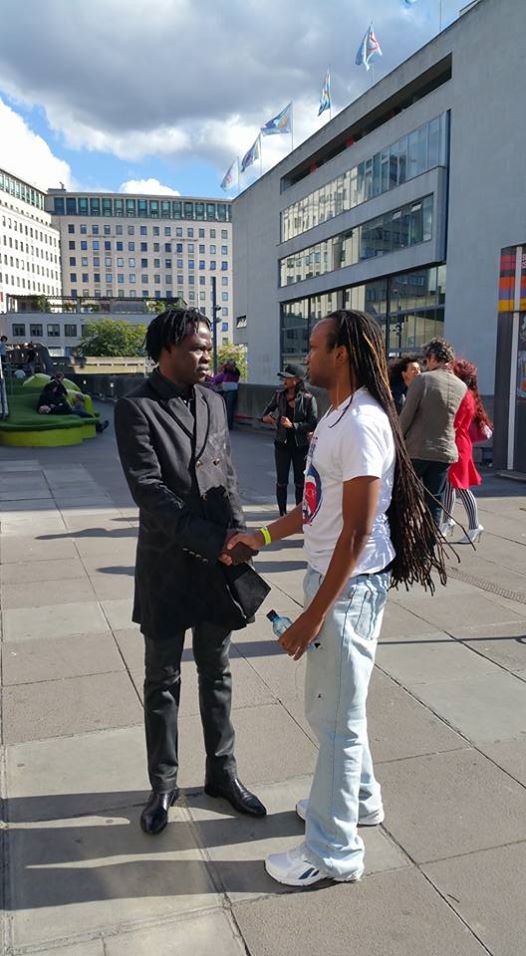
Tendai Huchu with Baaba Maal
photo courtesy of Ranka Primorac
Huchu’s second novel, ‘The Maestro, The Magistrate & The Mathematician’ has recently been published by amaBooks Publishers in Zimbabwe and by Parthian Books in the United Kingdom. It will soon be published by Ohio University Press in the USA and by Kachifo in Nigeria, as well in German by Peter Hammer Verlag and in Italian by Corpotre.  His first novel, 'The Hairdresser of Harare', which was released in 2010, has been translated into German, French, Italian and Spanish.

The Daily News’ Jeffrey Muvundusi (JM) interviewed Huchu on his writing career.

JM: Who is Tendai Huchu?
TH: To quote Eminem, “I am whatever you say I am.” On a forum like this, in a public newspaper, it doesn’t really matter how I choose to define myself or which aspect of my multifaceted identity I choose to reveal. Ultimately, what prevails is the misconception you and your readers decide to project onto the avatar that stands in for me in your imaginations.

JM: Briefly tell us what motivated you to become an author?
TH:  I have an itch that can only be scratched by writing, demons that need exorcising. Flashback 10 000 years ago and I was the dude drawing an antelope on a rock somewhere. I love reading, and writing is only a flipside of that same coin.

JM: What was your inspiration for writing The Maestro, The Magistrate and The Mathematician?
TH: I wanted to try something a little different from my first novel ‘The Hairdresser of Harare,’ to stretch myself a bit more as I played with language and structure. The great thing about being a Zimbabwean writer is that so much crazy shit happens, you’re in this unique position whereby your fiction is actually a watered-down simulation of an insaner hyper-reality.

JM: The novel tells the stories of Zimbabweans based in the UK. Do any of the stories relate to your own experience of living in the UK? Which of the three main characters do you feel closer to?
TH: That’s a tricky question because I am, by default, deeply suspicious of semi-autobiographical fiction. Then again, a writer can’t write something they don’t know, so an extreme argument goes, all fiction is autobiographical. Let’s just say my novel is a mishmash of stuff I’ve seen, stuff I’ve heard about, stuff I’ve experienced and plenty of stuff I made up.
The characters are all my babies – I moulded them from dirt and breathed life into them. I can’t say I’m any closer to one or the other.

JM: I think your novel tells us much about Zimbabwe by looking at the lives of Zimbabweans abroad. But does the book have appeal to non-Zimbabweans?
TH: Look, good fiction is universal. I read books by people from all four corners of the world, some dead folks for whom the separation is not only geographical but one of time too.
So, national identity, which in itself is a fictional construct, is neither here nor there for what draws readers to literature. The vast majority of my readers, by a significant margin, will be non-Zimbabwean.
Why? Because there are places in the world where this art form is considered important and where the economy allows people both the resources to buy books and the leisure time to read them.

JM: The novel has strong storylines, and a startling finale, but I also found myself laughing out loud at some sections. Why do you think humour is important in such a novel?
TH: Humour is an intrinsic and important part of human nature. Humour is a weapon, a cutting tool; you can use it to point out the absurdities and contradictions within society and culture. Then again, either you have it or you don’t, either you get it or you don’t.

JM: The Magistrate in the novel keeps 'in touch' with Zimbabwe through listening to Zimbabwean music as he walks the streets of Edinburgh. What keeps you in touch with home?
TH: Small point of correction, the magistrate isn’t using music to keep ‘in touch’ with Zimbabwe. He is conducting a psycho-geographical experiment, using music to buttress his memories of a new space.
And he is doing this consciously as opposed to the spontaneous, automatic, memory formation most of us do. Here is a man saying I want to remember this and I will use music as a tool to help me remember. You don’t need to stay ‘in touch’ with home, it’s in your heart, coded in your DNA.

JM: One comment about The Maestro, The Magistrate and The Mathematician is that the book shows your 'development as a writer'. In what ways do you think your writing has developed?
TH: That’s a pretty generous thing for anyone to say. I suppose writing is like anything else you do in life. You pick up new tricks as you go along. Few of my stories are as spontaneous as they used to be.
I now put a great deal of thought into voice and language, structure and pace, genre, and so I’m a little more conscientious than I used to be. The technical aspects of the craft are now as important to me as the stories I tell.
This may all sound boring and mechanical, but I still have a hell of a lot of fun doing what I do.

JM: You have been very active recently, with several events at the Edinburgh Festival and now at Africa Utopia at the Southbank Centre in London. Do you think these activities help in promoting a reading culture?
TH: My bread and butter work is solitary, me in a room with my laptop. This other stuff is just a sideshow, because the writer is now expected to dance for her/his bread. I turn down a lot of gigs because I find the schmoozing required pretty painful.
But I am also aware that this kind of stuff makes literature more visible and readers (for reasons beyond me) like to see the people who create the art they consume.
Reading, too, can be solitary, just like writing, so these things bring out the nerds and introverts, so a couple of times a year they can congregate and celebrate the art form they so love. Let’s just say my feelings about it all are rather conflicted.

JM: What advice would you give to aspiring Zimbabwean writers?
TH: Do your own thing and have fun doing it. Read a lot, everything you need to learn about this is in your library and online. Everyone out there is probably trying to tell you what to do. Don’t listen to them, especially dudes in the newspaper dishing out advice. Do your own thing. Be yourself.

JM: The short stories you write show your versatility by being in a wide variety of genres: science fiction, mystery.... What are you working on at the moment? 
What I write is probably a reflection of the fiction that I like to read and want to read. I hope the stories I write fill a gap in my library that needs filling. There’s always a subtle pressure for a writer to generate the same type of story and try to build a loyal market on that basis.
To me that’s just boring. I try to go into a story with an open mind and work it in the form that I feel is most appropriate for it, as opposed to saying I am an X type of writer.
Whether my readers follow me across all the fronts I’m fighting on is highly doubtful. But, you just do it for the love, man.
At the moment I’m scaling back on the short fiction which I’ve done a lot of this year.

I have to do a novel as part of the creative writing PhD programme I am on and with that will come a lot of academic reading and writing for my critical component.
That will take up a lot of my time. I also have a sci-fi novel and a literary novel on the hob. I’m also waiting to get into the next round of my translation of Ignatius Mabasa’s brilliant novel Mapenzi from Shona to English.
There’s quite a bit on my plate, so I have to step back and work out how I’ll use my time and how I can toggle between the various projects I am working on. I have to figure out the most efficient way of doing what I want to do without compromising the art.

JM: Do you intend to come back to Zimbabwe to promote the book?
TH: When my schedule allows, I may just do that. Though I can’t be sure what good that does for the book. The market, as Zimbabwean publishers will tell you, is pretty dire at the moment. Building up a reading culture that can sustain our growing canon requires a multifaceted approach. There is the state of the economy.
You need a decent sized, relatively stable middle-class for this art form to thrive. Libraries too are essential. I am talking well-stocked libraries with great staff willing to nurture their service users. Book stores too are important.
Then you have the school dimension, access to books for kids to hook them onto the literary drug while they are young and great teachers, who really are the writers’ pushers. But this kind of thing requires resources and a lot of thought over a long, long period of time.

JM: Who can you say are the greatest authors in the history of Zimbabwe and why do you think they are great?
TH: There are far too many to note down and this will quickly deteriorate into a name checking exercise. For a country that has only been literate for 140 odd years (mass literacy only really kicks off post-1980), I don’t think we’ve done too badly. I want us to stop thinking about great authors and maybe focus on great works of literature, that is, books that stand up on their own against the very best in the world canon. This, for me, is the really important question, because we spend so much time thinking about writers and very little on their work. The average Zimbabwean can name Dambudzo Marechera and will tell you he was a madman, blah, blah, but how many of us have read his work deeply and meaningfully?

Do we really have books that we can confidently stand alongside Crime and Punishment, Pedro Paramo, Infinite Jest, Germinal, 1984, Lord of the Rings, The Big Sleep, etc,?
Once we start framing these sort of things differently, thinking about the more fundamental elements of the truths we seek, I think we open ourselves up to a more intellectually rewarding debating space.

WWW.DAILYNEWS.CO.ZW/ARTICLES/2015/09/16/I-M-WHATEVER-YOU-SAY-I-AM-HUCHU


Wednesday, September 9, 2015

Zimbabwean Writers feature in a Celebration of Africa

from: http://www.thezimbabwean.co/2015/09/zimbabwean-writers-feature-in-a-celebration-of-africa/
  
Tendai Huchu and Bryony Rheam are set to take part in debates at Africa Utopia. Back for a third year Africa Utopia celebrates the arts and culture of the African continent. The festival looks at how Africa can lead the way in thinking about culture, community, business and technology and includes topics ranging from fashion, gender and power in politics, sustainability and activism. The 2015 edition of the festival features some of Africa's greatest artists across music, dance, literature and the arts, including Baaba Maal, Spoek Mathambo, Tosin Coker, Irenosen Okojie, Tony Allen, Toumani and Sidiki Diabaté, Orchestra Baobab, Kassé Mady Diabaté, Chineke! and Chi-chi Nwanoku.

The festival will be held between Friday 11 September to Sunday 13 September at the Southbank Centre in London. Tendai Huchu is due to take part in a panel on 12 September about 'African Male Identity', exploring the truths and myths of African masculinities, identities, sexualities, fatherhood and friendship. His second novel The Maestro, The Magistrate & The Mathematician has recently been published by amaBooks in Zimbabwe and by Parthian Books in the United Kingdom, and will soon be published in Nigeria, North America and Germany.

Joining Tendai at the festival will be Bulawayo-based writer, Bryony Rheam, who is a panellist the following day - Sunday September 13. The panel of which she is a member, will be looking at how genre fiction is changing the narrative of African fiction. Pulp and genre fiction include: sci'fi, horror, crime, erotica, utopia and historical fiction. Following on her first novel, This September Sun, Bryony has just finished writing her second novel, which is a murder mystery set in Bulawayo. This panel is chaired by Zimbabwean editor and literary critic, Ellah Allfrey.

During her visit to the UK Bryony will spend several days in Torquay, where she will receive her prize for being a winner of the Write Your Own Christie writing competition, which celebrates the work of one of the world's best-selling novelists, Agatha Christie. The competition involved writers from around the world writing a collaborative novel, starting with the opening of Christie's A Murder is Announced. Each month, writers were asked to submit the next chapter of the story. The judges then selected the winner for that particular month, and the competition, and the novel, then evolved over a nine month period. Bryony was runner-up for chapter seven, and winner for chapter eight, the judges commenting about her winning entry: 'It was a confident chapter with a terrific ending, as well as a carefully plotted solution.'

Bryony's prize is one night's accommodation at the Grand Hotel in Torquay, where Agatha Christie spent her honeymoon with her first husband. That evening, there will be a dinner at Christie's house, Greenway, now a National Trust property, also attended by the other prize-winners. Before the dinner, there will be a tour of the house, which is now a National Trust property. At the dinner will also be Christie's grandson, Matthew Pritchard, and her British and American publishers at HarperCollins.  Agatha Christie was born in 1890, so this year is the 125th anniversary of her birth and there is a special celebration in Torquay where the annual Agatha Christie Festival is held.


As a great fan of Christie's, Bryony is thrilled to be among the prize-winners. References to Agatha Christie can be found in This September Sun. The character of the grandmother in the novel is also passionate about Christie's work and her intricate plots.