Showing posts with label African Literature. Show all posts

Monday, May 4, 2026

Whatever Happened to Rick Astley? He Grew Up

 Reproduced from https://bryonyrheam.blogspot.com/2026/04/whatever-happened-to-rick-astley-he.html


Whatever Happened to Rick Astley? may be an unusual title for a book of short stories set in Africa. Western expectations of African literature demand something more exotic, something at least with connotations of heat, dust and hardship.  Like every place, Africa has more than one side to it and there are as many different experiences as there are people and places. 

Growing up in Zimbabwe in the 1980s, my life was an interesting mixture of experiences.  I lived on a gold mine out in the bush.  There were snakes and scorpions – and fear. It was an unstable time politically in post-Independence Zimbabwe.  Not everyone wanted the ruling party, ZANU-PF, in power and, in retaliation, the government sent North-Korean trained soldiers to Matabeleland to ‘sort them out’. This time of anxiety left an indelible mark on me. In other aspects, my life was ‘normal’ by Western standards.  I went to school, played sport, belonged to the library and watched television. 

Once a week, I listened to Sounds on Saturday, an hour of music videos of the ‘latest hits’ (some of them weren’t quite the latest), incorporating both Zimbabwean and Western music.  It was on Sounds on Saturday that I first saw Rick Astley with his shoulder pads and his jackets and his baby face, taking the steps two at a time and singing. Never gonna give you up, never gonna let you down …’

Did I adore Rick Astley? Not at all.  Did I like him?  Not particularly.  I was never one to hero worship celebrities. Did he leave any impact on my life whatsoever? No.  So why then did I decide, not only to write a story entitled Whatever Happened to Rick Astley? but to make that the title of my collection of short stories? 

It was a Friday evening. My sixteen-year-old daughter was out a friend’s party, and I was trying desperately to stay awake until ten o’clock, when I had to fetch her. I was drinking jasmine green tea and flicking through Facebook, catching up on who was doing what with whom.  There were the usual posts about food and weight loss; pictures of children and pets and the occasional potted plant; adverts for Indian take aways and plumbing services.  And that’s when it hit me: this was life at forty-five.

              There was a time that does not feel so long ago in memory, yet is at least thirty years ago, that I would never have been found at home on a Friday night.  Never.  If it wasn’t a party, it was a film we went to; if not a film, coffee with friends.  Then, when I was older, those dreaded night clubs, pubs and bars. Friday night was THE night to go out.  Nobody who had an ounce of life in them stayed at home on a Friday night.

              My teenage self swore a million times that I would not end up like my parents when I was older.  No, I would be one of those people who partied their way through life.  Not marriage, not children, not a position or a job was going to stop me, and yet there was nothing more comforting than coming home at the end of an evening and finding my mum still up, pottering around in her blue dressing gown.  An enduring image I have is of her sitting at the kitchen table eating a strawberry yoghurt and flicking through copies of Women’s Weekly.

              Of course, I did change – and I am glad I did.  I discovered I wasn’t half the socialite I thought I was. It’s not just that the thought of being out a night club in my forties, mother of two children and a school teacher to boot, sounds horribly dangerous (I can think of nothing worse than being one of those people who tries to hang around with people half their age, knocking back tequila and pretending they are having the time of their lives), but even parties and barbecues fill me with a kind of dread.  Truth is, I don’t even want to go out to the movies and, if someone would like to pop by for coffee, they are most welcome – as long as they are gone by nine thirty.

              I was therefore surprised by what I felt that night whilst sipping my jasmine tea and planning what I would make for lunch the next day.  I felt fear. Real, hard, cold fear, and it wasn’t because I longed for the past, or that I felt there was something else I should be doing with the present.  It was the next stage that frightened me.  The future. The ‘what now?’

              I had always thought of myself as quite an aware sort of person, not the type to be surprised by sudden revelations about my character or the direction of my life path.  I found I was not at all prepared for the changes I faced in my late forties.

              The first major change was my mother’s death six years ago, something I struggled to come to terms with. My father’s mental health deteriorated as dementia set in. On top of the sadness of witnessing this, I felt I had lost both my parents, and for someone who had always been a ‘home baby’, enjoying living near my parents and having them around as my own children grew up, this was very difficult.  For a long time, I floated in a strange sea of grief, not knowing how to move on.

              Empty nest syndrome loomed as my older daughter began to plan what she would do once leaving school.  It was a couple of years away still, but I began to think about it more.  I struggled to imagine what it would be like not to have children at home.  As much as increased time on my own, the freedom to come and go as I please and a reduced laundry pile were appealing, I felt a terrible emptiness, a death almost.

              Throw in the perimenopause and I was a wreck.  The most overwhelming thing was feeling the change in my life both physically and mentally and knowing there was nothing I could do about it.  I couldn’t stop the world.  I had to go on.

              I could have asked whatever happened to Boy George or Jon Bon Jovi for that matter, but it was exactly Rick Astley’s fresh-faced, unsullied, not-yet-disillusioned mien that made me pick him. What had become of him, and could that kind of optimism stand the years?  Where would I find him?  Had he ditched in his career, or had it ditched him?

              When I googled him, I was interested to find out that, unlike many other pop sensations, Rick Astley had given up his career to bring up his daughter.  A noble move for anyone, a man in particular, and especially someone who could have gone on and on to greater heights – or could he?

              Astley knew when to get out, when to make a change and when to do what he wanted to do.  It may be argued he had the money and the means, but he still managed to make a break and do what he truly wanted.

              Whatever Happened to Rick Astley? is the last story in my collection, and its positioning is deliberate. The anthology brings together twenty years of short stories, from my first story published,The Queue, to more recent ones, such as Moving On. Zimbabweans like to dwell on the past.  We talk about it, long for it, idolise it.  We constantly look back to a time when we were richer, happier and healthier. We are afraid of moving on because there is no clear guidance as to what the future holds. We cannot look forward because that future is hazy; we don’t know if it includes all of us or just the chosen few.

              It is understandable then that our literature also dwells in that gulf between the past and the
future, that uneasy present moment of loss and often despair, that reckoning between what has gone
and what is yet to come.
              I like to think that, like Rick Astley, Zimbabweans are due for a comeback and, as a result, our literature is changing direction.  We are exploring new areas and writing new stories. Whatever Happened to Rick Astley? is an acknowledgement of the past and the power it as to shape us, but it is also marks a turning point for me. As I enter a new phase of my life, I am apprehensive yet excited about what is to come. 


Bryony Rheam, April 4 2026

Friday, March 6, 2026

Zimbabwean writer Philani Nyoni, writes an interesting and candid review of Ignatius Mabasa's book 'The Mad' with its colourful insights of Harare, Africa and... sanity.


The Mad reviewed by Philani Nyoni in teambooktu.com

https://teambooktu.com/harare-is-a-garishly-painted-whore-a-review-of-ignatius-mabasas-the-mad?


TITLE: The Mad

PUBLISHED BY: amaBooks Publishers & Carnelian Heart Publishing

ISBN: 978-1-914287-96-1

PAGES: 235

AUTHOR: Ignatius Mabasa, Translated by J. Tsitsi Mutiti


I received a copy of Ignatius Mabasa’s The Mad with the anticipation of a bottle green fly washing its hands over a pile of human shit. I like shit, good shit, Ignatius usually writes good shit and I hoped this one, J. Tsitsi Mutiti’s translation of his iconic debut, Mapenzi, would fall into that category.

Soon after getting into the text I had the feeling I should read the original book in chiShona. I suppose I wanted to see how far from the original text The Mad  had strayed. I was bothered by the translation of “Shirikadzi inochema-chema” into “The widow sobs” (36).  It felt inadequate, and so I got the original version, in chiShona, and began to read them side by side. I quickly abandoned the comparison, satisfied that language carries a whole world on its shoulders: cosmology, symbols, blood memory and all that juicy stuff. I have, for a while, been speaking to Mabasa about translation, have followed Ngugi’s spectre to Limuru and stood in the Polytechnic raised where his theatre was razed, and one thing I know for certain, is that translation is more an act of rewriting. A simple phrase like “he felt as if a heavy person was sitting on him” when read in chiShona has supernatural connotations which the English does not convey, unless one chooses to over-explain. In the same vein, there are instances where the Shona idiom shines through translation, and the translator’s care is evident when she prefaces with phrases like “the ancients knew about life when they stated…” (51). I abandoned my duel-wielding style and decided to read The Mad for what it is, not the book I had formed up in my head.

In this translation, Mabasa’s timelessness shines through. What seemed to concern the writer in the year 2000 is still contemporary; in the eyes of his characters I saw a Harare that hadn’t changed much in twenty years. Over the course of my reading, I pondered one question: WHAT IS MADNESS? According to Einstein, it is doing the same thing over and over while expecting different results.

“I am not mad, but I know those who are mad” (183). We are offered many definitions of madness throughout the book, blessed with various samples and each invites one to ponder deeply. Sometimes madness is pathological, at times behavioural. It is institutional as well, it is all around us. Stylistically, it is not deployed as a tool with scat and jazzy rhythm like Brian Chikwava’s Seventh Street Alchemy, but appearances can be deceiving. Perhaps the style represents some semblance of sanity, a world that looks ordered and stable, but beneath the surface, fire burns and cauldron bubbles.

The text is acutely aware of its timelessness. On page 15 the narrator laments not being able to read his Mungoshi in an unlit minibus, on page 19 we are offered an insight into the persona’s inner turmoil when he says, “Now I appreciate Dambudzo Marechera’s sufferings as he carried around his idiosyncratic ideas, with those who didn’t think the same way as him calling him insane”. Again, the reader asks, WHAT IS MADNESS? It is interesting to ponder that line in connection with one on page 15, “No, don’t think that I am mad. When I am out of my mind I will let you know.” Or another on the following page: “Where can you find the strength to argue with someone and convince them that you aren’t crazy? It is not possible. That only makes them think your madness has stepped up a notch”.

In these passages, the author not only nods at Marechera and Mungoshi, like books that have literary characters are wont to do, there is hint of legacy and continuation, which justifies the existence of this publication as though answering the question of what has changed from the Harare Marechera sketched in Mindblast, or the place Mungoshi’s Lucifer Mandengu described as a failure’s junk heap in Waiting for the Rain.

Marechera, Mungoshi and Stanley Nyafukudza are often described in Zimbabwean literature as the Unbelievers who were disillusioned early with the liberation struggle. In Mabasa’s offering, the liberation war is a major part of the plot, and this time we see the fortunes of those who faced the bullets turned upside down, mostly through the plight of Hamundigone. “I am no longer a comrade, every other lizard is now calling itself a comrade” (36). The population is vastly disillusioned with the war, those ‘born free’ profess that, “…this war you always talk about has nothing to do with us. I don’t even know what Smith, whom you fought, looks like, so don’t keep irritating us. Were you forced to go to war?” (111). Meanwhile, some are claiming to have fought in the war and it seems to be a currency of power (183).

It is still an Animal Farm, as per a subtle nod to Orwell that references the new elite as not made in the image of God but with hooves to tread on the masses (18). The country seems to have gone to the dogs; and that is why “my brother is a real dog, like Harare” (85), an image that’s a bit on the (wet?) nose, since we have an actual dog named Harare featuring in the novel. Nutters are not welcome near Parliament, “even though the place itself is riddled with lunatics” (23). Although, I dare say, across the world, very few houses of Parliament aren’t nuthouses. Sewage flows in the streets (71), “Harare is worthless. Like bubblegum that has lost its flavour and just wastes your energy in chewing.” (38). Harare is brutal (57). Harare is a witch (35). Harare is a garishly painted whore… Harare is shameless do you know – and heartless. It is immoral like a plate that you dish out on even though it has not been washed… Harare! I fear Harare! (40). The Zimbabwe portrayed here, “has scooped out my spirit, the same way you do when digging a grave” (15). And whose fault is it? “…it’s those who have so pissed on you that even a war slogan has become nauseating” (13).

The pages are heavy with the smell of decay. Not just the piss and sewage drowning out the streets that even the blind know by smell when they have reached, but everyday life itself is in decay, “the life of youths in Harare is much like the heavily polluted Mukuvisi River” (56).  In Harare, “…the truth is that we all prostitute ourselves” (64). Although the characters are well sketched and feshed out, we see people alienated from themselves, transformed by poverty into caricatures in this Harare. They begin “to act like Americans who have no time for others” (25) and even walk headlong into destructive ways through alcohol and substance abuse, after all, “what way is not death?” (219) “Totems and clan names in Harare are the car you drive, the chequebook and MasterCard you carry, the suits you wear and the cellphone you have” (46). 

Humour carries this text a long way, reminiscent of Marechera’s House of Hunger where the horror of the details is saved by the quality of writing. The situations may be tragic but you have to laugh. It is not a damp and morose story of trial and flowing shit, that river of shit has many nuggets in it, sometimes the simple advice, like, “Bunny, do you know that if you steal you’ll be arrested? So let some things alone, like a sister’s breast” (194), because, “you may admire your sister’s breast, but no matter how arousing it may be, there’s not a thing that you as a brother can do about it” (44).

I hate that this book comes at a time when we have become obsessed with African positivity and enjoy labelling critical writers like NoViolet Bulawayo sellouts, a time when we seem to have forgotten that literature is a mirror, and breaking it doesn’t improve your veneer. I think such criticisms do not consider who we are writing for. For me, as it is with Stephen King, “writing is necessary for my sanity. As a writer, I can externalize my fears and insecurities… I’m able to ‘write myself sane'”.

It is still a good story, and for those who have seen sewage flow in the streets who have run out of candles during power cuts, or seen people lose their sanity and still go to work, with nobody stopping them even though they are crazy (34), it stands relevant today as it did back then. If only African writers could choose to write something more positive; right? Well, “…’if only’ is a madman’s philosophy” (55).


Philani Amadeus Nyoni

Philani Amadéus Nyoni is a Zimbabwean writer and actor.  His writings have been published on several platforms and media worldwide. This is his review of Ignatius Mabasa's latest work, 'The Mad'.

Friday, January 9, 2026

Book Review: The Mad by Ignatius T. Mabasa - Translated by J. Tsitsi Mutiti

The Mad reviewed by Tafadzwa Madzika in Greedy South (https://www.greedysouth.co.zw/2026/01/book-review-mad-by-ignatius-t-mabasa.html)


In Zimbabwean society, and to a broader extent Southern African society, there are larger than life characters who are regulars at the local shopping centre, who have their sanity constantly in question. They always have alcohol on hand and offer up monologues and rants against the "authorities" without any motivation. The lack of care by social services or the absence of them as a whole, makes them easy to feel sympathetic for, while their characters are often abrasive and easy to hate. 


This is Hamundigone, a war veteran and teacher at the centre of Ignatius Mabasa's The Mad, a 25 year old novel originally published in Shona as Mapenzi but recently translated Into English by J. Tsitsi Mutiti. In monologues that showcase keen insight and channel allegory, Hamundigone paints late 90s Zimbabwe in vibrant brushstrokes, while making us question his mental well being. Within the first few chapters it's clear that The Mad is a presentation of Mapenzi with nothing lost in translation.


"When you find yourself being asked when you will return, don’t think it is a sign of popularity. Sometimes people look forward to their freedom in your absence. So, now that I am going, don’t bother to ask me any questions because I have no answers for you. Just know that I will be back." - extract from The Mad


From Hamundigone's introduction there is a dive into characters just as vibrant as him, if not in personality then in the complexity of their lives. The Mad spins a web that touches on themes of culture, identity, homophobia, gender based violence, the liberation struggle, substance abuse and the AIDS pandemic. It is gripping yet laced with humour even in the most heartbreaking of moments. 


Through the lives of several individuals we travel through love, heartbreak, hope, while living in a repressed society. The fortunes of the country are expressed through a dog that changes names from Salisbury to Harare, and somehow strikes up a friendship with Hamundigone. The argument of cultural erosion vs needed adaptation is regularly put forward, along with a display of government inadequacies.


A novel 25+ years old yet still effervescent in its social commentary and satire. The stigma and fear mongering that gripped society in the 90s as depicted by The Mad, is almost exact mirror what happened during the world's most recent pandemic. A fact that shows us how well Mabasa captures Zimbabwean culture and the well entrenched underlying beliefs that guide Zimbabweans. 


The novel showcases both the brilliance of Ignatius Mabasa as a writer and J. Tsitsi Mutiti as a translator. A must read novel in every context.


Title: The Mad
Authors: Ignatius T. Mabasa
Genre: Fiction
Publisher: Carnelian Heart Publishing & amaBooks Publishers


The Mad is available across all major book selling platforms and locally in Zimbabwe from Book Fantastics.


Thursday, August 28, 2025

The Maestro, The Magistrate and The Mathematician by Tendai Huchu is August's book at the Bulawayo Book Club

Tendai Huchu's novel The Maestro, The Magistrate and The Mathematician is to be discussed this weekend (30 August) at the Bulawayo Book Club.

Three very different men struggle with thoughts of belonging, loss, identity and love as they attempt to find a place for themselves in Britain. The Magistrate tries to create new memories and roots, fusing a wandering exploration of Edinburgh with music. The Maestro, a depressed, quixotic character, sinks out of the real world into the fantastic world of literature. The Mathematician, full of youth, follows a carefree, hedonistic lifestyle, until their three universes collide.


Sunday, May 25, 2025

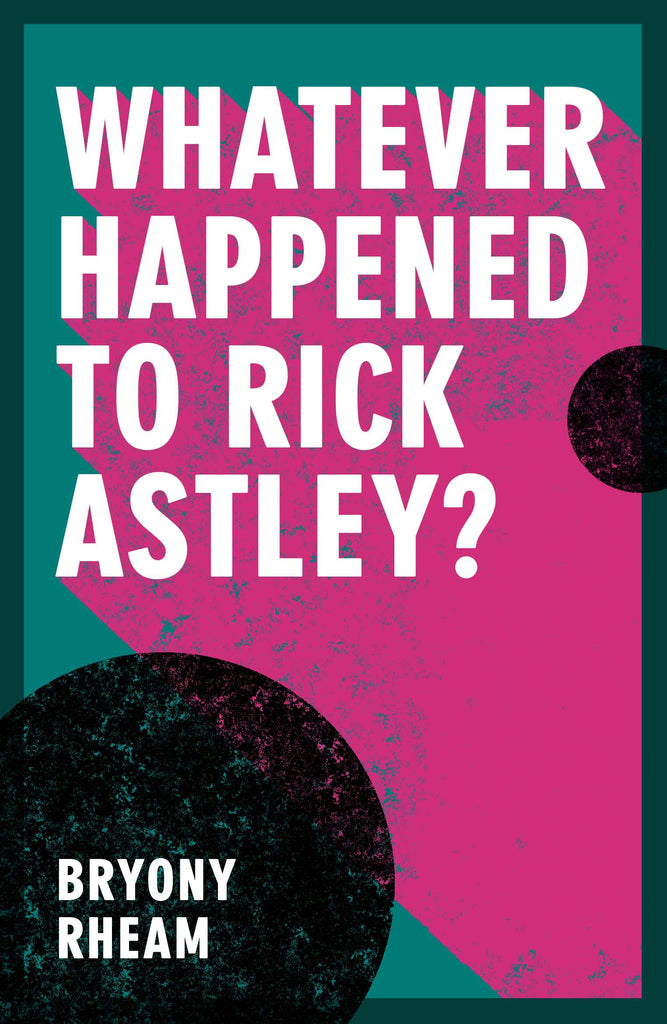
The Bulawayo Book Club discuss Bryony Rheam's 'Whatever Happened to Rick Astley?'

This month's meeting of the Bulawayo Book Club discussed Whatever Happened to Rick Astley? with the author of the short story collection Bryony Rheam. The book club is organised by Raisedon Baya and takes place at Alliance Francaise de Bulawayo.


Raisedon Baya's comments about the meeting, with two short story reviews by Raisedon, follow:


The Bulawayo Book Club just finished reading Bryony Rheam's collection of short stories entitled Whatever Happened To Rick Astley?. This is Rheam's third book after This September Sun and All Come to Dust. For the next few days I shall be doing some short reviews of some of the stories contained in the anthology.

Let me begin by saying the anthology offers thought-provoking insights into the human condition, societal issues, and the complexities of everyday life. Today I shall focus on "Potholes" and "The Piano Tuner". These two stories shed light on various themes like government neglect and the politicisation of public services, racial tensions and biases and the struggles of ordinary people in extraordinary circumstances.

Rheam's writing style, which hints at deeper meanings and leaves room for interpretation, adds depth to the narratives. 

"Potholes" is about how Gibson Sibanda starts fixing potholes in a road in Hillside suburbs and ends up moving to other roads. It is a simple story. Perhaps symbolic of how Zimbabwean roads have become. Anywhere, you know something is very wrong in a country when an individual who doesn't even own a car starts mending roads. The potholes are so many and the roads look neglected. Both local and national governments have abandoned their responsibility of mending roads. What is funny is the superficial mending of this one road because the Vice President of the country has bought a house in the suburbs. And they have to pretend to mend it. More hilarious is the fact they mend the road for an intended visit to the new house by the Vice President. A visit that never happens. A subtle dig by the author at our politicians and how simple decisions like mending a road have become political.

Then there is "The Piano Tuner". This one is set in Zambia but it might as well be a Zimbabwean story. A black piano tuner, Leonard Mwale, who apprenticed under a white piano tuner, takes over the business and continues to use the white man's name as the business name. (Doesn't this sound familiar?) On this particular day he is hired by an Indian client. The piano tuner is good. Very professional. He knows his work. Unfortunately, the Indian client discovers during lunch that he has engaged a black man and things change and racism rears its ugly head. It becomes clear that the Indian client would not have engaged the service of the piano tuner if he had known he was black. The invitation to lunch was extended to Thomas Jenkins the name, not the piano tuner. There are racial overtones in the story. So much that when the Indian leaves the payment for the service the money is short. He can't bring himself to pay a black man properly for proper service. The writer does not overwrite, she makes hints and leaves it to the reader to fill in the gaps.

With her current body of work I think Bryony Rheam now deserves to sit on the high table with other Zimbabwean literary giants. When we mention the likes of Tsítsi Dangarembgwa, NoViolet Bulawayo, Sue Nyathi, Siphiwe Gloria Ndlovu, we should not forget to include Bryony Rheam on that list. She has truly earned her spot.


Whatever Happened to Rick Astley? is published in Zimbabwe by amaBooks and in the United Kingdom by Parthian Books.


Tuesday, December 19, 2023

Wales Arts Review of Bryony Rheam's 'Whatever Happened to Rick Astley?'

Reproduced from https://www.walesartsreview.org/whatever-happened-to-rick-astley-by-bryony-rheam/


Eluned Gramich reviews a vibrant new collection of short stories from one of Zimbabwe’s leading writers in the form, Bryony Rheam.

‘The afternoon hangs suspended in the drowsy heat of late October. The house is quiet with the softness of sleepers.’ So begins ‘Music from a Farther Room’, one of sixteen stunning stories in Zimbabwean writer Bryony Rheam’s collection, Whatever happened to Rick Astley? The themes of the story are echoed throughout the book: isolation, loss, and a profound dislocation; of not knowing whether it’s the place or the people that truly create a sense of belonging. This particular story focuses on Julia, an elderly woman sharing a house with her son and English daughter-in-law, newly arrived in Zimbabwe from the UK. It moves deftly between the two women’s perspective, full of curiosity and understanding for both points of view. It’s not simply a generational divide that complicates their relationship, but cultural and social differences too, leading to a profound loneliness for both of them. Rheam’s smooth, resonating prose captures the increasing solitude thus: Julia’s ‘children are scattered throughout the world, not one on African soil. They’ve all asked her to live with them … but she always shook her head and gave a little laugh. Gradually, they stopped asking.’

Bryony Rheam

Rheam writes beautifully and skilfully about people whose lives have been affected by waves of migration and immigration; of the generational ebb and flow of people coming to, and leaving, Zimbabwe. One story in particular, ‘The Last Drink at the Bar’, sees a man visiting his homeland over the years from his job teaching in Wales, and each time he feels as though he is being pushed away, alienated, from the culture and community in which he was raised. His old drinking mates are suspicious of his desire to return; after all, shouldn’t he have everything he wants in the UK? Rheam explores the idea of belonging and un-belonging further by revealing the tensions in travel and tourism: ‘His was the oblivion of the tourist who sees only himself, the pivotal figure around which everything else revolves’, she writes of one character during his visit to Bristol, heavy with its history of the slave trade, its ‘Whiteladies Road’ and ‘Black Boy Hill’. In ‘The Fountain of Lethe’, a woman insists on bringing her family to a beloved holiday spot in Bulawayo, but the visit does not turn out to be what she had hoped: ‘What was it, that particular feel of hotel rooms? That mixture of holiday excitement and disappointment one wavered between.’ There are countless moments like these in the collection: sentences, wonderfully wrought, that illuminate everyday life.


This is Rheam’s third publication in Wales – following two successful novels This September Sun and All Come to Dust, both of which received major prizes. I enjoyed her novels, which are expansive and wide-ranging, but entering into the compact, complex, emotionally layered world of her stories, I was amazed by Rheam’s ability to move, and to create a deep sense of place, and character, in only a few pages. For me, one of the strongest stories is ‘Dignum et Justum est’, which follows two immigrant English teachers in Bulawayo as they travel towards very different fates: the story spans decades, yet it succeeds in giving a detailed portrait of the lives of these teachers, and the society to which they adapt – or fail to adapt. Rheam does this by employing a ‘light touch’; by never saying too much, or too little, which shows what a consummate writer she is. As for what happened to Rick Astley, you will have to read the collection, right to the last story, to find out.

Whatever Happened to Rick Astley? is available to buy in the UK here.


Whatever Happened to Rick Astley? is co-published by amaBooks and Parthian Books.


Monday, September 4, 2023

Interview: Bryony Rheam talks about her new collection of short stories ‘Whatever Happened to Rick Astley?’

Reproduced from Nation Cymru https://nation.cymru/culture/interview-bryony-rheam/


Bryony Rheam is interviewed here by Jane Morris

Jane Morris is an editor and publisher originally from Ebbw Vale. She moved to Zimbabwe in the 1980s when her husband Brian Jones took a job in the Applied Mathematics department at the National University of Science and Technology in Bulawayo. They set up amaBooks in the 1990s to publish emerging writers. One of their successes was Bryony Rheam whose novel This September Sun won the best novel award for Zimbabwe and went to No 1 on Amazon kindle.

On moving back to Wales in 2019 amaBooks have continued to be involved in the Zimbabwean literary scene. They are now based in Ceredigion. Here, Jane Morris talks to Bryony Rheam about her short story collection Whatever Happened to Rick Astley? which has just been published in association with Parthian Books of Cardigan.

Bryony, your latest publication, the short story collection Whatever Happened to Rick Astley? has an intriguing title. How did that title come about?

It all began with a Facebook post of mine. It was a Friday night and I was trying desperately to stay up until 9pm so that I could go and fetch my daughter from a party. I was remembering when I was a teenager and how we had to be out doing something on a Friday night and how early 9pm would have been then! It made me think of how quickly time flies, and how you become your mother. I was thinking of different songs that characterised my teenage years, which got me onto Rick Astley and then I wondered where he was and what he was doing. It was really comforting to find out that he had given up his singing career to bring up his daughter, and now she is an adult, he is making a comeback. There seemed to be a message in that for me. Life isn’t over just because you have reached a certain age, and each stage in your life brings different things.

You have said that you ‘don’t want to crush a story with politics’. How do you capture the effect that the economic and political situation has had on the lives of Zimbabweans?

It probably isn’t possible to write about Zimbabwe without bringing in the way in which we live and the way we have been treated by our government in the last twenty or so years. I think there is a difference though between showing how politics has shaped our lives and writing a ‘political’ story. For me, it’s in the background, but the main things in our lives are relationships and friendships and hopes and dreams. We don’t wake up in the morning and think of the government, but our lives are definitely influenced by the decisions that they make.

In what way do you consider that being a writer living in Zimbabwe has influenced your writing?

From a very early age, I have been able to connect with people’s emotions. It’s not always a good thing, believe me, because it can weigh me down. I pick up a lot of pain in people I meet. I know you could say that about people anywhere in the world, but there is this particular feeling that haunts Zimbabweans. We live in a fantastically beautiful country, but our lives are dominated by a haunting sense of loss. It is difficult to describe exactly because it is not as if Zimbabwe is in a war zone but there is definitely a feeling of something working against us. Writing about these things helps deal with the pain, especially if you can see a funny side to the story.

Do you identify with any of the characters in the stories?

There is a bit of me in every single story, but I think I identify most with the main character in ‘Whatever Happened to Rick Astley?’ – after all, it is a story based on my Facebook post! I draw a lot from real life, but I also change the details.

The academic, Professor Thabisani Ndlovu, who interviewed you for the launch of this collection in the UK, noted the level of interiority in a number of your characters as they delve deep to understand their situation and to move on. Could you comment upon this and give examples from the collection.

I have always loved authors such as Virginia Woolf and enjoy showing the inner thoughts of my characters. Often the shift in a story is merely in the thinking of one of the characters. I love taking a particular moment and showing everything that is happening at that particular point. Motivation is another aspect that I find interesting to explore: what takes us to a specific moment? What makes us do a specific thing. Most importantly, perhaps, what do we think, but don’t say? We spend our lives balancing our inner and outer worlds, often unconscious of our motivation for doing so. This is shown more in the stories with female characters: ‘Music From a Farther Room’, ‘The Fountain of Lethe’ and ‘These Things I Have Loved’, for example.

Whatever Happened to Rick Astley?


Wales Arts Review has chosen Whatever Happened to Rick Astley? as one of its summer reads. Why do you think readers in Wales would be interested in reading your collection?

Although the majority of the stories are set in Zimbabwe, I don’t think you need to have been there to understand or engage with them. We all suffer loss, we all feel joy and we all experience fear. It is characters we identify with, not necessarily situations. I hope that readers anywhere would find the stories of interest – and perhaps learn about a place they know little of. Stories can teach us things that TV documentaries and factual articles can’t.

Incidentally, I have a strong Welsh connection through my mother who was from Swansea. Some of the experiences of the narrator in ‘Dignum et Justum Est’ were generated by things she told me: the way the English often put down the Welsh and the use of terms such as ‘boyo’. There is also a Welsh link in ‘The Piano Tuner’ where the main character, Leonard Mwale, has taken over the piano tuning business from a man called Thomas Jenkins. Another character in ‘Last Drink at the Bar’ has moved to Cardiff from Bulawayo and, whilst he is glad that his British roots have enabled him to escape Zimbabwe’s woes and move, he is also incredibly homesick.

Zimbabwe has a strong tradition of short story writing and it could be argued that a short story reflects the spirit of a particular time. The stories in the collection were written over a period of twenty years, starting with the first, ‘The Queue’, and ending with the story that gives the book its title, ‘Whatever Happened to Rick Astley?’. Do you think that your stories trace a time line in the lives of Zimbabweans?

Yes, I think so. ‘The Queue’ was written at the beginning of Zimbabwe’s economic woes and it reflects that awful feeling of desperation that many people, especially those on pensions, were facing. Hyperinflation, petrol queues and food shortages characterised those years. It was quite a terrifying time with many people losing their life savings and ending up on the poverty line.

Many, many people have left Zimbabwe over the last twenty or so years and, for the people left behind, it has been a very sad time and there are many lonely people with no family left here. Sometimes there is a resentment towards those people who have left; sometimes those who have left have struggled to fit into the countries they have moved to.

That feeling of homelessness is in stories such as ‘Moving On’ and ‘The Rhythm of Life’. I would really like Zimbabweans to imagine a new future. Often when we talk of moving forward, what we really mean is that we would like to go back to the past (even though there was no perfect time in the past!). Whatever Happened to Rick Astley? is about accepting the past is gone and that there is still a future to look forward to.


Bryony Rheam’s collection of short stories Whatever Happened to Rick Astley? is copublished by Parthian and amaBooks. It is available from all good bookshops.


Saturday, June 24, 2023

Whatever Happened to Rick Astley? released soon


Whatever happened to Rick Astley? She imagined that he was happily married with children. A record producer, perhaps? That was the usual way with singers, wasn’t it?


The first copies printed in the UK arrived today and the first copies have been printed by the Zimbabwe printers - so all is looking good for the launch in both countries.

The collection of short stories by Bryony Rheam will be released in the UK on July 10, and will be available through all good UK bookshops and through Parthian Books. And, if you want to be ahead of the crowd, the book can be pre-ordered now from Parthian Books.

The date of the launch in Zimbabwe will be announced soon.


From Bryony Rheam, the award-winning author of All Come to Dust and This September Sun, comes a collection of sixteen short stories shining a spotlight on life in Zimbabwe over the last twenty years. The daily routines and the greater fate of ordinary Zimbabweans are represented with a deft, compassionate touch and flashes of humour.

From the potholed side streets of Bulawayo to lush, blooming gardens, traversing down- at-heel bars and faded drawing rooms, the stories in Whatever Happened to Rick Astley? ring with hope and poignancy, and pay tribute to the resilience of the human spirit.


'This varied and eclectic collection from Bryony Rheam sizzles with the undercurrent of a continent always on the very edge of chaos and disorder, and yet there is such warmth, strength and humility to the lives of her many eccentric characters. In turn these stories are funny, poignant, at times shocking, but always deeply moving.' Ian Holding, Unfeeling


'Whatever Happened to Rick Astley?, Bryony Rheam’s wonderful collection of short stories, deals with loss—loss of identity, loss of memory, loss of country, loss of someone you love. While the theme seems to be a heavy one, the stories capture the beauty and the magic of the ordinary. There is nostalgia here for what once was, but there is also a lot of hope for what could be. Anything that can give us hope in today’s day and age is truly amazing, and that is what this collection is.' Siphiwe Ndlovu, The Theory of Flight


'Bryony Rheam’s short stories are skilled, perfectly formed, and compelling; the characters are largely outsiders – whether geographically, culturally or emotionally – and completely realised, inhabiting detailed and believable worlds. In all, Whatever Happened to Rick Astley? is a deeply satisfying collection.' Karen Jennings, An Island


 And,  Rick Astley headlined today at the Glastonbury Festival.


Tuesday, February 21, 2023

Bryony Rheam's short story collection to be published in July 2023


'Bryony Rheam’s short stories are skilled, perfectly formed, and compelling; the characters are largely outsiders – whether geographically, culturally or emotionally – and completely realised, inhabiting detailed and believable worlds. In all, Whatever Happened to Rick Astley? is a deeply satisfying collection.' Karen Jennings

'Whatever Happened to Rick Astley?, Bryony Rheam’s brilliantly titled and wonderful collection of short stories, deals with loss—loss of identity, loss of memory, loss of country, loss of someone you love. While the theme seems to be a heavy one, the stories capture the beauty and the magic of the ordinary. There is nostalgia here for what once was, but there is also a lot of hope for what could be. Anything that can give us hope in today’s day and age is truly amazing—and that is what this collection is.' Siphiwe Ndlovu

'Bryony Rheam's wry humour is a bridge that connects genre fiction to literature. These beautifully crafted stories will satisfy all expectations.' John Eppel


Whatever happened to Rick Astley? She imagined that he was happily married with children. A record producer, perhaps? That was the usual way with singers, wasn’t it?

From Bryony Rheam, the award-winning author of All Come to Dust and This September Sun, comes a collection of sixteen short stories shining a spotlight on life in Zimbabwe over the last twenty years. The daily routines and the greater fate of ordinary Zimbabweans are represented with a deft, compassionate touch and flashes of humour.


From the potholed side streets of Bulawayo to lush, blooming gardens, traversing down- at-heel bars and faded drawing rooms, the stories in Whatever Happened to Rick Astley? ring with hope and poignancy, and pay tribute to the resilience of the human spirit.

Whatever Happened to Rick Astley? is due to be published by Parthian Books and amaBooks in the UK in July and by amaBooks in Zimbabwe at a date to be announced.

Bryony says of the collection that: 'Each story reflects something of my life in Zimbabwe over the last twenty years. It has not been an easy time for this country, but it is also not one without hope and joy.'

Tuesday, April 26, 2022

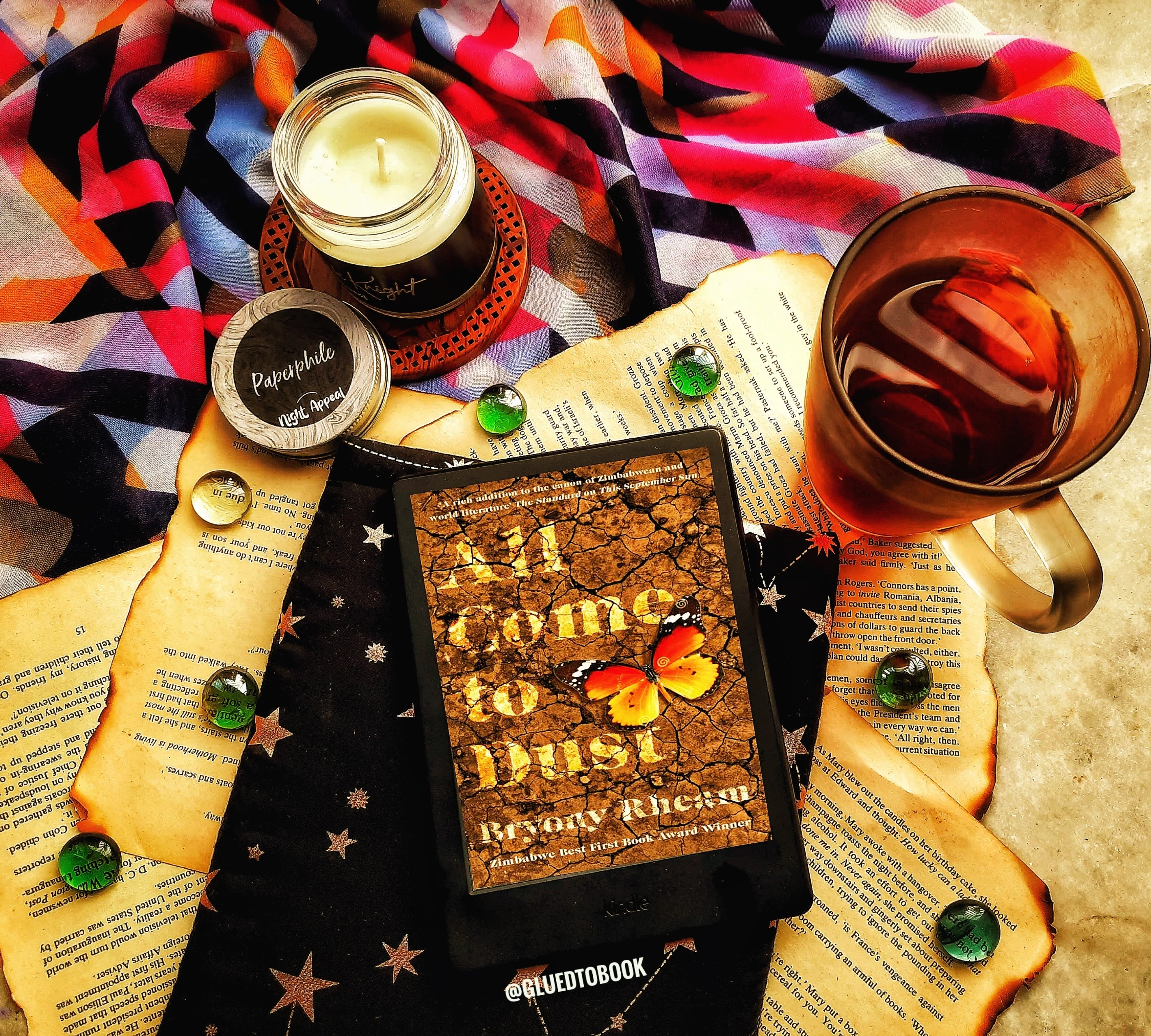
Glued to Book reviews Bryony Rheam's All Come to Dust

Reproduced from https://gluedtobook.wordpress.com/2022/04/23/all-come-to-dust-review-329/


 Chief Inspector Edmund Dube is introduced in All Come to Dust as he investigates the stabbing of a rich woman, Marcia Pullman. He is then refused access to the case, and police documents, and is removed from the case after it is determined she died of renal failure. Edmund’s past is revealed in a sequence of flashbacks to 1979 as he continues his investigation. A slow-paced police procedural set in Bulawayo, Zimbabwe, with subtle references to race, class, mental health, memory, and colonialism.

All Come to Dust, a mystery by Bryony Rheam, is a classic murder investigation steeped in Zimbabwean culture. Many components of the book can only take place in such settings, and they are necessary for the novel to evolve in the first place. The protagonist is a lone wolf with a complicated personality and backstory who is dedicated to completing his task. The characters are well-developed, albeit slowly, with just enough cliches or stereotypes to lead the reader to believe they already know something. At the same time, the plot is both compelling and tiny or contained. It takes its time unraveling and provides enough red herrings mixed in with its hints along the way to make you want to keep reading and not feel cheated out of a satisfying conclusion. Throughout, it is a portrayal of how class, race, and gender still work in contemporary Zimbabwe, not so much an indictment as a laying bare of how injustice and privilege are still baked into everyday life, and the attempts of diverse individuals to break free.

This is an intriguing and often amusing look at a crime that isn’t a crime, as examined by a man who draws inspiration from books and movies. The reader is given the perspectives of all the suspects, however, it’s difficult to believe any of them. In the end, I enjoyed this story. It grew heavier than I had anticipated and dealt with several difficulties I’m currently working through. If you’re seeking a mystery that also serves as a character study of Zimbabwe, this is the book for you.

Tuesday, February 1, 2022

NB Magazine Review of All Come to Dust

 Reproduced from NB Magazine's January Crime Fiction Round Up


All Come to Dust by Bryony Rheam


An intriguing Zimbabwean murder mystery, Rheam’s Bulawayo set crime novel is at once comforting for its cosy crime scenario but also disturbing for its subversion of the associated tropes creating a more complex and relevant read. The writing is easy, hinting at a golden age style tale of skulduggery, opening with a woman found dead in her bedroom, stabbed with a letter opener. However, this is Zimbabwe not Surrey and Rheam explores themes of racism and the colonial legacy and how those things haven’t changed enough while policing has got harder and poorer.

Marcia Pullman of 274 Clark Road does all her own cooking for her little social gatherings, there is one today. She deems the ‘girl’ Dorcas useless and the gardener, Malakai, had to be fired for incompetence and laziness. Food prepared, Dorcas sent out for the afternoon, Marcia lies down for a rest before book club. Later when the first guest arrives and Dorcas returns they are surprised there’s no sign of Marcia downstairs. Eventually venturing to the mistress's bedroom Marcia’s body is found.

Chief Inspector Edmund Dube of the Bulawayo central police station is grappling with another report, there are no Ss or Rs on his typewriter. He dreams of solving a real crime so, when a constable comes looking for super Detective Inspector Khumalo, Edmund jumps in to take the case. A white woman in the suburb has been killed and the missing gardener is the prime suspect. Edmund has to get a lift to the crime scene from a citizen outside the station. When Dorcas sees the commandeered driver she says he is the killer, she saw him argue with Marcia before, Edmund will have to follow that up. Meanwhile, Mr Pullman is indignant that the very clever detective Khumalo isn’t on the case but Edmund holds his ground. The strange thing is that Marcia was found inside a locked house and there are no unaccounted for keys. She was also dead when the would be killer stabbed her. A mystery indeed.

There are several interesting characters, a healthy dose of humour, often arising from misinterpretation, misunderstanding and jumping to conclusions. There’s also the serious aspects of modern Zimbabwe’s troubled society and its past trauma. This is genuinely subversive and fun.

https://nbmagazine.co.uk/the-verdict-january-crime-fiction-round-up/


All Come to Dust is published in Zimbabwe by amaBooks, and in the UK by amaBooks and Parthian Books, where it is available through www.parthianbooks.com/products/all-come-to-dust .


Sunday, August 1, 2021

Reviews of Bryony Rheam's All Come to Dust


Wow!  I haven’t had a book captivate me like this one in a long time.  I intended to just read a chapter to get a feel for it and 100 pages in I was in heaven.

This is a great plot for me personally.  At its most basic, this is a murder mystery set in current day Zimbabwe.  It evolves into something so much more to include issues of repressed memories, trauma, racism, colonialism, family and mental health.  Instead of telling us about these issues, we are shown through narrative, the effects of past decisions and events on current everyday lives of the individuals and their families.  I love books where I’m entertained as I learn that this is very well accomplished here.   There is often a bit of a philosophical tone which I quite enjoyed.  

Our main investigator is not the typical hunky detective type, rather an insecure male who is very aware of his flaws and is consciously working on his self-confidence.  I loved Edmund for the first half of this novel as he proves himself not to be as pathetic as he would have led us to believe.  There are some unexpected twists to his story that I did not anticipate, and I ended the book not quite as enamoured with him.  Human beings are not perfect and none of the characters in this book is without fault.  I love how real and flawed they are.  

 The plight of a poor white man in a newly independent African nation was engrossing.  We get to know Craig pretty well and his back story is most intriguing.   Rheam gradually reveals each player to the reader when his/her that perspective is revisited, and they all grow in complexity and the reader grows in understanding.   Mrs. Whitstable was the biggest surprise for me.  We get to know a few of the “good” characters quite well but none of the bad guys.  I’d have liked to see some of the story from Marcia or Mr Pullman’s perspective.  Many subplots were woven together for a satisfying ending.  I do have a few questions though, especially regarding the plight of the women who were transported over the border.  

There is a wonderful sense of place; smells, sounds, sights transported me to Bulawayo.  The writing is amazingly easy to read, and it moves everything along every quickly.  The use of some local language is perfectly integrated so that I never felt I had to look something up.   

I loved this book and look forward to more from a highly talented author.  I will be checking out her other novel, This September Sun, as soon as I can.  (Mary S. Educator, Netgalley)


All Come to Dust is a novel by a Zimbabwean set in modern Zimbabwe. On the surface it is a classic—and very complex—mystery. But I felt throughout as though there was a literary novel behind the scenes attempting to show itself behind the screen of a conventional mystery. The writing is often quite lovely, and the story is told from various points of view, each one shedding light not only on the diverse characters but also on the details of living in Zimbabwe. Add to this the fact that much of the suspense concerns the characters’ pasts, not the present murders of a disliked middle-class white woman, and you have a book that feels much more like literary fiction than a genre novel.

The mystery suffers somewhat. Its resolution is extremely clever, with one of those endings where you discover that every character’s story is an interlocking piece of the puzzle; but the clues leading up to the resolution are somewhat murky, often requiring cultural knowledge the average reader may not have (I didn’t). It takes a plot strategist and practiced writer like Agatha Christie to pull off the sleight of hand of showing the clues in such a way as to make them ignored but present enough in the subconscious for an “Aha—that was it!” moment at the end. This was not such a mystery, though it has enough of the trappings of a mystery to make the reader wonder exactly what it is trying to be. The reader who wants to be sure of the clues may need to reread the book—and this is a book that would stand up to rereading, primarily because of the vivid picture of Zimbabwe.

I found myself highlighting often, because of the vivid passages about Zimbabwe. Bryony Rheam’s slow, observant, and graceful writing calls to life the dusty roads, the smell of grasses, and the blossoms tossing in the trees, while limning an elderly generation of impoverished British non-leavers, a sleazy group of exploitative whites, and a mixed race underclass attempting only to find a job and make a contented life in a country where not even the electricity and water can be relied on. Bryony Rheam writes of this country with authority and astuteness. In Zimbabwe, she has found her ordained setting. I am not certain that the mystery is her genre. But I am sure she is a writer to watch; and I look forward to her next book with considerable eagerness. (Helen Aristar-dry - Goodreads)


Initially assuming that All Come To Dust was a straightforward murder mystery, I was impressed to find that actually Rheam is doing something much more intricate and important here. Rather than a No 1 Ladies Detective Agency-style southern African comic romp of a mystery novel, All Come To Dust instead grapples with difficult issues of colonialism, racism, mental health, and memory. The insights into the lives of the remaining white population of Zimbabwe were fascinating while clear-eyed: the reader is encouraged to sympathise with certain of them, but also reminded of their privilege. Highly recommended. (Janet B, Netgalley)


All Come to Dust is a long-simmering stew, with the raw-ingredients of an old-fashioned detective mystery and the mélange of spices of post-colonial Zimbabwe breaking down and melding together to offer up something far more than you might have expected when you started. The writing itself is incredibly patient, only revealing itself slowly and at its own measured pace. But within it Rheam is able to slowly develop an assortment of characters. Each time we revisit someone we learn more about them, forcing us to be patient as they reveal themselves. Similarly, the sense of place is intense. I have never visited Zimbabwe, but the writing instantly brought me to Bulawayo, from the scent of the flowers in the trees to the piles of utterly useless bureaucratic paperwork at the police station. Without ever being heavy handed, the occasional use of vernacular language combined with really specific sensory descriptions to really make the setting its own character, and one that affects every other character in their own way.

The characters are well drawn out, if slowly, just playing on enough of tropes or archetypes to let the reader assume they know something prematurely. The story itself is both riveting and small, or enclosed, at the same time. It takes its time unspooling, and offers enough red herrings mixed with its clues along the way that you want to keep reading and don’t feel cheated out of a proper resolution. All the while it is a portrait of how class, race, and gender still function in contemporary Zimbabwe, not as much an indictment as it is just a laying bare of how injustice and privilege are still baked into everyday life, and the efforts different people take to escape such social shackles. 

If you’re interested in a compelling detective story, you can find that here, and although surely this novel wraps itself in that affectation it is more than that. It was a joy to read, even as it slowed me down and insisted I take it at its own pace. Every aspect, from characters, to story, to writing, was deliberate and nothing felt rushed or hackneyed. The latter third of the book did feel a little more rushed than the first parts, though that is part and parcel with whodunits. There were some things that wrapped up a little too neatly, or quickly, again common in the genre but it didn’t feel entirely fitting with the rest of the story. It wasn’t enough to feel unearned, though, and the incredibly memorable primary character, who himself was more than just a copy-and-paste genre detective but actually someone who experienced growth and development throughout the story, was more than enough to give this novel high marks and a hearty recommendation. (Gyalten Lekden, Netgalley and Goodreads)


All Come to Dust is available:

 In the UK for pre-order from www.parthianbooks.com/products/all-come-to-dust  (UK Publication Date is September 2021). 

In Bulawayo  through Inganu Bookshop at the Orange Elephant, River Estate, 12th Avenue Extension, Bulawayo (WhatsApp 0772 851 609 or 0733 781 246).


In Harare through Bindu Books, 37 Victoria Drive, Newlands (0242 782720 or sales(at)bindu.co.zw).

in North America through the African Books Collective: https://www.africanbookscollective.com/books/all-come-to-dust

As as an ebook in North America: https://www.amazon.com/All-Come-Dust-Bryony-Rheam-ebook/dp/B094RJHMCJ

and in Australia and New Zealand: https://www.amazon.com.au/All-Come-Dust-Bryony-Rheam-ebook/dp/B094RJHMCJ


NetGalley helps publishers and authors promote digital review copies to book advocates and industry professionals. Publishers make digital review copies and audiobooks available for the NetGalley community to discover, request, read, and review.

Goodreads is the world’s largest site for readers and book recommendations. Their mission is to help people find and share books they love.