Showing posts with label Carnelian Heart. Show all posts

Thursday, March 12, 2026

J. Tsitsi Mutiti about the translation of Mapenzi to The Mad

 J. Tsitsi Mutiti's speech at the Harare launch of Ignatius Mabasa's The Mad


My sincere thanks to all who are gathered here to help us celebrate the completion and publishing of this English translation of Mapenzi to The Mad. I very much appreciate it.

I will begin by answering a question that I’ve been asked many times: why translation and why Mapenzi? The simple answer is that I fell in love with Hamundigone’s personality described by Memory Chirere as uncensored and sometimes utterly warm and likeable. I loved Bunny’s and Magi’s introspection. I loved all the characters because they are so relatable. These are not people to be pitied but strong people living their lives the best they can. They are people making the most of whatever resources are available to them to live their lives. 


The second reason is that I wanted to improve my halting Shona literacy. I could read Shona but not comfortably because I only had a few years of formal Shona education. What better way to improve on my Shona language than reading books in Shona? When I finished reading Mapenzi for the first time it stayed in my head. I think we need a word for books that stay with you for a long time. The way we have the word earworm in reference to songs that, when you hear them, continue playing in your head. While this book earworm was playing in my head I started wondering how Hamundigone would sound in English. Or Mai Jazz - how would her degree in popotology sound in English? 

Years ago, while at the University of Zimbabwe, I met Nhamo Mhiripiri and he introduced me to Russian literature. I became an enthusiastic fan of Gogol, Dostoevsky, Pushkin, Tolstoy and others. Every week would find me haunting the library in search of my next Russian novel. At some point Nhamo and I had a conversation about the beauty of translation and how all these great books would have remained inaccessible to most of the world if they had remained in Russian. I asked, why our great novels, like Mungoshi’s Kunyarara Hakuzi Kutaura, haven’t been translated into English and he responded 'You could translate your favourite books'. I laughed and forgot about it because I thought he was teasing me – but here we are. The seed planted so long ago germinated when I started asking myself whether I could really do it? Could I really translate a book in Shona into English and produce something reasonably resembling the original?  And just like that I decided to try it. This translation basically started life as a private exercise aimed at improving my Shona and to see if I could do it – and here we are; so many years later the exercise has borne fruit.

What a journey it was! It has been a learning experience all the way. The very first paragraph in the first line “ndinoparadza zvisina mutsindo sehwai”, which I translated as “I am a lethal and silent destroyer, like a ram”. When I first read hwai I was thinking of sheep. The word sheep is not normally associated with anything menacing. I had a conversation with my colleagues who set me right by explaining how dangerous the male of the species could be. Hence the choice of ram in the translation.

The other thing I learned is how much we take our mother language for granted. Its words are so deeply imbedded in our minds that we usually don’t really think about the concepts these words represent. When translating this analysis becomes necessary so that a fitting word or phrase can be found. Sometimes this is a simple process, other times it’s a wrestling match.

Language is a patchwork made with words, culture and other beliefs peculiar to the speakers of language. Patchwork was my grandmother’s favourite pastime. She was one of those people who could never be idle, and patchwork was what she did when there was no work for her to do. She was able to do so much patchwork because my mother’s side hustle of sewing and selling clothes produced a lot of fabric scraps for Gogo’s work. It was my job to sort through the scraps left over from sewing and pack all the suitable pieces into “Box raGogo”. Gogo made her patchwork into pillows, quilts and sometimes tote-bags for us her grandchildren. Sometimes one of her grandchildren would say I want a quilt just like the one you made for Mukoma Hope. She tried but it was not always possible to replicate Mukoma Hope’s quilt because the contents of Box raGogo depended on what my mother was sewing at the time. I would dig into Box raGogo under her instructions looking for the bits she wanted. Sometimes we’d find fabrics in the right colours but with wrong textures. Or the right fabric but the wrong colours. Ultimately the second quilt would be its own thing but with a greater or lesser resemblance to Mukoma Hope’s quilt depending on the time that had passed.

In some ways translation is very much like Gogo trying to use scraps from box B to replicate a quilt made with scraps from box A. Take a simple concept like walking. Box A will have words like famba, fora, kanyaira, pesvaira, bhidhaira, dhanaira, digaira, chakwaira. Maybe even pesu-pesu or tutya-tutya.  Box B will have walk, march, stroll, tread, waddle, toddle, prance, sashay, power walk and so on. Sometimes the correspondence is immediately obvious but other times the choice from Box B takes a bit of thought and improvising. Sometimes Box B might not have a corresponding word at all and one has to make do with a phrase or even a sentence. Take the word Munhu. That’s simple enough to translate into English. But what of chimunhu? Or Zimunhu? Or a concept like ngozi that is intrinsic to Shona beliefs. Would karma be good enough to convey the idea? Avenging spirit? Or does it need a paragraph to convey the full meaning of what ngozi is? 

This means that the final product bears some resemblance to the original (hopefully a lot) but is in a way its own thing. Ultimately translation is an approximation and, as a translator, one has to accept that some things will be lost in translation: nuances, some emotional content, cultural aspects. The idea is to minimise these losses as much as possible. And also to avoid new things creeping into the story because of cultural differences or differences in beliefs and values between the original audience the book was written for and the target audience of the translation.

Dealing with cultural differences between original audience and target audience

Language and culture are so closely intertwined that any work in a particular language is also a reflection of that culture.  A culture likely to be foreign to the targeted reader. This presents a problem of how to handle these cultural differences. I think writers of sci-fi and fantasy who create worlds that have their peculiar cultures and rules also experience the same problems of how to convey these worlds to their readers in a way that the readers will understand. Writers like Frank Herbert in his Dune series or Isaac Asimov in his Foundation series do this by using quotations from various documents and commentaries said to exist in those worlds. The quotations bring the reader to the author by explaining and educating the reader about the world they enter when they read these books. Likewise the translators can do a similar thing through footnotes and glossaries. Other authors like Anne Leckie in her Ancillary Series and Ursula Le Guin in her EarthSea series simply get on with their story assuming the reader will be able to infer what kind of world it is and how things work in that world from the story. There is little detouring to explain the culture and values of these worlds. This is similar to how translators can bring the author to the reader in the same way. This second approach puts greater emphasis on entertaining the reader, while the first approach looks to educate the reader. The Mad underwent a transition from the first approach to the second approach at the suggestion of the editors. I think they made a good call. As I say this has been a learning experience for me. My original purpose in doing this translation for myself was superseded by a new purpose to translate for an actual audience. 

Finally our cultures determine our values and this is an area where a translator has to make decisions about whether to take the values of the target audience into consideration. I did not do this but translated everything as is because sexist attitudes, homophobia and violence are intrinsic to who we are. Happily, the editors remembered to put a disclaimer at the beginning of the book concerning these issues.

 I’d like to thank Ignatius Mabasa for trusting me with the work of translating his creation and I hope I have not mutilated it too badly. I would like to thank Jane Morris and Samantha Vhazure for the superb work they did in polishing my rough work. And thanks to amaBooks and Carnelian Heart Publishing for believing in this translation enough to publish it.


Wednesday, March 11, 2026

The Mad, by Ignatius T. Mabasa, reviewed by M.A. Orthofer in The Complete Review


Reproduced from https://www.complete-review.com/reviews/zimbabwe/mabasait.htm#ours 

The complete review's Review:

       The Mad features a number of variously related figures, its chapters shifting in perspective from one to the next, various voices coming to the fore, whether in the first person or in action and dialogue in the chapters presented in the third person. 
       A central figure is the teacher Sekuru Hamundigone -- or rather former teacher, as he's recently been fired --, and much of the early part of the novel has him traveling from rural Bindura to the capital, Harare, soliloquizing -- or ranting -- to the others in the kombi they are travelling in. He claims: "I'm a genius but they call me mad". Given his behavior -- and babbling --, it's easy to see why he might be considered mad: as someone notes: "Ah, can anyone understand Sekuru Hamundigone ? He himself is sick. I can't follow his conversation". 
       Hamundigone is a familiar kind of figure, a war veteran traumatized by what he has experienced in his long-troubled country -- and also the 'wise fool'-type, who recognizes how wrong much has gone in the country since, someone who recognizes that: "The madmen are those who see madness in others when they cannot see their own".
       He laments:

I have been through much and much has been through me. Zimbabwe has mauled me so that even today the wounds remain unhealed and septic like the scars that I brought back from Mozambique after the war. Zimbabwe has scooped out my spirit, the same way you do when digging a grave. It has left a gaping hole that can't be closed. I have seeen so much in life for which I have no words to explain.

       His references show he is an educated teacher, up on both contemporary local writing as well as his Shakespeare -- complaining, for example, in the kombi:

I can't read my Mungoshi since there are no lights in this minibus. So what do I do ? You guys are blessed, you don't see bloody daggers before your eyes, you have no problems that steal your sleep and you can easily drift off even during travel on a bumpy road.

       He laments about those in power:

We know those who are mad. It is those who claim to have fought in the war of liberation when they did not. They are mad those leaders who claim they saw too much bloodshed during the war of liberation and want to offer libations of more blood. [...] The madmen tear up children's clothes to make their suits. They have cataracts in their eyes, not natural ones but cataracts that cause them to see mirages and fail to fix problems.

       We eventually also learn the reason that Hamundigone was fired -- not because of any perceived madness, but rather because he: "was straying from the accepted path", as he: "was no longer teaching the kids the authorized syllabus". He takes pride in having: "taught my kids to get to the root of ideas, the root of creativity", having taught them critical thinking -- but that was no longer acceptable in the system. 
       Interestingly, Hamundigone is flawed -- and failed in his role as a teacher -- in another way, as he had also at one point knocked up Magi, one of his daughter Cleodia's classmates, when he was her teacher. Magi had the child, and the matter was apparently discreetly covered up (with a private pay-off); it's not why he was fired. (Unsurprisingly, Cleodia, who now works in a bank in Harare, and Hamundigone are estranged.) Magi is now a student at the University of Zimbabwe (while her mother takes care of the toddler) -- though with much of her focus on trying to find a man who can support her (with Magi defending her choices by noting: "I just did what every other girl here at college is doing"). 
       Others figuring -- and coming to voice -- in the novel include Hamundigone's sisters, Charity and the widowed Maud, and Maud's young son, Reuben, and her lover, Bunny, who is, in turn, Magi's brother. The fear of HIV and AIDS is, understandably, widespread -- though the most detailed description of an STD (a character whose: "penis was covered with pimples and sores") is of a different sort (but comes about in a particularly shocking way). Money is always an issue (though, while inflation was already very high in the time the novel is set in, the economy had not yet succumbed to the devastating hyperinflation that came in the 2000s). Characters deal with rape, and several die. 
       The Zimbabwe here never recovered from the long fight for independence and the involvement of the conflict in Mozambique; as Magi puts it

      The war never ended. It morphed into other types and we are right now dodging bullets being fired by poverty and corruption.

       Among the minor characters is a dog, left for Mai Jazz to take care of "by her white employer when her employer fled the country and returned home to Britain". The dog, named Salisbury, is much-loved by Mai Jazz's employers, and they even go so far as to pre-pay for two years' worth of the fine pet food he is used to eating at the local pet store. Mai Jazz cashes that account in soon enough ("saying the dog had been run over by a bus"), and re-names the dog 'Harare'; for quite a while: "he refused to eat sadza and refused to answer to the name Harare" -- but, eventually, the dog gets the picture:

Salisbury realized that life had changed and began eating dusty sadza and feeding from bins. He became the Harare we now know. He had arrived in Zimbabwe. 

       An appropriate little allegory, in a city and a country that was, in many ways, going to the dogs .....
       And this city of Harare itself also figures prominently -- and as, for example, Bunny notes: "Harare is brutal" (while Magi comes to find: "It is like this with most people in Harare; they are like phantoms"). 
       There is some verse in the novel as well -- Bunny, for example, turning to it as he reflects on life and finding, among other things, that:

Life is a weeded plot
Where weeds sprout again tomorrow
And the day after
Until life is no more
All you have harvested being only questions.

       The Mad is a slice of such life, offering scenes from the lives of a rich cast of characters, but without easy or definitive resolutions to most of their situations (except, of course, those that don't survive ...). The madness of the place and times does not find a cure.
       Often -- and often for understandable reasons -- the characters bewail what happens to them, in language and outbursts that can verge on the histrionic, such as Magi explaining that: "I am emotionally roasting like a pig on a spit". Yes, quite a bit here drips with excess -- so also Hamundigone's behavior and outbursts under the cover of 'madness' (though as one of his sisters notes: "One good thing about him is that his madness is only verbal") -- but the characters are pushed to extremes by their, and the nation's, circumstances, as well as those they look to rely on, including the women looking for a man they can rely on (who pretty much all prove to be unreliable, and worse) or when Heaven is asked to take care of young boy Reuben for a few days .....
       Translator J.Tsitsi Mutiti discusses some of the translation issues and approaches she took in rendering the Shona into English in an introductory Note, and while aspects of the novel can be difficult for the foreign reader to follow, that is not primarily due to the language and references, which seem to be conveyed well. 
       In Bunny's description of Hamundigone, Mabasa surely is also suggesting that the story can only be told in this not-straightforward way, polyphonic and variously shifting in ways that can, yes, be confusing while getting to the (often ugly) roots of the matter:

It's hard for me to say whether he is mad because some of the things he says are true and significant, but the way he talks is confusing, so it is hard to say he is sane.

       Indeed, one surely might expect a novel titled The Mad to be more than a little mad as well -- and it is (with a madness that extends to another of the word's meanings, as there is much justified anger on display here, too). As Bunny prefaces his remarks about Hamundigone, however: "I now accept him just as he is" -- as the reader should this novel.

- M.A.Orthofer, 10 March 2026


Friday, March 6, 2026

Zimbabwean writer Philani Nyoni, writes an interesting and candid review of Ignatius Mabasa's book 'The Mad' with its colourful insights of Harare, Africa and... sanity.


The Mad reviewed by Philani Nyoni in teambooktu.com

https://teambooktu.com/harare-is-a-garishly-painted-whore-a-review-of-ignatius-mabasas-the-mad?


TITLE: The Mad

PUBLISHED BY: amaBooks Publishers & Carnelian Heart Publishing

ISBN: 978-1-914287-96-1

PAGES: 235

AUTHOR: Ignatius Mabasa, Translated by J. Tsitsi Mutiti


I received a copy of Ignatius Mabasa’s The Mad with the anticipation of a bottle green fly washing its hands over a pile of human shit. I like shit, good shit, Ignatius usually writes good shit and I hoped this one, J. Tsitsi Mutiti’s translation of his iconic debut, Mapenzi, would fall into that category.

Soon after getting into the text I had the feeling I should read the original book in chiShona. I suppose I wanted to see how far from the original text The Mad  had strayed. I was bothered by the translation of “Shirikadzi inochema-chema” into “The widow sobs” (36).  It felt inadequate, and so I got the original version, in chiShona, and began to read them side by side. I quickly abandoned the comparison, satisfied that language carries a whole world on its shoulders: cosmology, symbols, blood memory and all that juicy stuff. I have, for a while, been speaking to Mabasa about translation, have followed Ngugi’s spectre to Limuru and stood in the Polytechnic raised where his theatre was razed, and one thing I know for certain, is that translation is more an act of rewriting. A simple phrase like “he felt as if a heavy person was sitting on him” when read in chiShona has supernatural connotations which the English does not convey, unless one chooses to over-explain. In the same vein, there are instances where the Shona idiom shines through translation, and the translator’s care is evident when she prefaces with phrases like “the ancients knew about life when they stated…” (51). I abandoned my duel-wielding style and decided to read The Mad for what it is, not the book I had formed up in my head.

In this translation, Mabasa’s timelessness shines through. What seemed to concern the writer in the year 2000 is still contemporary; in the eyes of his characters I saw a Harare that hadn’t changed much in twenty years. Over the course of my reading, I pondered one question: WHAT IS MADNESS? According to Einstein, it is doing the same thing over and over while expecting different results.

“I am not mad, but I know those who are mad” (183). We are offered many definitions of madness throughout the book, blessed with various samples and each invites one to ponder deeply. Sometimes madness is pathological, at times behavioural. It is institutional as well, it is all around us. Stylistically, it is not deployed as a tool with scat and jazzy rhythm like Brian Chikwava’s Seventh Street Alchemy, but appearances can be deceiving. Perhaps the style represents some semblance of sanity, a world that looks ordered and stable, but beneath the surface, fire burns and cauldron bubbles.

The text is acutely aware of its timelessness. On page 15 the narrator laments not being able to read his Mungoshi in an unlit minibus, on page 19 we are offered an insight into the persona’s inner turmoil when he says, “Now I appreciate Dambudzo Marechera’s sufferings as he carried around his idiosyncratic ideas, with those who didn’t think the same way as him calling him insane”. Again, the reader asks, WHAT IS MADNESS? It is interesting to ponder that line in connection with one on page 15, “No, don’t think that I am mad. When I am out of my mind I will let you know.” Or another on the following page: “Where can you find the strength to argue with someone and convince them that you aren’t crazy? It is not possible. That only makes them think your madness has stepped up a notch”.

In these passages, the author not only nods at Marechera and Mungoshi, like books that have literary characters are wont to do, there is hint of legacy and continuation, which justifies the existence of this publication as though answering the question of what has changed from the Harare Marechera sketched in Mindblast, or the place Mungoshi’s Lucifer Mandengu described as a failure’s junk heap in Waiting for the Rain.

Marechera, Mungoshi and Stanley Nyafukudza are often described in Zimbabwean literature as the Unbelievers who were disillusioned early with the liberation struggle. In Mabasa’s offering, the liberation war is a major part of the plot, and this time we see the fortunes of those who faced the bullets turned upside down, mostly through the plight of Hamundigone. “I am no longer a comrade, every other lizard is now calling itself a comrade” (36). The population is vastly disillusioned with the war, those ‘born free’ profess that, “…this war you always talk about has nothing to do with us. I don’t even know what Smith, whom you fought, looks like, so don’t keep irritating us. Were you forced to go to war?” (111). Meanwhile, some are claiming to have fought in the war and it seems to be a currency of power (183).

It is still an Animal Farm, as per a subtle nod to Orwell that references the new elite as not made in the image of God but with hooves to tread on the masses (18). The country seems to have gone to the dogs; and that is why “my brother is a real dog, like Harare” (85), an image that’s a bit on the (wet?) nose, since we have an actual dog named Harare featuring in the novel. Nutters are not welcome near Parliament, “even though the place itself is riddled with lunatics” (23). Although, I dare say, across the world, very few houses of Parliament aren’t nuthouses. Sewage flows in the streets (71), “Harare is worthless. Like bubblegum that has lost its flavour and just wastes your energy in chewing.” (38). Harare is brutal (57). Harare is a witch (35). Harare is a garishly painted whore… Harare is shameless do you know – and heartless. It is immoral like a plate that you dish out on even though it has not been washed… Harare! I fear Harare! (40). The Zimbabwe portrayed here, “has scooped out my spirit, the same way you do when digging a grave” (15). And whose fault is it? “…it’s those who have so pissed on you that even a war slogan has become nauseating” (13).

The pages are heavy with the smell of decay. Not just the piss and sewage drowning out the streets that even the blind know by smell when they have reached, but everyday life itself is in decay, “the life of youths in Harare is much like the heavily polluted Mukuvisi River” (56).  In Harare, “…the truth is that we all prostitute ourselves” (64). Although the characters are well sketched and feshed out, we see people alienated from themselves, transformed by poverty into caricatures in this Harare. They begin “to act like Americans who have no time for others” (25) and even walk headlong into destructive ways through alcohol and substance abuse, after all, “what way is not death?” (219) “Totems and clan names in Harare are the car you drive, the chequebook and MasterCard you carry, the suits you wear and the cellphone you have” (46). 

Humour carries this text a long way, reminiscent of Marechera’s House of Hunger where the horror of the details is saved by the quality of writing. The situations may be tragic but you have to laugh. It is not a damp and morose story of trial and flowing shit, that river of shit has many nuggets in it, sometimes the simple advice, like, “Bunny, do you know that if you steal you’ll be arrested? So let some things alone, like a sister’s breast” (194), because, “you may admire your sister’s breast, but no matter how arousing it may be, there’s not a thing that you as a brother can do about it” (44).

I hate that this book comes at a time when we have become obsessed with African positivity and enjoy labelling critical writers like NoViolet Bulawayo sellouts, a time when we seem to have forgotten that literature is a mirror, and breaking it doesn’t improve your veneer. I think such criticisms do not consider who we are writing for. For me, as it is with Stephen King, “writing is necessary for my sanity. As a writer, I can externalize my fears and insecurities… I’m able to ‘write myself sane'”.

It is still a good story, and for those who have seen sewage flow in the streets who have run out of candles during power cuts, or seen people lose their sanity and still go to work, with nobody stopping them even though they are crazy (34), it stands relevant today as it did back then. If only African writers could choose to write something more positive; right? Well, “…’if only’ is a madman’s philosophy” (55).


Philani Amadeus Nyoni

Philani Amadéus Nyoni is a Zimbabwean writer and actor.  His writings have been published on several platforms and media worldwide. This is his review of Ignatius Mabasa's latest work, 'The Mad'.

Saturday, October 25, 2025

Mabasa, Vazhure carry Zimbabwean art to the world

Elliot Ziwira's article in The Herald on the launch of Ignatius Mabasa's The Mad and the opening of Samantha Vezhure's exhibition Nzwisa.

https://www.heraldonline.co.zw/mabasa-vazhure-carry-zimbabwean-art-to-the-world/


THERE are moments when Zimbabwe’s creative spirit refuses to be contained; instants when its words, colours and rhythms transcend borders, languages, and the limits of genre.

The past two weeks offered two such moments.

These are the launch of “The Mad”, Ignatius Mabasa’s English translation of his 1999 Shona classic “Mapenzi” in Harare on October 10, and the opening of “Nzwisa”, the debut solo exhibition by bilingual writer and painter Samantha Rumbidzai Vazhure, a week later.

Though different in medium, with Mabasa’s in the printed word and Vazhure’s in textured acrylic, both events celebrate the same thing. It is the unrelenting will of Zimbabwean artists to speak in their own voices, on their own terms, and to the world at large.

The artists insist that literature and art are not parallel roads but intersecting paths in the ongoing conversation about identity, collective memory, and belonging.

When Mabasa stood before the audience at the launch of “The Mad” book lovers knew that he was not simply introducing a translation. He was introducing a movement.

For a man who did his Doctor of Philosophy (PhD) thesis at Rhodes University, South Africa, in Shona to “decolonise knowledge” and let it “speak to the people,” the translation of “Mapenzi”, his audacious, surrealist exploration of post-independence disillusionment, into English is not a retreat from that principle.

Rather, it is its extension.

Mabasa began writing “Mapenzi” as a student at 22, during the radical ferment of the 1990s at the University of Zimbabwe. Those were the years of radicalism, when students dared to dream of a freer world and writers sought new idioms.

The novel’s title, “The Mad” captured that spirit. It is a kind of madness that equates to rebellion—madness as muse, madness as resistance, and madness as truth-telling.

It reflects on how mental illness, though sensitive and serious an issue, emerges beyond affliction to become a metaphor within the imaginative and often anarchic world of artistic expression.

For both spectacle and insight, artists, especially modernists, like Mabasa, find something almost seductively resonant in the idea of losing one’s mind. 

Madness, in the creative consciousness, is not simply a breakdown of the rational self. It is a way of seeing, an alternative mode of perception that unveils hidden truths.

It offers the artist a lens through which to dissect a diseased society, peel back the veneer of order, and expose the chaos bubbling beneath. In this light, madness is not a condition but a commentary.

As critic Kizito Muchemwa (2002) puts it, “Sanity is a very strange commodity in the fictional world created by the new generation of storytellers.”

This strangeness is rooted in the dissonance between the polished appearance of modern life and its deeper, more fractured reality. To speak truthfully about the human condition today, its loneliness, alienation, and existential disillusionment, artists often turn to madness, both as a theme and a symbolic tool.

Modernists are obsessed with fracture, loss, and dislocation. Their worlds are dream-like, fragmented, sometimes terrifying, and often riddled with the psychic debris of failed utopias.

In Zimbabwean literature, this obsession is profoundly felt. Writers like Memory Chirere, Ignatius Mabasa, Shimmer Chinodya, Clement Chihota, Robert Muponde, Stanley Mupfudza, and Brian Chikwava, among others, channel modernist impulses to probe national identity, despair, and deferred hope.

Their literary worlds are littered with ghosts of colonialism, war, economic quagmire, and betrayed dreams.

That is why Tsitsi Mutiti’s translation of Mabasa’s “Mapenzi” is crucial. 

In “The Mad”, rendered into English by Mutiti after earlier efforts by Tendai Huchu, the madness is not lost but is rather reimagined.

Mutiti explained that her task was “to ferry the spirit of the book,” not just its words.

That phrase alone captures the soul of literary translation: the delicate act of carrying tone, rhythm, and cultural memory across linguistic borders without draining it of its pulse.

Mabasa confessed that early translation drafts felt “too clean, too careful,” stripping away the absurdities that gave “Mapenzi” its wild energy. 

However, in the final version the balance between fidelity and freedom is restored. The English language becomes a new drumbeat for the same song: raw, unpredictable, and deeply Zimbabwean.

Memory Chirere called Mutiti’s translation of “Mapenzi” a “great piece of work” that stands “on its own the way an original piece does”.

He added: “Mutiti’s work is amazing when you realise that she is coming from the sciences, and has little or no training in translation.”

Therefore, the launch of “The Mad” marks more than a literary milestone.

It positions Zimbabwean literature squarely within the global conversation on translation, identity, and decolonial aesthetics. For too long, African literature in English has been framed through the gaze of the outsider—what Chimamanda Ngozi Adichie once called “the single story.”

Mabasa’s act of translating his work, guided by his own vision, asserts agency over that narrative.

It tells the world that Zimbabwe’s stories do not need to be discovered. They only need to be heard.


On October 17, another Zimbabwean voice spoke across continents. This time in colour, texture, and rhythm. In the tranquil setting of PaMoyo Gallery in Harare, Samantha Rumbidzai Vazhure unveiled “Nzwisa”, her debut solo exhibition which ends today.

The title itself, “Nzwisa”, invites the audience into a meditative space where art becomes a form of hearing as much as seeing. Vazhure, a self-taught painter and bilingual author, merges the sacred landscapes of Zimbabwe with the pastoral quiet of the Welsh countryside where she now lives.

In her canvases, past and present, home and exile, converge like echoes in a valley.

Each painting carries a story through visual poems that speak to identity, spirituality, and love.

In “Munhu Wangu” (2025), she captures tenderness and intimacy as communion rather than possession, while “Iwewe neni” delves into togetherness beyond the physical, suggesting a spiritual tether that defies space and circumstance.

Her piece “In the Embraces of Struggle” (2025) revisits Dambudzo Marechera’s “The House of Hunger”, turning his haunting words into a visual metaphor of intertwined histories in which black and white, coloniser and colonised, are locked forever in an unfinished embrace.

Yet, as in Marechera’s prose, there is resilience in the chaos.

In “Vapfuri Vemhangura” (2025) Vazhure honours skilled artisans of ancient Zimbabwean societies. The artwork celebrates craftsmanship, labour, and ingenuity, positioning metallurgy as both cultural heritage and a symbol of human inventiveness through the transformation of raw elements.

In traditional lore, the Soko Vhudzijena clan are praised as expert iron smelters (mhizha) who migrated from Hwedza, Mashonaland East. Similarly, the Shumba clan are said to have travelled from Mutoko through Hwedza to settle in Chivi—possibly Soko descendants who adopted the Shumba totem for strategic reasons.

Drawing inspiration from these ancestral migrations, which coincided with the southward spread of Iron Age farming, the painting depicts three men departing an iron-smelting site under the watchful protection of Chapungu, the sacred Bateleur eagle.

Though modest in scale, “Silence” (2024) communicates deep emotion through texture and tone. Set against a warm yellow background, the composition features a pair of lips—still, yet echoing the weight of words left unspoken. To one side, a mosaic of orange, red, mauve, and violet-blue textures evoke the richness and intricacy of African artistic expression.

The contrast between the vivid detailing and the muted backdrop creates an atmosphere of quiet intensity, suggesting that silence itself can carry strength, depth, and layered meaning beyond what speech can capture.

“Ziroto” (2025) speaks powerfully to Zimbabwe’s cultural psyche. Inspired by the prophecy of Chaminuka, who foresaw the coming of Europeans (those without knees), the artwork becomes a lament for historical silence.

“Who controls remembrance?” the painting seems to ask. “What happens when even our descendants no longer recognise us?”

Vazhure’s art, much like Mabasa’s writing, is an act of remembrance. It is a reclamation of the narrative from erasure. That her limited-edition prints are made from 3D scans of original paintings speaks symbolically to preservation; the attempt to retain texture and authenticity even in reproduction.

Her journey, from literary activist, author and publisher to painter since 2022, testifies to the interconnectedness of Zimbabwe’s creative spheres. Just as Mabasa moves between orality, prose, and translation, Vazhure moves between page and canvas, word and colour, as well as past and future.

Placed side by side, Mabasa’s “The Mad” and Vazhure’s “Nzwisa” demonstrate that Zimbabwe’s arts are entering a new epoch that refuses to separate literature from visual culture, intellect from emotion, or the local from the global.

Both artists confront the politics of visibility. Mabasa translates himself into English not for validation, but to occupy space in a language that once claimed ownership of his world.

On the other hand, Vazhure paints the landscapes of her memory, transforming nostalgia into resistance. In both cases, art becomes both expression and reclamation.

Their works explore a growing recognition that Zimbabwe’s literary and artistic output cannot thrive in isolation.

Collaboration between writers, translators, painters, musicians, and cultural institutions is what builds sustainable creative economies. Live music by Hope Masike at “Nzwisa” provides a sensory bridge between sound and sight—a fitting echo of Mabasa’s call for knowledge that “speaks to the people.”

Both events are crucial cultural signposts, showing how Zimbabwean art is reinventing itself as both local and global, traditional and experimental, as well as reflective and confrontational.

When one listens carefully, as “Nzwisa” urges, and reads deeply, as “The Mad” demands, one realises that both Mabasa and Vazhure are engaged in the same sacred act of translating Zimbabwe’s soul.

Indeed, creativity, like memory, is never static. It shifts form, crosses oceans, and speaks in tongues. Whether through a translated novel that carries the rhythms of Shona madness into English syntax, or through brushstrokes that merge ancestral prophecy with modern abstraction, the message is the same.

Zimbabwe’s stories still matter, and they are still being told, boldly, beautifully, and in full colour.

Even though the applause may fade at book launches and gallery openings, the larger work continues. The collective task is to sustain spaces like the National Gallery of Zimbabwe and PaMoyo Gallery to nurture publishers like Carnelian Heart, to support translators and editors such as Mutiti who make language porous, and to celebrate writers who, like Mabasa, keep pushing the boundaries of possibility.

In the end, every page turned and every canvas unveiled carries a quiet command—listen. Listen to the voices of those who dare to translate dreams into being. Listen to the madness that births meaning, and listen to Zimbabwe speaking to both itself and the world.


The Mad is co-published in Zimbabwe and the United Kingdom by amaBooks Publishers and Carnelian Heart Publishing.

Copies of the book are available in Zimbabwe through Book Fantastics (contact through @bookfantastics on Instagram, or @Book_Fantastics on X) and in the UK through Amazon (https://www.amazon.co.uk/Mad-Ignatius-T-Mabasa/dp/1914287967/) or through carnelianheartpublishing.co.uk. It will be available next year in North America through the University of Georgia Press.


Tuesday, October 14, 2025

Celebrating the Launch of Ignatius Mabasa' s ‘The Mad’

Reproduced from https://munyori.org/2025/10/mad-about-mabasa-a-celebration-of-the-mad/


by Beaven Tapureta


In the cool evening of October 10 a gathering of ‘the mad’ writers, publishers, artists, arts journalists, academics, friends and family enjoyed the memorable official launch of The Mad, a newly co-published English translation of Ignatius T Mabasa’s 1999 Shona novel Mapenzi, a classic.

A charming mood prevailed at the National Art Gallery of Zimbabwe as mbira songbird Hope Masike livened up the event with her spiritually powered music.

Although the waiting for the new baby is now over, the story behind it is of a devoted team of ‘doctors’ that withstood the hiccups yet cherished some positive experiences in its process of birth.

Guest speaker Aaron Chiundura Moyo, who is a renowned writer, playwright and actor, left everyone in stitches as he congratulated The Mad author Mabasa for drawing a crowd of ‘the mad’ in the room.

Speaking after Mabasa’s wife, Conelia, had told of how the Mapenzi draft manuscript became Ignatius’  ‘bait’ to win her love, Chiundura Moyo said artists in their budding years generally do that. One can imagine the young Mabasa walking up to the girl with that special ‘I am-a-writer-babe’ pride, flashing the manuscript in front of her like a sweetener, giving his all for love.

But Mrs. Mabasa’s story reminded Chiundura Moyo of a time he also once lured and excitedly shared one of his manuscripts with a girl who never returned it. Nobody knows if she read it and worse still, she never mentioned she loved him too! 

Chiundura Moyo went on to touch on very serious issues pertinent to the business of translation, warning that in the absence of a clear cultural understanding of the original language, translators may kill our literature instead of promoting it globally.

Though the needs of non-Shona speakers must be considered, the translated version must have oneness of the original aura, the intrinsic value of the original language, he said.

He applauded Mabasa for his commitment to the preservation of African culture through language and Joyce Tsitsi Mutiti, The Mad translator for demonstrating that translation is not completely an academic exercise but also an activity done out of passion.

The major challenge generally faced by translators is how best a translated book, targeting a new audience, can balance with the inspiration that produced the original. Writers or artists are known to have personal habits in their work of creating. These habits are inseparable to their creations, they are a part of the unwritten context.

Indeed, a translator is not a re-writer, yet, without certain knowledge, some contextual meanings are lost when word-by-word translation is unnecessarily stuck to.

For instance, said Chiundura Moyo, an owl (zizi in Shona) could have considerable symbolical meaning when viewed from an African viewpoint whereas for a foreign audience, it’s simply a bird.

Culture, however, he said, should not be a limitation for translators, only that a certain alertness of the original purpose is demanded of those involved in the translation.  

For writer and publisher Samantha Vazhure (Carnelian Heart Publishing Ltd), it was a great honour to be asked by the long-established amaBooks to co-publish The Mad with them.  

Ignatius Mabasa could not help introducing himself to the gathering through a gripping story from his next novel which he said is titled Death of a Storyteller.

He re-traced the path Mapenzi has walked since the days he authored it when he was a student growing among ‘the radicals’ at the University of Zimbabwe.

His reflection of Mapenzis ups and downs, before and after it was published, was enough to justify the decision to avail it internationally.

At one time writer, Tendai Huchu was engaged to do the translation while publisher Irene Staunton and celebrated literary critic and researcher Flora Veit-Wild helped with ideas and suggestions. Although Huchu completed the translation, it was Tsitsi Mutiti’s translation completed a few years before Huchu’s that spoke to Mabasa’s heart.

Speaking at the launch, the translator Mutiti said she was intrigued by Mabasa’s style of characterization which very well captures the social milieu.

“I fell in love with Hamundigone’s personality who (Memory) Chirere describes as uncensored and sometimes utterly warm and likeable. I loved Bunny’s and Magi’s introspection. I loved all the characters because they are so relatable. These are not people to be pitied but strong people living their lives the best they can. They are people making the most of whatever resources are available to them to live their lives,” said Mutiti.

As reiterated by Chiundura Moyo in his presentation, that language is the backbone of a culture, likewise Mutiti discovered the inherent power of mother languages. 

“The other thing I learned is how much we take our mother language for granted. Its words are so deeply imbedded in our minds that we usually don’t really think about the concepts these words represent. When translating, this analysis becomes necessary so that a fitting word or phrase can be found. Sometimes this is a simple process, other times it’s a wrestling match. Language is a patchwork made with words, culture and other beliefs peculiar to the speakers of language,” she said.

Mutiti’s engagement with The Mad was enlightening especially in matters to do with ‘cultural differences between original audience and target audience’.

“Language and culture are so closely intertwined that any work in a particular language is also a reflection of that culture.  A culture likely to be foreign to the targeted reader. This presents a problem of how to handle these cultural differences. I think writers of sci-fi and fantasy who create worlds that have their peculiar cultures and rules also experience the same problems of how to convey these worlds to their readers in a way that the readers will understand,” said Mutiti. 

Later, an open discussion led by writer Memory Chirere was held to give those present a chance to ask Mabasa and Mutiti some questions. Wisrod, a registered microfinance company, sponsored the book launch.


Thursday, October 9, 2025

The Mad reviewed in The Financial Gazette


  'We are all the richer for the penetrative insights and experiences this important novel can give us.'

Read the full review by Diana Rodrigues on p31 of The Financial Gazette of 9 October 2025: (https://epaper.fingaz.co.zw/subscriber/read-mac-publication/205#Thursday%209%20October%202025/31).


Wednesday, September 17, 2025

The Harare Launch of Ignatius Mabasa's The Mad


You are invited to the launch of The Mad at the National Gallery of Zimbabwe in Harare on 10 October 2025 from 6.00pm to 7.30pm.

Ignatius Mabasa, the author of the original chiShona version Mapenzi, and J. Tsitsi Mutiti, the translator of Mapenzi into English as The Mad, will be in discussion moderated by Memory Chirere.

Thanks to Wisrod Investments and the National Gallery of Zimbabwe for supporting the event.

The Mad is co-published in Zimbabwe and the United Kingdom by amaBooks Publishers and Carnelian Heart Publishing.

Copies of the book will be available at the launch for $20, otherwise in Zimbabwe through Book Fantastics (contact through @bookfantastics on Instagram, or @Book_Fantastics on X) and in the UK through Amazon or carnelianheartpublishing.co.uk.


The Mad has already received international attention as  a shift in the movement of stories across languages - works first written and published in African languages being increasingly translated into English for a broader readership. J. Tsitsi Mutiti's translation of The Mad is to be published in North America next spring as the inaugural title in the University of Georgia Press's African Language Literatures in Translation series. 


Thursday, August 28, 2025

African novels are being translated to English in a bold new trend: Ignatius Mabasa's The Mad reviewed.

Reproduced from The Conversation

 https://theconversation.com/african-novels-are-being-translated-to-english-in-a-bold-new-trend-we-review-ignatius-mabasas-the-mad-263958

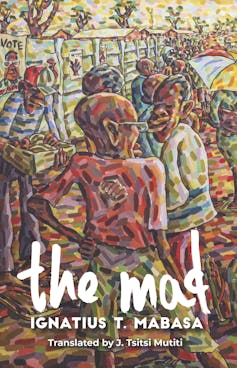
A figurative oainting of African men talking on the street.


When it comes to African literature, translation has mostly meant translating work from European languages into African ones. Translation from African languages into English has been long overdue.

Now it appears that a shift in the movement of stories across languages is underway. Works first written and published in African languages are increasingly being translated into English for a broader readership.

As a scholar of African literature and publishing, I am optimistic about the launch of a new book series called African Language Literatures in Translation by the University of Georgia Press. The series is edited by US-based literary scholars Christopher Ouma and Alexander Fyfe.

The Mad is one of the inaugural titles in the series. It’s a translation of Zimbabwean author Ignatius Mabasa’s much loved novel Mapenzi. The Mad is being jointly released in the UK and Zimbabwe by Carnelian Heart Publishing and amaBooks.

Mapenzi is written in Shona, but the ambitious series aims to translate a range of significant African works from other languages too, including Kiswahili and Sesotho.

This helps shift the terrain of African literature. It allows English readers to encounter African novels as they were first imagined, in the rhythms, idioms, and sensibilities of African languages. It helps counter the erasure of African languages in world literature.

Mapenzi

When Mabasa’s debut novel Mapenzi appeared in 1999, it was recognised as a landmark text in Shona literature. Shona is a Bantu language widely spoken in Zimbabwe.

Mapenzi tells the story of a disillusioned young war veteran who becomes the uncensored witness to the false promises of independence in Zimbabwe. He witnesses the collapse of social values, and the madness of a society trapped between hope and despair.

The novel’s daring style and unruly humour drew comparisons with Dambudzo Marechera, Zimbabwe’s literary provocateur. And with the stylistic innovations of Charles Mungoshi, the great craftsman of both Shona and English prose.Mapenzi was quick to win accolades and was adopted as a school text for a generation that came of age at the turn of the millennium. Since then, Mabasa has become a central figure in the promotion of indigenous African writing.

His commitment and investment was shown when he became the first scholar to write and submit a PhD in Shona at Rhodes University in South Africa. Mabasa is also a translator in his own right. He most recently helped translate Zimbabwean novelist Tsitsi Dangarembga’s Nervous Conditions into Shona.

His career has been a reminder that languages such as Shona are not minor, but vibrant mediums for complex thought and artistic innovation.

Now, more than two decades later, Mapenzi can be read in English for the first time.

The Mad

The Mad has been translated by J. Tsitsi Mutiti. Unfortunately, there is no information about the translating author in the book. Even a cursory internet search yields little to nothing.

In works like this, that cross language, culture and geography, the translator plays a crucial role, not just in the text’s language but in shaping its tone, context and accessibility. A translator’s note would have provided insight into the challenges and decisions involved in the process. Instead, the translator and the process of translation remain invisible.


This lack of acknowledgement overlooks the labour and interpretive skill required to bring such a work to life in another language. The hope is that future editions will correct this omission. Leaving it unaddressed risks diminishing the very cross-cultural understanding that translation seeks to foster.

Translating Mapenzi is no small task: Mabasa’s prose brims with poetry, satire and linguistic play. Its cadences are deeply rooted in Shona idiom. The novel’s innovative structure includes chapters titled after characters, abstract concepts, places and song lyrics, pushing the boundaries of form and style in Shona literature.

In her translation Mutiti meets this challenge with remarkable skill, sustaining Mabasa’s lyricism and rhythm without smoothing out its texture. The result is a translation that feels alive, attentive both to the sense and the spirit of the original.

That said, there are occasional lapses into flatly literal translation, particularly in the dialogue. These moments feel more like direct transpositions from the Shona than deliberate stylistic choices in English. As a result, the translation at times struggles to assert a voice of its own.

Translation as decolonisation

Nonetheless, the publication of The Mad highlights how translation in African literature is not just a tool for accessibility. It is also a critical, interpretive and archival practice that reshapes the canon, its circulations and readerships. The Mad contributes to African literature’s global visibility and intellectual vitality.

For decades, the global image of African literature has been shaped largely by writers who chose or were compelled to write in colonial languages.

Kenyan author and academic NgÅ©gÄ© wa Thiong’o, who recently passed away, has been one of the most famous advocates for writing in African languages. He insisted that the struggle for decolonisation could not be separated from the struggle over language. Yet, as he himself often admitted, African-language writing has remained marginal in the circuits of publishing and translation.


A series like this aims to help change that. Other forthcoming titles include Zanzibari writer Ali Hilal Ali’s Mmeza Fupa (translated as The Swallowers of Bones by Meg Arenbeg), Kenyan novelist and sociologist Katama Mkangi’s Walenisi (translated as They Are Us by Richard Prins), Lesotho writer and teacher NtÅ¡eliseng ’Masechele Khaketla’s Left Behind (translated by Makafane TÅ¡epang Ntlamelle), and Halfani Sudy’s Kirusi Kipya (translated as New Virus by Jay Boss Rubin).

In this context, The Mad is more than an English version of a Shona classic. It is part of an invitation to rethink what African literature is and where it comes from. Mabasa’s novel, in Mutiti’s supple translation, demonstrates how much vitality lies in the vernacular imagination, and how translation can open doors without erasing the local textures of language.

With The Mad, a new and vital moment begins.


Tinashe Mushakavanhu

Assistant Professor

Harvard University