Sunday, November 23, 2025
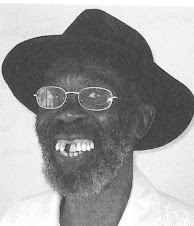
John Eppel at the Bulawayo Book Club
Saturday, August 30, 2025
A review by Raisedon Baya of Tendai Huchu's The Maestro, The Magistrate & The Mathematician
There is literature that comes to you, sits with you, keeps you company, helps you sleep and then goes away and never bothers you or visits you again. Then there is literature that comes -usually without much fanfare or much ado - grabs you by the collar, sits you down, commands you to listen, asks you important questions, demands you to think, takes away your sleep and when it leaves, leaves you lost, unsure of what just happened or what you just experienced. Literature that touches you in places many others will not reach. This literature, rich and unflattering, is rare and special.
When I picked Tendai Huchu's book, The Maestro, The Magistrate & The Mathematician , I honestly didn't know what to expect. The title, somehow, looked heavy, brainy - complex. I honestly was in no mood for a heavy and complex read. Little did I know I was in for some ride. Several pages into the book Tendai Huchu had me sitting on the edge of the cliff, holding my knees, not knowing whether he wanted me to jump off or hang on.Huchu swung me from one storyline to another, one character's life to another - from the Magistrate to the Mathematician, to the Maestro and back. He took me around Edinburgh, Scotland , showed me the streets, the nightclubs, the beach and homes where most immigrants spend their time doing care work - 'wiping bums' as many like to say. He painted characters that were so vivid, so realistic, so relatable - characters that had come overseas in search of dreams, characters still dreaming and those who had been uprooted and looked lost. He painted, and painted and painted.
Huchu's writing, the weaving of the stories, the details, the evidence of deep research, the humour - it sometimes just jumped on you from nowhere - and the richness of language made me want to pause after every chapter and call all my literature loving friends for a feast.
This book, with it's strange title, was a lesson in reading, in literature. What it means, what it must mean for different people. What it can do to our lives. What is good literature and what is not? The books we read and the books we don't read. Who decides or influences our reading list. A subtle highlight of the complex relationship between readers, authors, and the literary world.
It was also a lesson in Zimbabwean music - that it has meaning and lessons and can be a soothing and powerful companion when one is uprooted from home and placed in some strange foreign land with its strange cultures and expectations.
Another lesson was in diaspora/immigrant life. Tendai Huchu paints a vivid canvas about this kind of life. He gives it to you as it is. Like a doctor who gives you pills knowing they won't be sweet to the tongue or nurse that gives a child an injection knowing its sting will shock the child but also very aware of the necessity of the shock. Unflinching, yet necessary.
Huchu explores themes such as immigration, identity, culture, politics, especially the complex relationship between Zimbabwe's official opposition and the ruling party. After putting the book down you'll ask yourself one question "is it a political novel or not?" And your answer to that will be interesting to other readers of the book.
Thursday, August 28, 2025
The Maestro, The Magistrate and The Mathematician by Tendai Huchu is August's book at the Bulawayo Book Club
Tendai Huchu's novel The Maestro, The Magistrate and The Mathematician is to be discussed this weekend (30 August) at the Bulawayo Book Club.
Three very different men struggle with thoughts of belonging, loss, identity and love as they attempt to find a place for themselves in Britain. The Magistrate tries to create new memories and roots, fusing a wandering exploration of Edinburgh with music. The Maestro, a depressed, quixotic character, sinks out of the real world into the fantastic world of literature. The Mathematician, full of youth, follows a carefree, hedonistic lifestyle, until their three universes collide.
Tuesday, July 15, 2025
Potholes in 'Whatever Happened to Rick Astley?'
Raisedon Baya discusses the story 'Potholes' from Bryony Rheam's short story collection Whatever Happened to Rick Astley?, which was being discussed by the Bulawayo Book Club.
---------------------------------------------------
"Potholes"
I'm a sucker for political satire. I sometimes see it where it's not there. So please forgive me for seeing Potholes as some kind of political piece. Subtle but there. I don't know if there is anything called "covert satire" but in this piece I see a writer taking a short dig at politicians and the government.
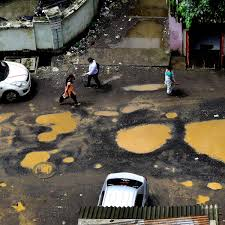
The futility of one man's, Gibson Sibanda's, attempt to solve a national problem is sad if not laughable. Everyday we laugh at our problems and at ourselves. It's nothing new. The potholes are not only in Napier road but everywhere, as we later find out in the story. "He went first to Ilanda and then to Famona and finally settled on Pauling Road in Suburbs."
The dig is more pronounced when suddenly the city council wakes up to quickly fix the road because the the Vice President has bought a house in the neighbourhood. They quickly fixed the road so that the VP of the country would drive safely, and unbothered, to his new house. Here is a government of the people that has been captured and now panders to the whim of politicians. Politicians' lives have become more important than the ordinary people that the government claims to serve. Somehow priorities have been turned upside down. The servant has become the master.
Potholes are a sign of roads gone bad. Unattended to. Unrepaired. And a danger to motorists. Potholes could also be a metaphor of something horrible gone wrong with our politics. Something that needs fixing immediately. And not by one person.
Whether or not the author intended the piece to be a political satire or not, the story effectively highlights the absurdity and injustice of a system that prioritises the needs of the powerful over those of the general population.
The story is also a typical example of "there is complexity in simplicity." It looks and reads so simple but on a closer look its depth is outstanding. Potholes is just but of the 16 stories in Bryony Rheam's outstanding collection aptly titled Whatever Happened to Rick Astley?
Sunday, May 25, 2025
The Bulawayo Book Club discuss Bryony Rheam's 'Whatever Happened to Rick Astley?'
Let me begin by saying the anthology offers thought-provoking insights into the human condition, societal issues, and the complexities of everyday life. Today I shall focus on "Potholes" and "The Piano Tuner". These two stories shed light on various themes like government neglect and the politicisation of public services, racial tensions and biases and the struggles of ordinary people in extraordinary circumstances.
Rheam's writing style, which hints at deeper meanings and leaves room for interpretation, adds depth to the narratives.
"Potholes" is about how Gibson Sibanda starts fixing potholes in a road in Hillside suburbs and ends up moving to other roads. It is a simple story. Perhaps symbolic of how Zimbabwean roads have become. Anywhere, you know something is very wrong in a country when an individual who doesn't even own a car starts mending roads. The potholes are so many and the roads look neglected. Both local and national governments have abandoned their responsibility of mending roads. What is funny is the superficial mending of this one road because the Vice President of the country has bought a house in the suburbs. And they have to pretend to mend it. More hilarious is the fact they mend the road for an intended visit to the new house by the Vice President. A visit that never happens. A subtle dig by the author at our politicians and how simple decisions like mending a road have become political.
Then there is "The Piano Tuner". This one is set in Zambia but it might as well be a Zimbabwean story. A black piano tuner, Leonard Mwale, who apprenticed under a white piano tuner, takes over the business and continues to use the white man's name as the business name. (Doesn't this sound familiar?) On this particular day he is hired by an Indian client. The piano tuner is good. Very professional. He knows his work. Unfortunately, the Indian client discovers during lunch that he has engaged a black man and things change and racism rears its ugly head. It becomes clear that the Indian client would not have engaged the service of the piano tuner if he had known he was black. The invitation to lunch was extended to Thomas Jenkins the name, not the piano tuner. There are racial overtones in the story. So much that when the Indian leaves the payment for the service the money is short. He can't bring himself to pay a black man properly for proper service. The writer does not overwrite, she makes hints and leaves it to the reader to fill in the gaps.
With her current body of work I think Bryony Rheam now deserves to sit on the high table with other Zimbabwean literary giants. When we mention the likes of TsÃtsi Dangarembgwa, NoViolet Bulawayo, Sue Nyathi, Siphiwe Gloria Ndlovu, we should not forget to include Bryony Rheam on that list. She has truly earned her spot.
Whatever Happened to Rick Astley? is published in Zimbabwe by amaBooks and in the United Kingdom by Parthian Books.