Saturday, November 28, 2009

This September Sun launched in Bulawayo


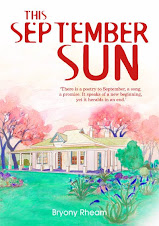
A highlight of the artistic calendar in Bulawayo was the recent launch of Bryony Rheam’s epic novel, This September Sun, at the Bulawayo Club, with guest speaker Owen Sheers, the award-winning writer and poet from Wales. The Club hosted the event as it features in This September Sun. The work focuses on the lives of the two main female characters, the romantic grandmother Evelyn, who arrived in the then Rhodesia in 1946, and her granddaughter Ellie. The novel can be read on many levels, as a mystery, as Ellie, through her grandmother’s diaries and letters, is able to untangle the secrets of Evelyn’s life. Another level is Evelyn’s independence that corresponds with that of the independence of Zimbabwe. The first chapter of the novel, that Bryony Rheam read at the launch, tells of Ellie’s sixth birthday – the day that Zimbabwe gained its independence and the beginning of her grandmother’s escape from a marriage in which she has felt trapped. As the novel unfolds Ellie learns more about her own identity and is able to come to terms with the past and in the process also gain a form of independence.

Professor Brian Jones, from the publishers ’amaBooks, introduced the book. He quoted a number of people who read the novel prior to the launch. The performance poet, Albert Nyathi, writing from the United Kingdom, described This September Sun as, “a wonderful book. Bryony’s book is poetry. I read it on the plane, underground trains and buses. I finished it today on the bus when I was coming from Birmingham to Coventry and I said to myself, here is another Doris Lessing.”

In his opening address Brian Jones noted how the book had struck a particular chord with those growing up in 80s Bulawayo, the period that coincides with the narrator’s youth, one reader commenting: “I grew up in Bulawayo at the same time as Ellie, but experienced the 1980s in a different way – from a black person’s point of view – but, while the book is fiction, the Zimbabwe described is not” and from another reader: “It’s so beautifully written and part of the book describes the period in which I grew up in Zimbabwe so there are so many little things she mentions that capture that era so perfectly. I couldn’t put it down and relished every single page”.

Bryony told the attentive audience of around 150 people that it had taken her over 9 years to complete her novel of nearly 400 pages and that her main aim in writing the book was to write a good story.

In talking of the book, Owen Sheers commented that she had achieved her aim and that This September Sun is a compelling read. He also noted the author’s craft in writing a many layered novel, one of the layers being family relationships in a changing world.

Brian Jones concluded the launch by thanking those organisations that had recently supported ’amaBooks, including the Zimbabwe Culture Fund Trust, HIVOS, Beit Trust and Alliance Francaise de Bulawayo.

Sales at the launch were brisk, and this pace has continued with shops re-ordering as they have sold out. In commenting later, Brian Jones was gratified that a second print run was already underway. Books are available in shops throughout Zimbabwe, anyone who has difficulty can obtain information as to where to find the book from amabooksbyo@gmail.com.

The launch was followed by a ‘Dinner with Poetry’ at the Club, attended by around 70 people. Poetry readings between the courses were by Owen Sheers and John Eppel, the award-winning Bulawayo poet.

The following day, a champagne breakfast book signing by Bryony, with Owen Sheers present, took place at the new Indaba Book Café in 9th Avenue.

Wednesday, November 18, 2009

Owen Sheers at the Book Cafe in Harare


On Monday 23 November, Owen Sheers will be at the Book Cafe in Harare at 5.30pm to talk about myths and how they appear in modern writing. He will be joined in the discussion by Joseph Tirivangana, expert in Zimbabwean myths and legends. Owen will also read his poetry together with several Zimbabwean poets, including David Mungoshi, Ethel Kabwato and Batsirai Chigama. Again, entrance is free and all are welcome.

Meet Owen Sheers in Bulawayo


The British Council in Bulawayo are organising a Management Express meeting for Friday 20 November at 5.30pm at the Bulawayo Rainbow, where Owen Sheers will talk about his own work and links with Zimbabwe, and read from his books. Owen is a poet, novelist, playwright, actor and BBC TV presenter from Wales. He is best known in Zimbabwe for his semi-fictionalised account The Dust Diaries, recounting the life of his great-great uncle, Arthur Shearly Cripps, maverick missionary to Southern Rhodesia. The event will also recognise the achievements of three Bulawayo graduates of the British Council Crossing Borders creative writing project, Bryony Rheam, Christopher Mlalazi and Raisedon Baya, who have all recently had books published. All are welcome.


Friday, November 6, 2009

Launch Invite for This September Sun


A night to write home about

amaBooks and Alliance Francaise de Bulawayo invite you to

a Book Launch and a Dinner with Poetry

THURSDAY 19th NOVEMBER

5.30pm Launch of the novel This September Sun, by Bryony Rheam
Guest Speaker: Owen Sheers
Free Admission, All Welcome

followed by, for those who wish, at
7.00pm, Dinner with Poetry
With readings by Owen Sheers from Wales and John Eppel from Zimbabwe

A
table d’hôte menu will be available, with choices of starter, main course and dessert.

Please book early for the dinner as numbers are limited, telephone Bulawayo Club reservations on (09) 64868. Payment for dinner to be made directly to the Club at the dinner.

This September Sun This September Sun, the first novel by Bulawayo writer Bryony Rheam, is a chronicle of the lives of two women, the romantic Evelyn and her granddaughter Ellie, from the time Evelyn arrives in the country at the end of the Second World War to the present day.
Growing up in post-Independence Zimbabwe, Ellie yearns for a life beyond the confines of small town Bulawayo, a wish that eventually comes true when she moves to the United Kingdom. However, life there is not all she dreamed it to be, but it is the murder of her grandmother that eventually brings her back home and forces her to face some hard home truths through the unravelling of long-concealed family secrets.
The book has been described as ‘a wonderful first novel’ (Caroline Gilfillan), ‘a beautifully executed story’ (Christopher Mlalazi) and an ‘absorbing debut novel’ (John Eppel).

Bryony Rheam was born in Kadoma in 1974 and lived in Bulawayo from the age of eight until she left school. She studied in the United Kingdom and then taught in Singapore before returning to teach in Zimbabwe in 2001. Bryony has had short stories published in several anthologies and she won the Intwasa Arts Festival koBulawayo Short Story Competition in 2006.


Owen Sheers is a poet, author, playwright, actor and BBC TV presenter from Wales. Owen is best known in Zimbabwe for the semi-fictionalised account of the life of his great-great uncle, Arthur Shearly Cripps, maverick missionary to Southern Rhodesia,The Dust Diaries. He is also a renowned award-winning poet, and his first novel Resistance has been translated into ten languages. Recently, he was the presenter of the BBC series A Poet’s Guide to Britain.


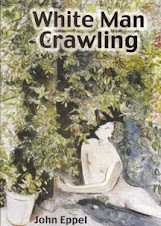
John Eppel is Bulawayo’s best known writer and poet, with four collections of poetry, six novels and two collections of short stories and poems to his name. John was awarded the Ingrid Jonker Prize for his poetry collection Spoils of War and the M-Net Prize for his novel D G G Berry’s The Great North Road.


Monday, November 2, 2009

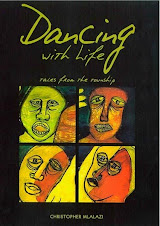
Dancing with Life gets Noma Award Honourable Mention


Dancing with Life: Tales from the Township has won an Honourable Mention in the 2009 Noma Awards. The Noma Award has become the most significant book prize in Africa since its inception in 1980, with entries in the categories of scholarly or academic, books for children and literature and creative writing. Christopher Mlalazi’s collection of short stories was one of just four books from across the continent recognised this year, chosen from submissions from 43 publishers in 12 different African countries. The Noma Award went to Nigerian writer Sefi Atta’s for her short story collection Lawless and Other Stories, which won the US$10,000 prize. Tunisian writer Sonia Chamkhi’s Leila ou la femme de l’aube, and Love in the Time of Treason, by South Africa’s Zubeida Jaffer were also singled out for Honourable Mention.

The Noma Award Jury is chaired by Walter Bgoya from Tanzania, one of Africa’s most distinguished publishers, with wide knowledge of both African and international publishing. The other members of the Jury in 2009 were: Professor Simon Gikandi, Robert Schirmer Professor of English at Princeton University; Professor Peter Katjavivi, Chairman of the National Planning Commission in the Government of Namibia, and former Vice-Chancellor of the University of Namibia; and Mary Jay, Secretary of the Jury. The Award is sponsored by Kodansha Ltd, Japan.

The judges said of Christopher Mlalazi’s book: ‘Mlalazi’s collection of short stories is an important addition to the new writing from Zimbabwe concentrating on the social disintegration of the country. The stories stand out by being set in Bulawayo, drawing on the distinctive identity of a provincial city, its Ndebele culture, and its marginal relation to the centre. The success of the stories lies in the experiences of ordinary people coping with violence, anger and angst, rather than any self-conscious sense of form.’

Christopher Mlalazi is a graduate of the British Council Crossing Borders Project, a mentoring scheme for writers. He feels that his skills as a writer were honed by his participation in this scheme. As well as being recognised by the Noma panel, Chris won a 2009 National Arts Merit Award in Zimbabwe for Dancing with Life for Outstanding First Creative Book.
Brian Jones, a director of the publishers ’amaBooks, said that he was ‘delighted for Christopher. It is a major achievement for Dancing with Life to be considered by the Noma panel as one of the best four books published in Africa last year, particularly as this is his first book. We’re proud that we were the first to publish Christopher with a short story in Short Writings from Bulawayo, and we have included his stories in each of the subsequent books in the Short Writings series. To me, Christopher’s strength as a writer lies in his keen powers of observation and in his writing remaining rooted in his personal experiences of life in the townships.'

Sunday, October 25, 2009

Owen Sheers to launch Bryony Rheam's This September Sun


Welsh writer and BBC TV presenter Owen Sheers has agreed to be guest speaker at the launch of Bryony Rheam’s novel This September Sun. The launch is planned for 19 November at the Bulawayo Club, which is mentioned in the novel.

Owen was born in Fiji, but was brought up and educated in Abergavenny in South Wales and at New College, Oxford. He has written two books of poetry, The Blue Book, which won the Forward Best First Collection prize and Skirrid Hill, which won a Somerset Maugham Award. His first novel, Resistance, published by Faber in 2008, was short-listed for the Writers Guild Best Book Award and has so far been translated into nine languages. Big Rich Films have optioned Resistance for Owen and Amit Gupta to adapt and Amit to direct. Owen’s most recent publication is a novella, White Ravens, a contemporary response to the Mabinogion myth.

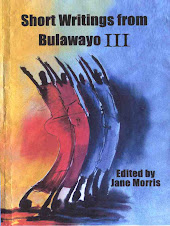
Owen is best known in Zimbabwe for the semi-fictionalised account of the life of his great-great uncle, Arthur Shearly Cripps, maverick missionary to Southern Rhodesia. The incredible story of Cripps' African legacy, Owen’s travels in his footsteps and the volatile history of a nation are all told in a series of layered, interwoven narratives that distort the boundaries between biography and fiction. The Dust Diaries was short-listed for the Royal Society of Literature’s Ondaatje Prize and won the Welsh Book of the Year award. Owen has had close links with Bulawayo – he has a poem published in the ’amaBooks collection Short Writings from Bulawayo III, a short story in Long Time Coming: Short Writings from Zimbabwe and five poems in Intwasa Poetry. Owen also participated in the Intwasa Arts Festival koBulawayo 2006, where he first encountered Bryony Rheam’s writing.

Owen recently presented the BBC television series A Poet’s Guide to Britain. He also wrote the introduction to the accompanying anthology.

Friday, October 16, 2009

Review of John Eppel's Hatchings, from www.complete-review.com


Hatchings is set in a Zimbabwe that many whites have fled but in which there is still a large group that either has taken advantage of the situation or is there for (supposedly) ideological reason. An equal-opportunity satirist, Eppel mercilessly skewers almost everyone, black and white, in an often outrageous work that also has a surprisingly gentle edge to it.
It is around New Years, 1991 going into 1992, and the story begins with the Fawkes family on a camping trip. The daughter, Elizabeth, is going on sixteen and torn between her lust for bad boy Jet Bunion and her new-found religion. Though her parents aren't devout, Elizabeth has found herself born-again -- and disapproving of the ways of many of the girls at school.
Underage sex is rampant at Bulawayo's various private (public) schools, with various teachers and headmasters taking advantage of their positions to get sexual favours from the often extremely young girls. This unfortunately results in a lot of unwanted pregnancies, and one of the novel's very sharp running gags is that disposing of these (and many other) unwanted infants has become a big business -- so big that they're running out of places to stow them away, leading to several cases of the discovery of the dead babes, with a variety of consequences. Early on, when a dumped baby is discovered, all the girls at one school are lined up by the police and:

They then systematically felt every girl's breast in order to determine which, if any, were in milk. The fourteenth girl in the queue was discovered to be conspicuously pregnant so then the police began to feel tummies (and even further down with the prettier girls) as well as breasts. As a result of this exercise, no fewer than seven girls, one in the first form, three in the second form, two in the third form, and one in the sixth form were instantly expelled from the school. All these girls, the police investigation showed, were either pregnant or had recently given birth.
Elizabeth wants to be virtuous, but Jet is oh so tempting ..... Still, her parents -- despite their concerns about her religiosity -- are supportive and this is a functioning family. When Dad asks Elizabeth to hatch a prized Asil Khan egg he has obtained she agrees to carry it around in her bra for the necessary three weeks -- apparently the best environment for successfully bringing it to hatch (they've done this before). This obvious infant substitute is in good hands with dutiful Elizabeth.
Many of the other kids aren't involved in nearly as harmless fun -- but the fault lies largely with the adults, who range from corrupt to what amounts to criminally insane (usually with a strong ideological foundation). One reason
Hatchings works is because there are also some genuinely decent (and/or clueless) adults, including Elizabeth's parents, but much of the fun is with the over-the-top characters who engage in some of the worst stuff. Beginning with Ingeborg Ficker, "Bulawayo's premier artist", it's a very comic cast of characters. Ficker, for example, is "one of the few, very few native born white Zimbabweans who had not been corrupted by colonialism" -- at least as interpreted by the local ideologues; in fact, of course, her brand of revolutionary liberalism (and her art) is as off the wall as anything.
Typical for Eppel's humour (at least of the less sexually explicit sort -- of which there is a great deal) are observations such as:
It was fashionable at parties where anybody who was about to become anybody in Bulawayo had been invited, to ask a sprinkling of non-whites to attend. This created an exquisite feeling in the hosts and hostesses of living on the edge of peril. It is a shocking yet exciting thing for your ex-Rhodesian to entertain in his home -- on his settee, mind you, eating off his plates, drinking not out of an old jam tin under a tree in the back yard, but out of proper glasses, using your toilet, for Christ's sake ! -- a sprinkling of non-Europeans.
He's also particularly good at skewering those who have benefitted from the great white flight after independence, taking advantage of what was left behind -- property, jobs, opportunities galore -- and cashing in on it. So, for example, the "desirable Cocks" (yes, Eppel is a bit too obvious with a few too many of the names):
They were very proud of their home in the Eastern Suburbs, which they'd bought in the early eighties for seven thousand dollars and which was now insured for half a million dollars. True, they'd upgraded the property consistently over the years. They'd taken out all the indigenous trees and put in a swimming pool and a sauna. They'd cut down the hibiscus hedge and put up a seven foot instarect wall topped with five layers of barbed wire. They had paved nearly the entire one and a half acres with 'state of the art' bricks. They had fitted a second hand plastic seat to the lavatory in the servant's quarters.
Eppel moves the novel across quite a few characters and a variety of conditions; the Fawkes' place is one of the few relative idylls, while elsewhere corruption -- sexual and moral -- dominates. With an easy style and making absolutely everything fair game -- some of the conduct is, even when recognisable as satire, absolutely shocking -- Eppel has writen a very entertaining and sharp book. Remarkably, he also offers what can only be described as a sweet ending, a perhaps too abrupt backing off of all the harsh (but admittedly very amusing) glare from before (and, yes, it does involve that hatching of the chick).
This is very good social satire, tackling some serious subjects -- the theme of the water shortage is well-integrated into the story, for example, and though he plays it for cruel laughs he does right by the sexual abuse as well. Eppel spreads his story a bit thin -- it is very crowded and storyline-packed for such a short novel -- and occasionally feels a bit rough and rushed, but on the whole is an impressive achievement. Despite its flaws, it is well worthwhile.