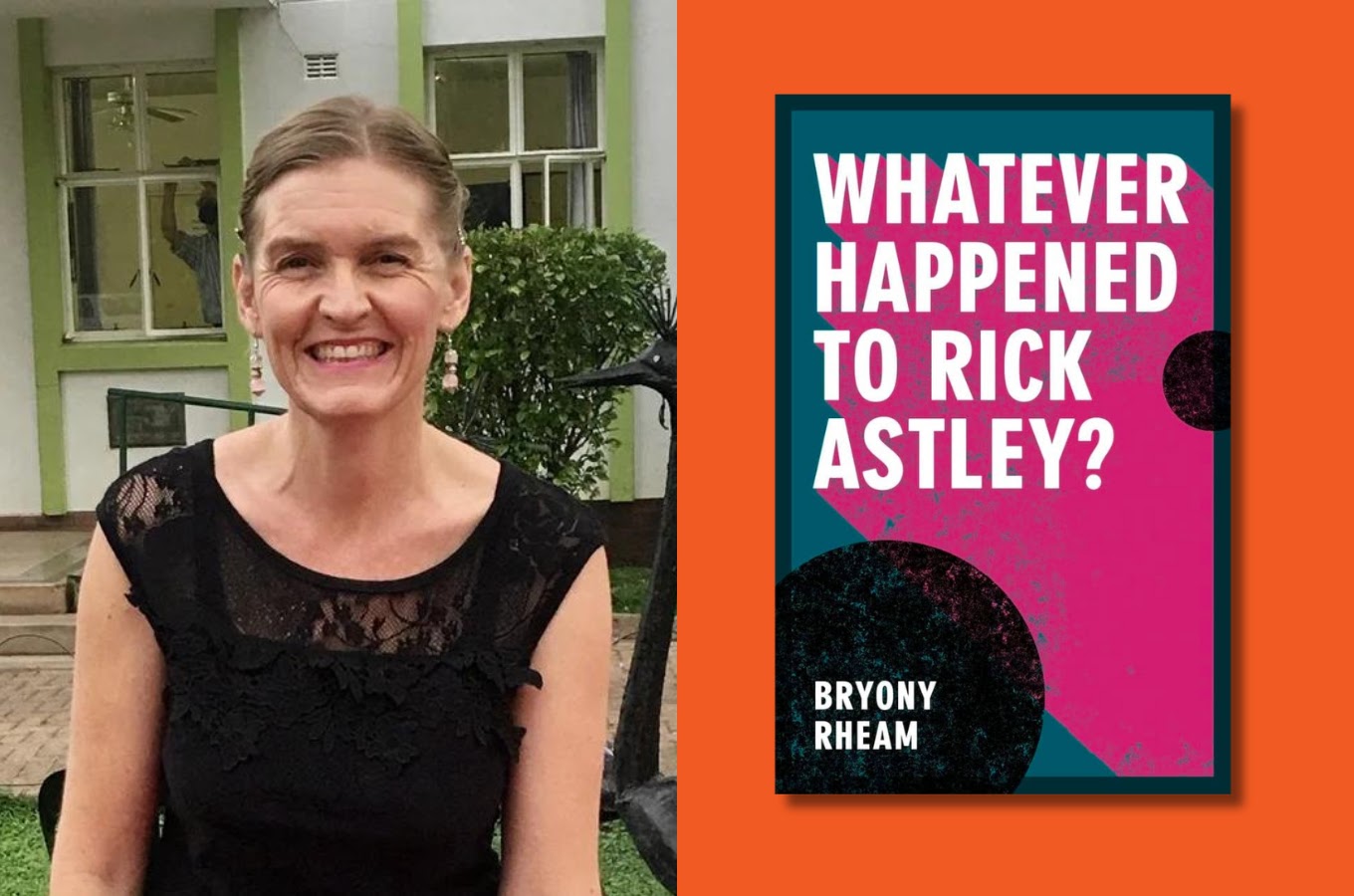
Bryony Rheam's short story collection Whatever Happened to Rick Astley? reviewed by Nhlanhla Dube in Brittle Paper (https://brittlepaper.com/2024/04/an-authentic-zimbabwean-voice-a-review-of-whatever-happened-to-rick-astley-by-bryony-rheam).
Bryony Rheam’s latest collection of short stories is a striking book. Whatever Happened to Rick Astley? shows just how prolific Rheam has become. This is her third book after This September Sun and All Come to Dust, and is a valiant attempt at understanding Zimbabwe.
In her fiction, Rheam is unrepentant about being Zimbabwean. The figure of the white Zimbabwean writer has caused significant discomfort in Zimbabwean literary circles. Zimbabwe’s strained race relations have meant that contributions to the canon by white writers have often faced extra scrutiny. Scrutiny in order to ascertain relevance, aesthetic fit, and maybe most worryingly, patriotic allegiance. Through her books, and more specifically this latest one, Rheam proves that she is an authentic Zimbabwean voice.
In Whatever Happened to Rick Astley?, Bryony Rheam demonstrates an acute awareness of the Zimbabwean landscape and its people. The first story in the collection, “Potholes”, is a beautiful ode to suburban Bulawayo. Gibson Sibanda, the protagonist in that story, fills the potholes that are found along most of suburbia’s roads. In performing this thankless duty, Gibson represents the humdrum nature of life in Zimbabwe. Daily toil without material comfort, Gibson’s duties are a Sisyphean act, but they are nonetheless performed with feverish zeal. Passing motorists don’t acknowledge his hard work – “Hardly anyone stopped to say thank you or toss him a couple of coins”. The story is deeply political. It comments on the political climate because the road Gibson fixes is eventually revealed to be one which leads to the Vice President’s house. City Council funds are eventually directed to fixing the road properly. Rheam generally shies away from overt political commentary in her work. However, this story shows that literary political commentary can be done in subtle ways. Ways which do not provoke the establishment, but which are still perceptive and nimble.
Rheam is often at her strongest when she writes about Zimbabwe’s diaspora. Migration has greatly shaped, to a considerable degree, the Zimbabwean narrative of the past two decades. In “Last Drink At The Bar”, Zimbabwe’s white diaspora is brought into focus. William Floyd moves from Bulawayo to Wales in order to escape what has become the tragic image of Zimbabwe’s elderly whites. White aged Zimbabweans often meet their demise at old people’s homes, abandoned by their children who are overseas and with no family to care for them. William Floyd makes a life for himself in the UK. Returning home often is a way to ameliorate the fact that despite material comforts, the United Kingdom is a bleak, cold and desolate country. “He tried pub after pub after pub after pub, but never did he find anywhere quite like The Bar in Bullies”. There is a spatiotemporal shift that occurs whilst William is abroad. The home he returns to is not the home he left. More so, the people he left behind have changed. William no longer fits in. This is not the first time Rheam has explored this theme. Her novel This September Sun charts this same problem. Once a person leaves home, that home is lost forever.
Rheam has a talent for observing small situations. Seemingly unimportant interactions between characters are focused on, to reveal that there is much more going on beneath the surface. Rheam thus appears to be a writer who follows the molds left by Russian writer Leo Tolstoy. In this collection, the focus is not on fast action or big things, but rather minute detail. The titular short story “Whatever Happened to Rick Astley?” demonstrates this abundantly. In that story, a mother reflects on the passage of time and her grown-up child: “It seemed like just the other day that she had held him as a baby; just the other day that she had lain awake at night, rubbing her swollen belly, contemplating the years that lay before them both”. The central theme of the story is that time moves forward and it waits for no one. Rheam’s central point is that there is a line of connection between generations. Life repeats itself. The young become old, and youth is fleeting. In the story, Rick Astley’s music signifies the passage of time. A musician once at the center of popular culture has now faded into obscurity.
These stories from Rheam are decent for the most part. However, Rheam struggles with consistency in quality. Throughout the collection, there are some stories which are notably underwhelming. “The Colonel Comes By” is one such story. This is a story about family bonds and a tenuous father-and-daughter relationship. One is not sure whether it’s meant to be a children’s narrative, a ghost story, or an exploration of quack new age mysticism. Whatever it is meant to be, Rheam fails spectacularly in demonstrating her point to the reader.
Another deficient story is “The Piano Tuner”. It takes place in Ndola, Zambia. This is an unusual setting far from Rheam’s usual Bulawayo. Leonard Mwale is the piano tuner hired by an Asian couple to do some work. The story seems to hint at racial tension and bigotry but it never quite makes this exposition. Rheam over-deploys her subtlety. The result is that the story’s thematic exploration is unfulfilled. The reader is left with innuendos and hints that are never explained. I pity the undergraduates who will be forced to analyze this story in some English 101 introductory class at university.
Another exception, albeit a minor one, I take with this collection is the inclusion of “The Queue”. This story was earlier published in the “Short Writings From Bulawayo” anthology. Including it in this latest collection is unfair and the publisher should have done better. There is no value for money for the book buyer if they are paying just to read stories they have come across before. To be fair, Rheam is not the only writer to do this. However, seeing as this is her first collection, it would have been wise to use the opportunity to publish only new stories readers have not come across before.
Whatever Happened to Rick Astley? is a welcome book. Rheam’s writing career is progressing. With many publishers closing shop in the country, we should welcome any new books that aim to qualitatively add to the canon. Zimbabwean literature benefits from voices such as Rheam’s. However, Rheam is now becoming an established writer and the critical acclaim of her first trailblazing novel This September Sun has long worn off. This collection was a chance for her to show off her ambidexterity when she writes between the novel and the short story form. Although there are some glimpses of excellence, I’m not convinced that she has demonstrated her literary excellence through these short stories.
Nhlanhla Dube: Contributor
Nhlanhla Dube is a native of Harare,Zimbabwe. He holds a PhD in English Studies from Stellenbosch University. He is currently a Postdoctoral Research Fellow in English Literary Studies at the University of Cape Town. His research interests are Geocriticism, Spatiality, Literary Bulawayo and John Eppel. He has published peer reviewed papers on Law and Literature and Literary Pornography.