Friday, February 22, 2013

Freedom Poetry Competition


Poetry Bulawayo, in partnership with amaBooks Publishers,  is running a 
Poetry Writing Competition under the theme FREEDOM. 


Poetry Competition Rules


1. Deadline for submission of poems is midday of Wednesday 
13th of March 2013.
2. Each poet can submit a maximum of up to three poems.
3. Poems should not exceed 30 lines.
4. All poems should be in the English language although a few lines of 
vernacular are permissible; translations should be provided if a few lines 
of vernacular is used.
5. There is no age or geographical restriction for the competition.
6. Prizes that are not collected within 30 days of announcing the winners 
will be forfeited 
7. Poems will be judged according to originality, creative interpretation of 
theme and artistic quality.
8. Poems should be typed with each poem on a separate page. There 
should be a cover page with poet’s full name (even if pseudonym is used), 
contact details (email, phone/cell number, physical/postal address).
9. Poems should be emailed as Microsoft word/pdf attachments with 
'FREEDOM poetry competition’ in the subject line to 
poetrybulawayo@gmail.com. 
Alternatively, poems can be hand delivered to Studio 9, National Gallery 
of  Zimbabwe in Bulawayo.
10. The adjudicators’ decisions are final and no correspondence will be
 entered into after the adjudication process is finalised.

Entries that fail to meet the guidelines mentioned above will be 
automatically disqualified .


Friday, February 15, 2013

Caine Prize Judges announced

The judges of this year’s Caine Prize for African Writing have been announced. The panel will be chaired by art historian and broadcaster Dr Gus Casely-Hayford. He will be joined by award-winning Nigerian-born artist, Sokari Douglas Camp; author, columnist and Lord Northcliffe Emeritus Professor at UCL, John Sutherland; Assistant Professor at Georgetown University, Professor Nathan Hensley and the winner of the Caine Prize in its inaugural year, Leila Aboulela. 
This year 96 qualifying stories have been submitted to the judges from 16 African countries. The judges will meet in early May to decide on the shortlisted stories, which will be announced shortly thereafter. The winning story will be announced at a dinner at the Bodleian Library in Oxford on Monday 8 July.

The five shortlisted stories, alongside the stories written at the Caine Prize workshops are published annually by New Internationalist (UK), Jacana Media (South Africa), Cassava Republic (Nigeria), Kwani? (Kenya), Sub-Saharan Publishers (Ghana), FEMRITE (Uganda), Bookworld Publishers (Zambia) and ‘amaBooks (Zimbabwe).
Included in the 2012 anthology is the story by last year’s Nigerian winner, Rotimi Babatunde. Chair of judges Bernardine Evaristo said at the time, “Bombay's Republic vividly describes the story of a Nigerian soldier fighting in the Burma campaign of World War Two. It is ambitious, darkly humorous and in soaring, scorching prose exposes the exploitative nature of the colonial project and the psychology of Independence.”
The 2012 anthology, African Violet, is available in Zimbabwe in Harare at the National Gallery, the Book Cafe, Blackstones and Avondale Bookshop and in Bulawayo at the National Gallery, Induna Arts, Tendele Crafts, Best Books, Innov8 Ascot and Z&N Bookshop.

from:www.thezimbabwean.co.uk


Thursday, February 14, 2013

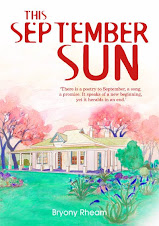
Spanish Book Club discussion of 'This September Sun'


Beaven Tapureta reports for WIN Zimbabwe on the Spanish Book Club discussion of Bryony Rheam’s This September Sun

from http://win-zimbabwe.blogspot.com/2013/02/win-newsletter-issue-no-64.html


The discussion was led by writer Eresina Hwede


Full participation in any discussion of a work of creative writing is guaranteed by the participants' reading and understanding of the text for criticism. As this is possible where books are readily available for such purpose, it then calls for organizers of book clubs or discussions to device strategies that ensure the club members read the book before the day of the discussion.
At a discussion of the novel 'This September Sun' held on February 12 at the Spanish Embassy Book Club it was apparent that a few writers had read the novel and the rest were familiar with the novel through blurb and reviews.

However, the group discussion at the Embassy was thought-provoking as various questions were raised on story structure, characterization and themes, proving that a book is like a multi-faceted stone reflecting light in different shades. Different readers tend to have different views.
While the blurb describes the book as mainly about family secrets and history, writers at the discussion explored certain ‘overtones’ about the relationships of black and white characters in the novel.
Eresina Hwede, who led the discussion, said she was most struck by the loneliness of the characters, whom she said were but drifters, people who lack a sense of belonging and dissociate themselves from family. Each character that dies in the story, dies with regrets, she said.
On another note, she said comments made particularly about the black characters in the novel reflected no association of blacks and whites during the time the story happens.
“I wonder why few black characters that are in the novel appear briefly and they are portrayed as servants of white characters. Mr. Mpofu, who is not a servant but a lawyer, appears for a short moment towards the end of the story,” said Eresina.
Roger Stringer, a librarian and publishing consultant said as a white person, he saw the book from a completely different standpoint, arguing that the novel is not about blacks and white people's relationships but about a family. The novel is not a social story but a personal story about the relationship between a girl and her grandmother, he said.
"What strikes me in the story is the mystery, like a detective story, where one discovers what was unknown before," Roger added.
While Eresina and a few other writers maintained that although 'This September Sun' is known to be about family secrets, it exposes the political uncertainty of the historical period it covers. The burning of the Union Jack (soon after independence) which resulted in grandma sustaining a tea-pot-shaped scar which, the writers said, resembles the map of Zimbabwe, and various incidents in the story metaphorically carry political overtones.
However, Roger felt it would be unfair to pick out three pages out of a book of so many pages and give it such particular weight as the author only concentrated on family relationships.
Tinashe Mushakavanhu however saw Zimbabwean fiction in general as having little or no interaction at all between blacks and whites.
Beatrice Sithole, also present but had not read the book, said the fact that the book stirs such debate could explain why it is being studied at ‘A’ level as a literature set book in Zimbabwe. It having so many layers of meaning makes the novel worthwhile for critical study, she said.
 The discussion was also graced by renowned writer Virginia Phiri and other writers. 'This September Sun' was written by Bryony Rheam and published in 2009 by AmaBooks in Bulawayo. It won Best First Book Prize at the 2010 Zimbabwe Book Publishers Association Awards.

Thursday, February 7, 2013

The Intwasa Short Story Competition 2013


The Intwasa Short Story Competition 2013

The Intwasa Short Story Competition enters its ninth year this year, 2013. The competition, which was inaugurated in the first year of the festival, is an annual literary event seeking to promote original creative writing talent in English. In 2011 the award for the winner was named the Yvonne Vera Award, after the late Dr. Yvonne Vera, a literary genius whose works include Why Don’t We Carve Other Animals, Nehanda, Without a Name, Stone Virgins, and Butterfly Burning. The Yvonne Vera award carries a $500 cash prize.

The rules of the competition are as follows:
- There is no particular theme
- Entries must be written in English
- Entries should be previously unpublished
- Only one entry per person
- All work must be original
- Entries must be typed
- Maximum 3000 words
- The competition is open to all Zimbabwe citizens and residents
- Entries must be submitted by June 30, 2013
- Late entries will not be accepted
- Only the short-listed candidates will be personally notified

The competition has developed to become one of the leading writing competitions in Zimbabwe, continuing to encourage and promote the original Zimbabwean narrative. Last year the competition was won by Violette Kee-Tui with her story Tattered Cloth. The story explored interracial relationships and had the judges praising its use of language and imagery. Violette Kee-Tui is a former editor of the Edgars  Club Magazine.

Sipho Mpofu’s A Congenial Man and Nixon Nembaware’s The Rain God of Nyatanga Hill were among the top three stories of 2012.  Each year the standard of writing continues to improve.

Writers are invited to start submitting their stories to:

Intwasa Arts Festival koBulawayo
403 LAPF HOUSE
Jason Moyo Street
8th Avenue
Bulawayo


The 9th edition of Intwasa Arts Festival koBulawayo is set for 24 -29 September 2013. The festival will be held under the theme Cultural Diversity – The Common Heritage of Humanity. 

Wednesday, February 6, 2013

Bookshy: an African Book Lover reviews 'This September Sun'


Book Review: Bryony Rheam's "This September Sun"

... and so my love for Zimbabwean literature just keeps on growing. I absolutely enjoyed reading Bryony Rheam’s debut novel This September Sun, and would like to say a big thank you to Jane Morris from ’amaBooks for sending me a copy of this book to read. 

Set mainly in Bulawayo, Zimbabwe, This September Sun tells the story of two women - Ellie who is just trying to make sense of her life, and her grandmother, Evelyn, whom she had a really close relationship with.

Growing up in post-Independent Zimbabwe, Ellie never quite fitted in and felt stifled in her hometown and just longed to escape. In the hope that she would finally find what she was looking for, she moved to the UK for her undergraduate degree, only to find out that something was still missing. While Ellie is trying to make sense of her life, we get flashbacks to her childhood in Bulawayo, the times she spent with her grandmother, as well as glimpses into what it was like being white in pre- and post-independent Zimbabwe. Ellie’ s life was also filled with secrets - well her family, and especially her grandmother’s. It’s not until Evelyn is brutally murdered and Ellie discovers her grandmother’ s diaries and letters that she is able to piece together Evelyn’s life. It is only then Ellie is finally able to answer the many questions that were left unanswered, and in a way start making sense of her life.

In This September Sun, Bryony Rheam goes back and forth in time (between 1940s and 2000s), to expertly weave two different women’s accounts of their lives and paint possibly one of the most beautiful stories I have read in a while. Reading Evelyn’ s story and her life, I felt like I had found someone’ s diaries and letters. And I think I loved this book because it felt so real - the characters, the setting, their lives. At the end of the day we are all human beings with flaws. We laugh, we cry, we make mistakes, we do silly things, and we can all be annoying. Even more than that, I have never resonated more with a character than I did with Ellie - there were elements of her, which in a strange way mirrored me. And probably added to why the characters and the novel felt so real.

This September Sun won the Best First Book Award at the 2010 Zimbabwe International Book Fair, and I can see why. Reading novels like this is what makes me love not just African literature, but really literature in general. I can only hope that more people get the chance to read this beautiful story.

5 out of 5 stars


from: http://bookshybooks.blogspot.co.uk/2013/02/book-review-bryony-rheams-this.html

Tuesday, February 5, 2013

'This September Sun' at the Spanish Embassy book club in Harare


The Embassy of Spain


You are invited to the next edition of the
Spanish Embassy book club
on Tuesday, February 12th, at 17:30 to 19:00 hours,
at the Cultural Centre, 16 Phillips Avenue in Belgravia.
“This September Sun”, written Bryony Rheam,
will be presented by Eresina Hwede,
writer, poet, scriptwriter, playwright and editor. 
Copies of the book are available at the Embassy at the discounted price of $14 a copy.
Please RSVP: romee.fisher@maec.es or telephone (04) 250 741

Thursday, January 24, 2013

Tendai Huchu reviews This September Sun


‘On the 18th of April 1980, my grandfather burnt the British flag.’ So begins Bryony Rheam’s genre blending debut novel. Ellie, the main protagonist, is a young girl searching for identity in the self-absorbed, often neurotic postcolonial settler community in Zimbabwe. Her relationship with Evelyn, her grandmother whose cupboard has more skeletons than most, provides a back drop to a narrative that sweeps right from the Second World War through to the early 2000’s. Evelyn leaves her husband, Ellie’s grandfather, and strikes out on her own late in life, forming a new partnership with Miles, a man with his own difficult past, trying to eke a living on a small dust bowl outside of Bulawayo. Through Ellie’s observations we learn of the lives of the small closeted, white Zimbabwean society, dirty laundry is aired, nothing is spared, the illicit affairs, alcoholism, racism, misogyny, hopes, dreams and fears that linger long after the sun has set on the British Empire. Is there still a place for the white man in Africa and how to find a place on a changing continent is one of this novel’s central themes. Rheam masterfully crafts a novel that runs back and forth in time, using elements of the first person and epistolary to stitch a work that reads and feels more like a memoir than a conventional novel. This September Sun’s bold narrative successfully focuses on grand events, two wars, and the very small, minutiae of everyday life, four o’clock tea, cross generational relationships between grandmother and granddaughter in a changing world. Rheam’s Africa is not the Africa of the media - that is a continent reduced to nothing more than poverty and strife, it is a place where real people live with everyday worries and regular problems and the novel strikes an optimistic tone missing in most African Literature. 
Tendai Huchu is the author of The Hairdresser of Harare


This September Sun is available throughout Zimbabwe and in selected outlets in South Africa and Zambia. Please contact amaBooks if you have problems finding it.

It is also available in the United Kingdom through our partner Parthian Books, and as a Kindle ebook.

In North America, it can be obtained through the African Books Collective.