Wednesday, June 1, 2022

Hans M. Zell's Series of Profiles of Women in African Publishing

from: https://brittlepaper.com/2022/05/check-out-this-database-on-women-publishing-book-trade-in-africa/


Women in African Publishing & the Book Trade: A Series of Profiles
 is a listing of women working in the publishing industry across the African continent.

The list is curated by the Swiss publisher Hans M. Zell and aims “to showcase…the variety, richness and energy of women involved in book publishing and the book trade in Africa today, as well as some of the women who have made significant contributions to the African book sector in the past.”

In the first edition of the list published inThe African Book Publishing Record, 24 women were profiled. Ghana’s Deborah Ahenkorah, to Nigeria’s Bibi Bakare-Yusuf, to Rwanda’s Louise Umutoni, and South Africa’s Colleen Higgs are some of the profiles featured.

The new edition is an additional 28 names from across 8 countries. It includes established names like Kenya’s Muthoni Garland, founder of Storymoja, the Nigerian editor Enajite Efemuaye, Managing Editor of Farafina Books and co-founder of Society of Book and Magazine Editors of Nigeria (SBMEN), Uganda’s Hilda Twongyeirwe, Executive Director of FEMRITE, and Trish Mbanga, former Director, Zimbabwe International Book Fair.

The kind of information included in the listings are wide-ranging, from basics about the women and their work including positions held, company/organization’s name, contact address, website, publication etc. to social media handles and links to interviews and press coverage.

The list is a great networking tool, making it easier to connect with African women in the publishing industry. It is also a storytelling project of sorts, in the ways it shines a light on the increasing influence of African women in publishing, showing the changes taking place in an industry that has not always championed gender equality.

The scope of the second edition has been extended to include academics involved in publishing education and training, and who have written extensively, and eloquently, about many aspects of publishing and book history in Africa.

The directory does not, however, currently include women who are literary agents, or editors and publishers of journals or literary magazines.


Click on the link below to access the directory:

https://brittlepaper.com/wp-content/uploads/2022/05/Women-in-African-Publishing-the-Book-Trade-A-Series-of-Profiles-by-Hans-M.-Zell.pdf


Monday, May 30, 2022

All Come To Dust by Bryony Rheam — enter the mysterious detective


Review of All Come to Dust, a murder mystery novel set in Zimbabwe by Bryony Rheam


from BookerTalk May 24, 2022  https://bookertalk.com/all-come-to-dust-by-bryony-rheam-enter-the-mysterious-detective/


Bryony Rheam’s Zimbabwean crime fiction novel All Come To Dust offers a detective who is as much a mystery as the murder he is meant to be investigating.  Chief Inspector Edmund Dude models himself on the quick witted, perceptive detectives he’s seen in countless films and TV programmes. He is particularly fond of The Saint. Edmund is itching for a chance to prove he’s their equal and not simply the guy who sits in a back office in a shabby Bulawayo police station organising paper work and files. 

His chance comes with the death of wealthy ex-pat Marcia Pullman, a woman  who nobody likes and everyone seems to have had a reason to want out of the picture. She bullies her staff, lords it over other members of her book club and looks down her nose at other ex-pats who have fallen victim to Zimbabwe’s rampant inflation.

Edmund’s determination to discover the person responsible for Marcia’s death is frustrated at every turn. Her maid servant and people who knew her fail to pass on key pieces of information or deliberately try to mislead Edmund. Given the run around by the pathologist and denied access to the case files, Edmund comes to suspect that the dead woman’s husband is using his connections high up in the police force to get the case closed down as fast as possible.

Despite being told more than once by his senior officer to keep his nose out of the case and go back to sorting out paperwork, Edmund perseveres. He turns out to be an unorthodox detective who bumbles along with the reluctant help of a heavy-drinking odd job man as unofficial “assistant”. Together they mount night time surveillance operations and stage house break-ins to search for documents. 

Edmund is a complex man, a loner and an outsider who looks for order and structure in his life. We learn his backstory through a series of flashbacks to his childhood in 1979. They reveal a mystery in his own life: the fate of the couple who were his mother’s employers. They had taken Edmund under their wing and ensured he got a good education. But one day when he was still a boy, they just disappeared. 

There’s a further mystery about the Chief Inspector and his role in the police force that comes to light very late in the novel. It would spoil the book for other readers so I’ll just say that the mystery within a mystery within a mystery structure adds an interesting dimension to All Come to Dust. It makes it far more than just another police procedural.

It’s a carefully structured novel that touches on issues of class, race and the colonial legacy in modern day Bulawayo. More significantly it highlights the way young and poor black Zimbabwean girls become prey to unscrupulous people with empty promises of a better life in another country.

The plot takes a while to unravel and comes with more than its fair share of red herrings until it ends with an Agatha Christie style denouement. It was a little too long for my tastes but I did enjoy the novel’s insights into life in Zimbabwe.

All Come to Dust will definitely appeal to readers who enjoy character-driven crime fiction with plenty of twists and a memorable and unusual detective figure.


Footnotes

Bryony Rheam was born in Zimbabwe and currently lives with her family in Bulawayo. Her first novel This September Sun was named best first book in the Zimbabwe Book Publishers’ Association Awards in 2010. All Come To Dust, her second novel. was chosen as one of ten top African thrillers in Publishers Weekly, who described it as a “stunning crime debut". It was first published in Zimbabwe in May 2021 and worldwide by the Welsh independent press Parthian Books in March 2022.


Tuesday, April 26, 2022

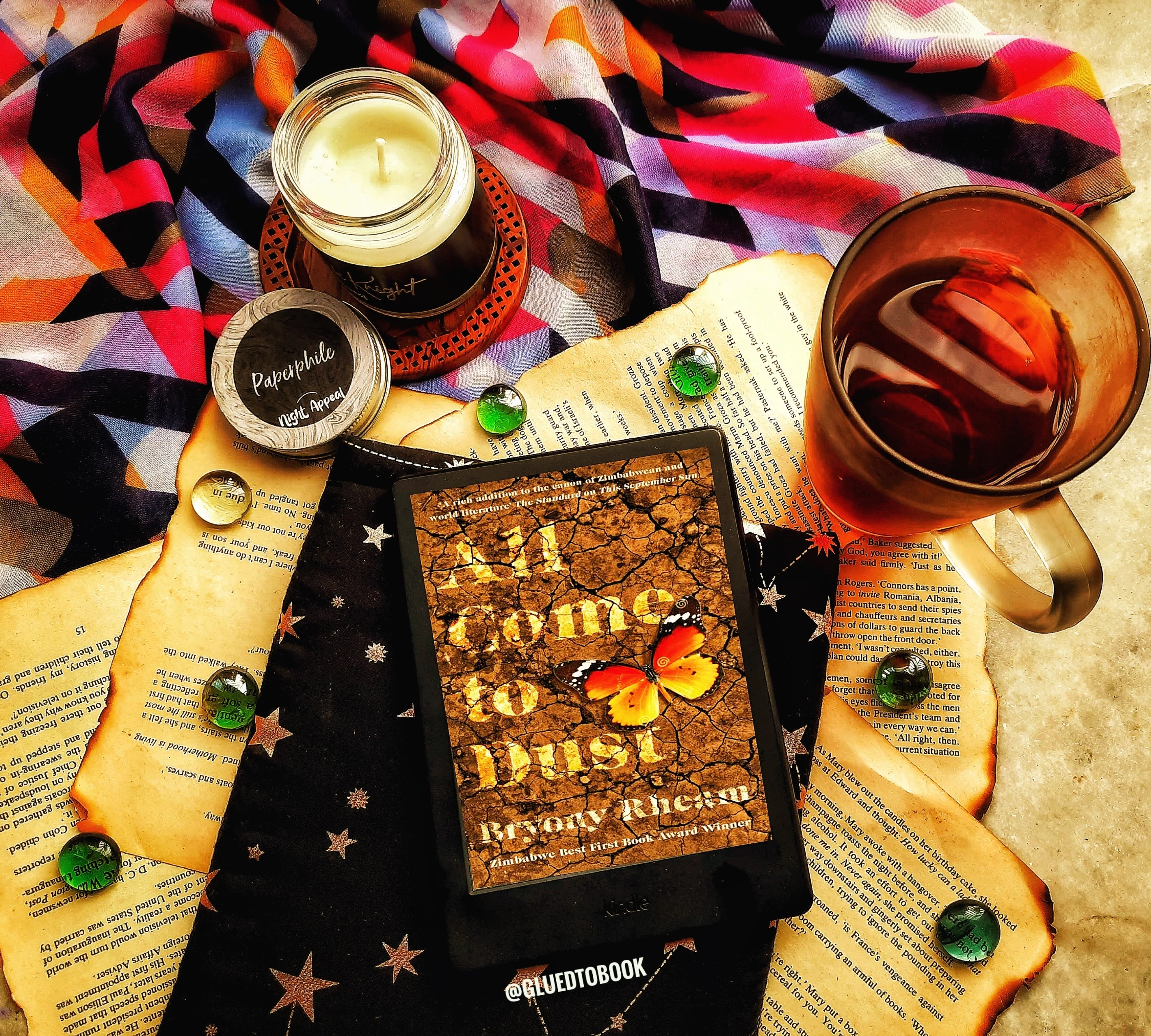
Glued to Book reviews Bryony Rheam's All Come to Dust

Reproduced from https://gluedtobook.wordpress.com/2022/04/23/all-come-to-dust-review-329/


 Chief Inspector Edmund Dube is introduced in All Come to Dust as he investigates the stabbing of a rich woman, Marcia Pullman. He is then refused access to the case, and police documents, and is removed from the case after it is determined she died of renal failure. Edmund’s past is revealed in a sequence of flashbacks to 1979 as he continues his investigation. A slow-paced police procedural set in Bulawayo, Zimbabwe, with subtle references to race, class, mental health, memory, and colonialism.

All Come to Dust, a mystery by Bryony Rheam, is a classic murder investigation steeped in Zimbabwean culture. Many components of the book can only take place in such settings, and they are necessary for the novel to evolve in the first place. The protagonist is a lone wolf with a complicated personality and backstory who is dedicated to completing his task. The characters are well-developed, albeit slowly, with just enough cliches or stereotypes to lead the reader to believe they already know something. At the same time, the plot is both compelling and tiny or contained. It takes its time unraveling and provides enough red herrings mixed in with its hints along the way to make you want to keep reading and not feel cheated out of a satisfying conclusion. Throughout, it is a portrayal of how class, race, and gender still work in contemporary Zimbabwe, not so much an indictment as a laying bare of how injustice and privilege are still baked into everyday life, and the attempts of diverse individuals to break free.

This is an intriguing and often amusing look at a crime that isn’t a crime, as examined by a man who draws inspiration from books and movies. The reader is given the perspectives of all the suspects, however, it’s difficult to believe any of them. In the end, I enjoyed this story. It grew heavier than I had anticipated and dealt with several difficulties I’m currently working through. If you’re seeking a mystery that also serves as a character study of Zimbabwe, this is the book for you.

Thursday, April 21, 2022

Novelist Bryony Rheam on Winning Path

 Reproduced from the newsletter of the Writers International Network of Zimbabwe: 

WIN LITERARY NEWSLETTER, VOL 2, ISSUE 19, which celebrated the winning writers from the 2022 Zimbabwe National Arts Merit Awards.

by Beaven Tapureta


Bryony Rheam shows her recent accolade from the 2022 NAMA Awards.
Her second novel All Come To Dust won the Outstanding Fiction Book award.


EVERY writer dreams of success and success usually happens when one commits him/herself to art. Many writers have fallen by the wayside after their books failed them. No sales, no recognition, no reviews.

But while winning matters, one has to consider working hard with a heart of faith. Writing is an act of faith, so said someone.

For Bryony Rheam, recognition gauges the reader response for a book. And when a book keeps on winning, she says it shows that readers are connecting with the themes tackled. 

After her debut novel This September Sun (2009, AmaBooks) won the Best First Book at the Zimbabwe Book Publishers Association Awards in 2010, she was in 2014 winner of the International ‘Write Your Own Christie’ Competition, a competition dedicated to the international writer Agatha Christie whom Bryony has put on top of her favourite writers list.

“I have been an Agatha Christie fan for a very long time. I enjoy the books because the focus is on the mystery, not the murder. I like solving the puzzle. Modern crime writers focus more on the murder and enjoy lots of gory details, but the actual mystery is not that exciting,” said Bryony. 

This September Sun went on to be selected as set text for ZIMSEC Advanced Level Literature in English in Zimbabwe from 2012 to 2017.

WIN once published a comment by a literature student who said she remembers one day her teacher shed tears while reading to the class a touching passage in the novel. Indeed, such is the power of Bryony’s words as a story-teller.


All Come To Dust (2020, AmaBooks), her second and recent novel, has joined the winning streak.

Late last year it scooped a literary award at the Bulawayo Arts Awards and this February it won the Outstanding Fiction Award at the NAMA Awards.

Bryony told WIN how she feels about the overall success of her books.

“I feel both my novels have been successful, especially in Zimbabwe. Their success shows that readers are connecting with the issues they raise,” she said.

All Come To Dust is a crime thriller, falling in the class of another African novel Five Nights Before The Summit (2019, Weaver Press) by USA-based Zambian author Mukuka Chipanta.

There seems to be an attempt by writers to fill in the gap of crime fiction in English. For example, Sinister Motive by South Africa-based Zimbabwean emerging writer Wellington Mudhluri also uses the crime fiction genre which was once popular with Shona novelists of yore.

However, the use of various genres by Zimbabwean writers to speak about local issues is what Bryony applauds.

“I feel there is a need for Zimbabwean writers to explore different genres and use them as ways to reflect life in this country,” said Bryony.

Her words confirm what renowned writer NoViolet Bulawayo said last month in The New York Times: “We have to insist on imagining the worlds that we want to see.”  NoViolet was speaking about her new book Glory which one critic described as ‘a modern African Animal Farm’, meaning it explores a different ‘Animal Farm approach’ to highlight certain issues affecting Zimbabwe.

Truly, by using the imagination and exploring various forms of writing, writers can deal with issues troubling our motherland.

 (Read an interview with Bryony published in our previous issue, DOWN MEMORY LANE )

All Come to Dust reviewed in Grumpy Old Books

Reproduced from http://grumpyoldbooks.blogspot.com/2022/04/all-come-to-dust-by-bryony-rheam.html


All Come To Dust by Bryony Rheam


 526 pages 

You can buy All Come To Dust...Here 
You can follow Bryony Rheam's blog...Here 

 I have received a free copy of this book from amaBooks and Parthian Books in exchange for an open and honest review. 


The Blurb... 

Marcia Pullman has been found dead at home in the leafy suburbs of Bulawayo. Chief Inspector Edmund Dube is onto the case at once, but it becomes increasingly clear that there are those, including the dead woman’s husband, who do not want him asking questions. 

The case drags Edmund back into his childhood to when his mother’s employers disappeared one day and were never heard from again, an incident that has shadowed his life. As his investigation into the death progresses, Edmund realises the two mysteries are inextricably linked and that unravelling the past is a dangerous undertaking threatening his very sense of self. 

My Review... 

Well, what an unexpected gem. 
All Come To Dust tells the story of black Police Officer Edmund investigating the murder of wealthy ex-pat Marcia Pullman in modern day Zimbabwe. I think the book succeeds because it engages the reader on many levels. 

Firstly there is an excellent, convoluted, multi-layered murder mystery ala Agatha Christie or PD James. Or I should say there are three mysteries at play. Who (if anyone) murdered Marcia Pullman, who defiled her corpse and what happened to the McDougal family. The McDougal family were Edmund's mother's employers who took a special interest in Edmund, ensuring that he got a good education. However, one day during Edmund's childhood they just disappeared. 
 
There is also a slightly comedic/tragic aspect to Edmund. He is a very shy, bookish introvert bumbling along in his investigation. He finds a collaborator in semi-alcoholic, white-trash, handyman Craig. Craig is a cynical and resentful man. Set this against the incompetent and corrupt background of the comically under resourced Zimbabwe Police Force and it can make for a situation ripe for ridicule. 

In addition the author offers some very interesting takes on a culture that is alien to most western readers and one that would also seem to be in a slow decline. She gives a fascinating insight into the once powerful but now diminishing white Zimbabwe/ ex Rhodesian community. 

As well as the regional insights into class, culture and colour of her community, the author also portrays parts of the universal human experience very well. Loneliness, religion, despair and hope are deftly handled. How the past comes back constantly and intertwines with the present is also a thread throughout this intriguing novel. 

The first part of the novel is steadily paced, but ramps towards the end and the denouement, where Edmund gathers the suspects together and goes through their various, nefarious and complicated intrigues one by one. If there was a tweak to be made, I think the complex plot and numerous back stories, while all well done, means the narrative is possibly slightly too long. 

I started this book expecting a bog standard cozy crime caper. I was pleasantly surprised. The balance of cozy to crime was just how I like it. The hinterland of excellent socio-political with a philosophical tinge writing was a huge bonus. 

Selected Quotes... 

"I envy you, Chief Inspector. 
Me? Why? 
Because you're black. You belong to a community, a race. Living here, being white is such a burden. We've been cut adrift from wherever we came from, amputated like a gangrenous leg that no longer works. We have no roots, no base."

"The kind of policeman she was used to was watchful but for other reasons. Their eyes followed you with a watchful greed. How could they get what they wanted be it money or goods - or sex? But the truth, the truth was rarely something a police officer looked for unless it benefited them in some way."

"I went to Sir Herbert Stanley Primary School, he said without really knowing why he said it. In his embarrassment he wanted to find a reason for his intelligence, as though he didn't deserve it. I was very fortunate to have been sent there by my mother's employers. 
Her wry smile broadened. You're very lucky. But intelligence has little to do with education. I know a lot of educated people who aren't very clever at all."

"Always he felt the loss of that faith. It was like the loss of a childhood belief in fairies or Father Christmas. What was the difference in those beliefs - God and Father Christmas - except at a certain age someone told you the truth about the latter and let you get on with the former? What would life be like as an adult if you still believed in a fat bearded man who came down the chimney once a year? You'd be mad. Yet a God who was never seen, never had been seen, lived on and on - and on." 

About the Author... 


Bryony Rheam was born in Kadoma, Zimbabwe. Her debut novel This September Sun won Zimbabwe's Best First Book Award in 2010 and reached Number 1 on Amazon Kindle in the UK. She has also published a range of short stories in anthologies. In 2014, she won an international competition to write a chapter of an Agatha Christie novel. She has attended the Ake Book and Arts festival in Abeokuta, Nigeria and Africa Utopia at the Southbank Centre in London. Rheam is a recipient of the 2018 Miles Morland Writing scholarship. She is an English teacher at Girls’ College and lives in Bulawayo with her partner and their two children.

Tuesday, April 5, 2022

Agatha and I


Agatha and I, by Bryony Rheam, is reproduced from https://murderiseverywhere.blogspot.com/2022/03/agatha-and-i.html


Bryony Rheam

Bryony Rheam is a Zimbabwean author who lives with her family in Bulawayo. Her debut novel This September Sun won Best First Book award in Zimbabwe and went to #1 on Kindle in the UK. Her new book, All Come to Dust, also an award winner, was chosen as one of ten top African thrillers by Publishers’ Weekly who described it as a “stunning crime debut”. I loved the book, and it was my pick of mysteries set in Africa for 2021. Paula Hawkins (author of The Girl on the Train) clearly felt the same way, describing the protagonist, Chief Inspector Edmund Dube, as “a fictional detective as memorable as Hercule Poirot”.

That would have made Bryony’s day because of her long association with Agatha Christie’s books. Here she tells us about that and how it motivated All Come to Dust.

Welcome Bryony to MurderIsEverywhere. Michael Sears


In preparing what to write for this blog, I looked back on some old blogposts of mine where I discussed the importance of Agatha Christie in my life. One of the lines stands out for me and seems to have taken on a deeper meaning than I meant at the time. I had just finished researching Agatha Christie’s trip to Rhodesia in 1924, a trip that resulted in her writing her third novel, The Man in the Brown Suit, and I had delighted in being able to follow her on part of her journey to Bulawayo and Victoria Falls. I wrote: ‘When I began my research, I thought I was following Agatha Christie on part of her journey, but now I wonder if the journey hasn't become my own.’

My journey with Agatha Christie began many years ago with my maternal grandmother. She was a lovely lady: very clever, well-read and funny. Having left school at the age of fourteen, she was largely self-taught. She loved to read, and she read anything and everything, but, in particular, she loved Agatha Christie. On Friday afternoons, I would take her books to the library for her, and I would exchange one lot of Agatha Christies for another.

She must have read them all; she must have read them two or three times, but it did not bother her. As an adult, and as an ardent fan of Christie’s myself, I now understand part of this desire to read and reread her novels. My grandmother was brokenhearted - she had lost her son in a car accident when he was twenty-one. She struggled, but she could not overcome severe depression and grief. All reading provides an escape, but with Christie it was so much more.

Agatha Christie

Agatha Christie is considered the "Queen of Crime". Although not alone in doing so, she is credited with the development of the crime novel into what we know today and its growth in popularity. She is best known for a "closed murder" story in which the crime can only have been committed by a limited number of people, each with their own particular motive for doing so. Everyone is a suspect and usually it is the least obvious person who "dunnit".

The murders are not gory; there are no detailed descriptions of prolonged deaths, the pain and injuries inflicted or the mutilated body. That is not important. What is, is the method and the motivation. The planning behind the murders is always meticulous: the murderer knows who will be where when, how many minutes he or she has to cross the garden and enter the study window, how important it is that the poison is administered with the bedtime cocoa and not the after-dinner coffee, or how the drinks on the tray must be arranged just so in order that the victim chooses the correct one.

Of course, they make other errors which eventually lead to their downfall. Yet it is this absolute attention to detail that I believe makes Christie novels so intriguing. It’s the puzzle that’s important and puzzles can eventually be solved. All the pieces are there; the reader just has to put them together correctly – which of course we rarely, if ever, do – and that’s exactly where Christie’s genius lies.

Despite her upper-middle class background, Agatha Christie always felt like something of an outsider, which likely accounts for two of her most famous detectives, Hercule Poirot and Miss Marple, being on the margins of society: Poirot is a foreigner and Marple is elderly. As such, they are able to bring attention to both the idiosyncrasies and the shortcomings of English society.

But there is another way in which Christie undermines the very essence of Englishness, and, in doing so, also undercuts the stereotypes associated with it. Her books capture that beautiful feel of an orderly life: the clock ticking in the drawing room, the letters on the breakfast tray, the train arriving at exactly three minutes past four. Her characters who lead such orderly lives are well-spoken, polite and know which spoon is for the soup and which for the dessert. The undermining of all this is what unsettles us so much. How could the vicar’s wife devise a murder so clever and with such calculation that it takes the powers of a super sleuth to detect the flaws? How could the murderer have written such hateful letters in the beautiful library; how could they have thought of putting poison in the tea served so punctually at four o’clock on the terrace?

It unsettles us. Christie takes us into the dark areas of the places we consider safe. More than that, the very things that add to that lovely slow rhythm of conventionally English life - trains that run on time, tea at four o’clock, an efficient postal system - seem to have been used against us. If these things, these people, these places are unsafe, then where is not? We would feel less vulnerable on the streets of New York or in the ganglands of Glasgow. As readers, we feel we have got into the car of the stranger our parents always warned us about. But they were smiling, they were welcoming, they had double-barrelled surnames we say – and so we seal our doom.

The good thing, of course, is that she rescues us. The detective arrives, the plot is worked out and the murderer is caught. Except perhaps for Murder on the Orient Express, everything is sorted out and any loose ends are firmly tied up. The puzzle is solved and the dark places dissolve. Once again, the calm ticking of the clock is restored. That is what I find so satisfying and that is what appealed so much to my grandmother. She had come to fear life. Her experience told her that anything can be taken from you at any time, even people you love with your entire self. Being a good person, living a good life – what did it mean? It was no guarantee that you wouldn’t be dealt a terrible hand. But if the dark places were not made light in her own life, at least they were in fiction.


Bryony with Matthew Pritchard

In 2014, I was a winner of the Write Your Own Christie competition organised by AgathaChristie.com.  The prize was dinner with Agatha Christie’s grandson, Matthew Pritchard, and her publisher at HarperCollins at Greenway, her home in Devon.  It was an emotional moment for me, one that linked the little girl who spent afternoons listening to her grandmother’s stories of life in India and Persia to the adult with a longing to write a crime novel of her own.


Outside Agatha Christie's House in Greenway

Yet it was to be another six years before this became a reality. All Come To Dust was published in Zimbabwe in November 2020, the UK in September 2021, and in the US this month. When I sat down to write it, I wanted to follow the structure of a classic Christie novel. However, there were some very obvious differences that I had to negotiate: present day Bulawayo is very different to the England that Christie wrote of from the 1920s to the 1970s. A closed murder seemed unlikely; in fact, it felt claustrophobic. The more I thought and planned, the more that it became apparent that many of the conventional tropes of the western crime novel would not work.

Zimbabwe’s police force is riddled with corruption.  It is also generally quite inefficient and there would certainly be very little forensic investigation into a death. However, I still decided to use a policeman to investigate the murder. He is also an outsider, a man who wants to do good in a world that seems overwhelmingly corrupt. He spends his time typing up traffic offences, trying to put the world to rights through the meticulous recording of events that will probably be settled by the payment of a bribe to someone on the force.

The lack of forensic investigation was a bonus for me as I, like Agatha Christie, could concentrate on the puzzle and not get weighed down by having to bring in technical detail. Nor did I go into any great description of the murder itself for I do not feel the need to do so. This is probably one of the reasons why reviewers often describe All Come To Dust as ‘an old-fashioned’ murder.

Yet this would suggest a ‘happy ending’ and, while it is true, that the mystery itself is solved, there is also a strong sense that any form of justice in Zimbabwe is not administered in the conventional way.  The sense of restored order evident at the end of an Agatha Christie novel is also not present. The peace is hesitant, wary, aware always that it is under threat.

Modern Day Bulawayo

I might not have set out to undermine the archetypal crime novel, but it became increasingly clear that the structure did not sit well in an African setting. It seemed obvious therefore to try and highlight this disconnect rather than ignore it. In doing so, I was able to explore modern Zimbabwean society through an eclectic range of characters, each bound in some way to the past and fearful of the future.

When I finished writing All Come To Dust, I decided that I would not write another crime novel. I had set myself a challenge and I had completed it. But now I see crime writing offers so many opportunities to explore the inconsistencies evident in Zimbabwean life. And so it is that the quest to follow Agatha Christie’s journey has led me to a journey of my own. I can only be excited of what lies ahead.


Bryony is to participate, with Michael Sears, at this year's International Agatha Christie Festival.

Thursday, March 3, 2022

All Come to Dust 'is way above five stars'


To simply describe this beautifully written, densely textured, novel as a murder mystery would be an egregious understatement. To describe it as a police procedural, or a maverick cop, or a psychological thriller – for it is all of these – would similarly undersell it. To set the scene, the story centres around Edmund Dube, a black Zimbabwean, at two specific points in his life. In 1979, aged seven (the Jesuitical age when personality is formed), he is almost the only non-white pupil at a prestigious school in Bulawayo, Rhodesia. His access to the school had been facilitated by Chief Inspector McDougal, for whom Edmund’s mother worked as a maid. Now, in Bulawayo, Zimbabwe, he is Detective Chief Inspector Edmund Dube. The cultural shifts evidenced in that name change underpin this book but are subliminal not overt. The reader doesn’t need to know the history because the writing provides the ambience.

When a woman is reported as murdered, Edmund rushes off to investigate and quickly establishes that the paperknife buried in the centre of her chest is not the murder weapon, because she was dead before she was stabbed. The deceased is a white woman, Marcia Pullman, part of the dwindling number of such individuals, rich, influential, a pillar of society and detested by almost everyone. Her husband is a beefy, obnoxious, functioning alcoholic who, on the face of it, runs a safari company. Both of these sound like stereotypes, caricatures, but in this writer’s hands they are neither. Edmund begins an investigation but is swiftly removed from the case (if a natural death embellished with a dagger actually constitutes a case) and side-lined, ridiculed. Clearly the Pullmans have enormous influence within this kleptocracy. Edmund, and an unlikely (indeed random) assistant, must try to resolve if there is a murder; if so who is the murderer; what illegal activities surround the Pullmans' apparent control of the local powers-that-be? And what connection, if any, is there with his childhood?

The quality of the writing, the skilful use of metaphor, the sense of place, the depth of the characterisation, the intricacy of the plot, combine to produce a singular work. This book is way above five stars.

 from Denis Wheller, Goodreads