Friday, November 27, 2015

Kirkus Review of 'The Maestro, The Magistrate & The Mathematician'

In this much-anticipated second novel from Huchu (The Hairdresser of Harare, 2015), the lives of three Zimbabwean transplants to Edinburgh intertwine as they struggle to make a place for themselves in a foreign land.
“You know why these people colonised us, right?” a friend says early on to the character known only as the Magistrate. “It’s the cold, it drives a man mad, so, when they came to Africa and saw us lounging in the sun, it drove them absolutely berserk.” Huchu is a master of crafting savvy and wry social observations. Here, complex characters are organically created through heightened, vivid dialogue and stream-of-consciousness interior thoughts. The Magistrate—who served in this judicial capacity back home in the city of Bindura, Zimbabwe, but has yet to find work in Scotland—feels the shame of being unable to provide for his family “looping round his intestines” while his relationship with his wife grows strained because of it. Farai, a Ph.D. student in economics whose family remains back in Zimbabwe, instead aches with the absence of his family and his homeland. The pot-smoking Maestro simply seeks comfort in drugs and entertainment. The loss and preservation of one’s own culture in an alien land is a major theme: “his daughter had been here too long” and was in danger of losing her Zimbabwean cultural values, moans the Magistrate. “Already her speech had a slight Scottish inflexion.” But as the political situation in Zimbabwe grows unstable, the personal lives of the expatriates also spiral dangerously out of control in a series of suspenseful, albeit somewhat contrived, plot points.
A sensitive exploration of the concepts of identity, family, and home grounded in a rich, intricately detailed depiction of the immigrant experience of the global African diaspora.
https://www.kirkusreviews.com/book-reviews/tendai-huchu/maestro-magistrate-mathematician/
Nov 19th, 2015

Thursday, November 26, 2015

'The Maestro, The Magistrate & The Mathematician' reviewed in Wales Arts Review


After the success of his debut, The Hairdresser of Harare (2010), Tendai Huchu’s second novel, The Maestro, The Magistrate and The Mathematician is a cleverly written, multi-layered narrative about the lives of three Zimbabwean men residing in Edinburgh, Scotland. It is set in the early-to-mid 2000s, with its characters following the political unrest in Zimbabwe under the Mugabe Regime, all the while mapping out new lives in Edinburgh.

The chapters alternatively follow each character’s story; three different novellas are interweaved together. The Magistrate, a middle aged, once well-respected man of law, now trying to adjust to a new life in Edinburgh where his qualifications and titles mean little. While his wife has secured a job, the Magistrate remains without one, straining their relationship, all the while trying to come to terms with a teenage daughter growing up in an alien culture.

The second narrative follows Farai, the Mathematician. A PhD student writing his thesis on hyperinflation in African economies, who comes across some extremely important papers during his research. Farai closely follows the political upheaval in Zimbabwe too, having strong ties and family still there. Coming from a wealthy background, he is an opinionated character, who interprets the world through a self-assured judgement that the reader may often question. In his early twenties, Farai is representative of ‘laddish culture’ with his male flatmates and their casual sexism. Arguably a flawed character, Tendai Huchu somehow still makes Farai a likeable one to the very end of the novel.

The last but not least is the Maestro, a man immersed entirely in literature, working in a menial position at a superstore. The Maestro is intensely withdrawn, representing the ‘outsider’ who feels and sees everything deeply on another level. There is a dose of pessimism to the way he sees the world, yet many of his thoughts are reflective of our thoughts as the Maestro contemplates existential philosophy, from Sartre to Nietzsche, all the while spiralling downwards psychologically. The idea that, thinking is good, overthinking is bad, applies to the Maestro, who arguably becomes a nobody, yet representative of everybody at some point in their life. He is also the most mysterious character of the novel, as the reader reads on hoping to find out the events or family connections that may explain his isolated and dejected character, afraid of letting people in.

Connecting these three is Alfonso, a seemingly buffoon of a character and fellow Zimbabwean in diaspora Edinburgh. Despair leads the Magistrate to Alfonso, who gets him a job at a nursing home as a carer, while also introducing him to the MDC in Scotland, the political opposition to ZANU-PF. Alfonso plays a key role in interweaving these narratives and bringing the characters together, as well as being a catalyst for the events that take place. The reader may easily undermine him, only to be proven otherwise later on.

Against the backdrop of Edinburgh, the idea of the city in relation to the characters is a predominant one, as illustrated by the cover. Through the Magistrate’s long walks and bus rides we encounter the city. He becomes a flâneur figure, physically mapping out the urban city around him with every stride while listening to Zimbabwean music, as though trying to adapt to the unfamiliar with the help of the familiar. Influences of psychogeographical texts are evident here.

The Maestro, The Magistrate and The Mathematician is a very self-conscious novel, and to label it as one that simply depicts the estranged immigrant experience in a foreign country would be rudimentary and limiting to what it has to offer to the reader. It is about that, yet so much more. Written in eloquent yet humorous prose, its characters experience and consider ideas that are very relatable and universal. With its theme of class and the irony of downward social mobility, as opposed to upward that the characters seek through migration, there is a clear distinction between each of their narratives. Tendai Huchu depicts the way they talk, their worldviews and their lives in a very real, authentic manner. From the Maestro’s intensely lyrical block text to Farai’s free indirect colloquial speech, their energy bounces off the pages. Tendai Huchu himself makes a humorous appearance at one point, as the annoying writer character that Farai encounters at a party, who starts talking about his writing.

Arguably, there are influences of the postmodern in the novel’s fragmentation and the themes of belonging, loss and identity and focus on the localised, individual story. As Alfonso states to the Magistrate, “when all is said and done, all anyone will ever care about is your story”. And it does just that by leaving a lasting impression on the reader. Yet the novel is a different one at the end to the one that the reader begins with. There are no ‘loose ends’ in the carefully structured plot, and the surprise ending makes the reader want to go back and reread it again in a new light.


With its knitting together of languages and political history, The Maestro, The Magistrate and The Mathematician flows well even for a reader unfamiliar with Zimbabwean culture. The surprise ending and the variations in the style of writing might throw some readers off, while for others, add to the richness of the novel. Books allow us to reach places and experience lives we otherwise would not, and this one does just that. A literary fiction that isn’t afraid to tackle issues and is bold yet playful in doing so, this one is a must read.

by Durre S. Mughal, http://www.walesartsreview.org/

Monday, November 23, 2015

Dan Wylie reviews Textures, a poetry collaboration by Zimbabwe's John Eppel and Togara Muzanenhamo

Commemorating sight and sound


from: http://thisisaerodrome.com/review-textures-john-eppel-togara-muzenanhamo
Textures must be one of the most unusual, even ironic, poetry collaborations to have come out of Zimbabwe in recent years. Zimbabwe’s publishing industry being in a state of near-total collapse now, amaBooks in Bulawayo represents a rare light of literary trust and hope – and this is a particularly brave publication.
One limb of this attractive double-hander is John Eppel, probably now the country’s most long-standing resident poet and satirical novelist. He is vilified in government-controlled rags such as The Patriot, partly just for being white, inconveniently and persistently present, partly because his satiric tone and self-deprecating demeanour are routinely missed or misunderstood. He has now published a number of poetry volumes, beginning with Spoils of War (1988), and a swathe of satirical novellas and short-story collections. These have become a little more serious of late, approaching the seriousness of the poetry in this volume (except, to be sure, the poem “Dorothy Recollects”, in which he sends up his own ‘colonial’ Wordsworthian Romantic inheritance).
The second limb is less well-known, a younger and almost preternaturally talented newcomer, Togara Muzanenhamo. Unlike Eppel, who as far as I know has never been published in volume form overseas, Muzanenhamo has already been picked up by Carcanet Press in the UK. These two poets’ contributions (some 30 poems apiece) are arranged in interlocking groups, setting one another off in intriguing ways.
It is both ironic and heart-warming to see the white and the black, the established and the upcoming, in counterpoint and communion. Ironic also because – contrary to stereotype – it is Eppel (though South African-born) who appears the rooted local, Muzanenhamo the globally-travelled intellectual. Eppel writes about the local flora, fauna (especially birds, here), and landscapes, and of highly personalised feelings; Muzanenhamo writes mostly of anywhere but Zimbabwe – Peru, the USA, Norway, Mozambique – alongside apparently wholly unlocatable, almost fantasial scenarios.
The volume is prefaced with a perceptive introduction by Drew Shaw, then lecturer at Zimbabwe’s National University of Science and Technology. He quotes a revealing and poignant comment by Eppel:
[A]s you get older you have a much more powerful sense of mortality, so you don’t take being alive for granted anymore. But you don’t see life and death in nature; you just see one form of energy changing into another form of energy, in nature time is cyclical. And somehow I think there’s consolation for ageing poets to spend more time observing the minutest details out there.
Those details, however, are always turned to inner psychological capital, with mythic resonances, as in one of the several bird poems, “Brown-Hooded Kingfisher”:
                                    You have been immobilized
by instinct, by a chronic state of bliss.
You once fished in waters above the sky,
in the firmament of death and desire.
… Impossible beak,
orange legs, reddish feet glued to a tree;
Dickensian eyebrows, unnerving shriek
shadowed by a gentling, ‘pity for me’.
This exemplifies a number of characteristic features of Eppel’s poetry: the intimate, almost scientific detail, the precise rhythms and stanzaic rhymes, and a certain intrusive note of the maudlin. Also, the hint at his wide reading in the allusion to Dickens; such referencing – a trait he shares with his companion poet – gets quite dense on occasion:
Can’t get that dangling girl out of my mind,
nor the jealousy that provoked it. Why
are pampered Olympians so unkind
to mortals who challenge them, vivify
them in the first place? Athene, mistress
of weaving, versus the Lydian wench,
Arachne, who dares to make Olympus
say yes to human pain. How do the French
put it: la Terre détruit le Ciel?
It’s a story Sartre might want to tell. (“Golden Orb Spider”)
A jocular tone wrestles with nostalgia for the entanglements of thwarted or lost love – perhaps his presently most common theme – and the colloquial ironically counterbalances the careful form. The hyper-local is viewed with affectionate wryness through the lens of world literatures. These are subtleties typical of Eppel at his best.   He works persistently with ‘traditional’ European forms – four-line stanzas, villanelles, and especially sonnets, as in the sequence here of five sonnets exploring the environs and sentimental meanings of Bulawayo’s Hillside Dams. Here, childhood memories, lost loves and everyday textures mingle in intimately realised scents and sounds.
Muzanenhamo, by contrast, tends to utilise the limber and fragmented forms characteristic of late Modernism: he combines, one might say, the intellectual prism of an Auden with the vivacity of a Neruda. Like Eppel, though, Muzanenhamo reveals an extraordinary range of reading, often glimpsed in his poems’ epigraphs, which come from unlikely sources, ranging from a cricketer and a Tour de France cyclist to quotation from the Pittsburgh Post-Gazette. A lot of his reading, and so his subject-matter, is historical: so he manages to derive strangely universal meaning from locales ranging from a car mechanic’s workshop to a sailboat to a cemetery in Lexington, USA. In almost every case the technical terms are wielded with complete confidence. Yet most remains visceral and vivid: a poem about a typically abstruse subject, the 1665 Battle of Vågen in Bergen, Norway, includes this segment:
Cannon fire thundered with the heavy vibrato of war.
From his vantage point he could see the crafts
shivering after bouts of light hung
long then rang with distant noise.
In his mind, the thought
of men dying could not be reconciled
with what he viewed. Rain coursed down his face
salted with tears he could not hold back…
Muzenanhamo has an enviable ability to imagine himself into such an historical situation. Other of his poems also seem to displace the ‘personal’ emotional life at one remove into imagined scenarios; some read like snatches from South American magic-realist novels. “Peruvian Sunsets” opens thus:
Xalvadora stumbled back after Alvaro removed his boots. It wasn’t that Alvaro’s foot was metallic, nor was it the foot’s cold mercurial glow that caused her to panic and suddenly retreat with fear; no – it wasn’t that at all. When Xalvadora looked down again at Alvaro’s bloodless ankle, she saw her own face staring back…
It’s all rather mysterious yet, within its own world, weirdly persuasive. Muzenanhamo’s final twenty-poem sequence, “Game of 12 Moons” – an extended collection to balance Eppel’s Hillside Dams series – is more poetically lyrical but equally cryptic, like overheard segments from lost folktales:
She had been playing the game
with her shadow,
the game of twelve moons –
lifting floorboards in the kitchen,
whispering hurriedly to herself.
The sun would rise soon,
the smell of the air would change,
as would everything else
in the forest.
This is airy and simple, compared to most of his poetry, which incorporates a rare and cerebral sophistication. Nothing could be further from the run-of-the-mill Zimbabwean fare which deals obsessively and dully on common themes, reducing poetry to obvious proverbial mantras and demonstrating a tentative grasp on linguistic accuracies. Eppel writes more accessibly, perhaps, though the loops of his thought, self-consciously yet conversationally threaded through careful patterns of rhyme and syllabics, present enough density to reward many re-readings.
In a way, the two poets are united by so high a degree of craft that almost every poem – they are not all equally weighty or felicitous – serves as a kind of meta-meditation upon poetry itself. As Eppel writes in the poem “Tortoise”:
[T]hose who commemorate sight and sound –
poets, composers, and picture-makers –
will complete the work of undertakers,
and begin the work of he ‘who with his finger wrote on the ground.’
Textures is published by amaBooks.
Dan Wylie is professor of English at Rhodes University.


Tuesday, October 27, 2015

Huchu to launch novel in Edinburgh - The Zimbabwean

Ellah Allfrey interviewing Tendai Huchu at the Edinburgh Festival
photo courtesy of Petina Gappah
Tendai Huchu is set to launch his second novel,The Maestro, The Magistrate & The Mathematician, on Friday October 30 as part of the Edinburgh Independent Radical Book Fair. The novel was published in Zimbabwe by 'amaBooks and in the UK by Parthian Books.
Next month Huchu's book becomes available in Nigeria through the publication by Kachifo. Huchu will be travelling to the Ake Arts and Book Festival which runs from 17 to 21 November under the theme, 'Engaging the Fringe'. Dialogue will focus on culture and creativity, with reference to genres and forms that do not often receive deserved attention.
The Maestro, The Magistrate & The Mathematician will also be available in the United States next year through the University of Ohio Press and it is to be translated into German and Italian.
The novel is a carefully crafted, multi-layered novel. Although set in Edinburgh, Tendai Huchu , with his inimitable humour, reveals much about the Zimbabwe story as he draws the reader deep into the lives of the three main characters.
Huchu is a prolific writer and and his short fiction and nonfiction have appeared in The Manchester Review, Ellery's Queen's Mystery Magazine, Gutter, AfroSF, Wasafari, The Africa Report, Kwani? and many other publications. As well as writing Tendai Huchu has translated works from Shona into English.
He is a PhD student of Creative Writing at the University of Manchester.
The Edinburgh Independent & Radical Book Fair is an annual literary festival, which takes place in October providing 5 days of cultural and literary events which are free for all to attend.
Set up in 1996, past fairs have been opened by writers such as Wole Soyinka, Vandana Shiva, Benjamin Zephaniah, Shere Hite and Mark Thomas.
In addition to author events and book launches there are school workshops, film screenings, an exhibition and creative writing workshops. The aim is to give plenty of time for discussion at events and to encourage dialogue between writers and their audience, and amongst readers – this often spills over in to the bar and café area afterwards.

The Maestro, The Magistrate & The Mathematician is set in Edinburgh and revolves around the lives of three Zimbabwean men trying to make a new life there as immigrants. Lauri Kubuitsile, in her review of the book in Botswana's Mmegi, writes: ‘The three storylines might work well alone, but are made more by being woven expertly into and through each other. The writing is beautiful, in places stunning. The descriptions of Edinburgh are from the pen of someone who loves that city and it can’t help but show through his words. There are many books about Africans in the diaspora, many books that appear similar after a while, but not this one. This one stands apart.’

From: http://www.thezimbabwean.co/2015/10/huchu-to-launch-novel-in-edinburgh/

Wednesday, October 21, 2015

Book reaffirms Zim's poetry status

Textures, poems by John Eppel and Togara Muzanenhamo, reviewed in the Daily News, October 18, 2015


Textures, published by Bulawayo-based amaBooks, is an innovative new poetry collection from two intriguing Zimbabwean poets: John Eppel and Togara Muzanenhamo.  
   Both poets are gurus of the technical form, formal master craftsmen of the art of poetry, here displaying a familiar selection from the different types of poem: sonnets, sestinas, dizains, villanelles, etc. often only vaguely remembered from high school study of poetry and removed from the more familiar free form. This reviewer is a novice poetry reviewer, a reader of poetry rather than a poet, so this appraisal will focus more on content than form.
   While other countries express fears that poetry is dying, Zimbabwe, by contrast, has been described as ‘a country of poets’. Many forms of poetry exist alongside one another from the traditional to the performing to the activist poet. In Textures amaBooks has brought together two wordsmiths who decorate a literary landscape of personal love and longing, though this can by no means be described as a love anthology.
   Each poet speaks in his own distinctive voice: John Eppel’s first poem is the nostalgic ‘Suburban Night in August’, which begins ‘The distant all-night drums, a dripping tap…’ and ends expectedly with that pain of love lost so painfully shared ‘……unclasp your hair, give it a tousle, set it free, smiling at him the way you smiled at me.’
   Togara Muzanenhamo dramatically introduces himself with the shocking ‘Gondershe’ ‘Having never fired a gun before, he held the rifle as though the weapon were a dying child about to say something only they could share...’ ending with the revelation of the 12 year old soldier cradling his gun and awaiting a certain death.
   While Eppel can, at first reading, seem light hearted, less serious, he can also stun his reader as he does with the simple brilliance of ‘Only Jacarandas’.  His beautiful sequence ‘The Hillside Dams’ walks us into his head and heart as he reveals his innermost thoughts description intertwined with emotion.
   Eppel’s love of the Matopos, the birds, the plants are only a part of the everyday existence that he uses to paint the landscape of his own experience for the reader. His ‘Four Villanelles’ brings with it a rawness of the pain of his own experience of longing and loss. Sometimes regretful and jaded, other times light hearted and droll, Eppel provides us with a rollercoaster of emotions familiar to us all. He speaks with the sad voice of a sage, his still beating heart exposed for us all to see.
   While Eppel’s words can be brimming with satire, wry humour, self-deprecation, gentle self-teasing, by contrast, the landscape the younger Togara Muzanenhemo paints appears more mystical, more spiritual, more idealistic, more ardent: an enticing window we can only hope to look into but perhaps not enter, lacking as we undoubtedly do, the vision of this brilliant poet.
   Muzanenhemo’s poems and prose are memorable explorations of many worlds, home and abroad, his own intimate experiences and those learned from the books and photographs of the world of history. 
   At times he opens a time capsule as in ‘The Texan’ where he beautifully describes the rescue of an aviator ‘From Weeks Field the sun hangs uncertain, the air sharpened by the curse of razored winds -….’ Again in the ‘Bluegrass Country’ he unearths the story of the jockey Isaac Murphy who won the Kentucky Derby three times. Forgotten for many years we hear the painful story of his exhumation as he is reburied away from his wife who he lay buried alongside for decades ‘….my head in your arms forgotten…..the music of unwanted distance grating loud with what can only be the memory of an intimate age’. But Muzanenhemo’s voice resonates most where he writes of his own feelings, when his own sensuality becomes enmeshed with the characters he brings to life, as in ‘Peruvian Sunsets’, ‘He pressed his weight harder against her skin. His sweet smoky breath boiling deep in the atoll of her collarbone….Kissed him. Lips, hard against his. Mouth, flat against his mouth’.  
   Muzanenhemo gently moves from romantic longing as in 'Desire', ’But… he also thought of how her face would melt at the sight of him…..’ to the epic disturbing ‘Game of Twelve Moons’ where ‘…His tears fell silently. Sparkled. Moonlight glistened off grass. This is how our deepest miseries are made to shine, he thought.’  He slowly weaves his magic through the pages of this eclectic collection moving from observation to personal reflection, poetry to prose but always with the artistry of the esoteric expertise that few ever possess and even fewer share through poems.
   Textures is a celebration of life and love in all forms: its beauty and its cruelty. The exquisite fabric woven by Togara Muzanenhamo and John Eppel in this collection will remain to be enjoyed over and over by all those fortunate enough to buy this book.

  The feisty independent amaBooks are to be congratulated, together with two of the most outstanding protagonists from this country of poets. 

Reviewed by Pat Brickhill

Textures, by John Eppel and Togara Muzanenhamo
ISBN: 978-0-7974-9498-5      amaBooks, Bulawayo, December 2014

Monday, October 12, 2015

'Long after I read it, there are moments of stillness when I begin to think about the book and how much of myself I see in it.'

Bryony Rheam

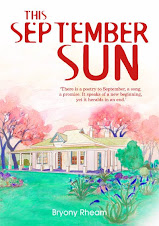
The day I finally finished reading Bryony Rheam's This September Sun, sometime in September, it was the one book I wondered about how I got to the end, why it ended, and why wasn’t I a little slower as I read it.

This September Sun is the most profound book I’ve read this year and for an author’s first book, I can only begin to think how this work can claim to be fiction. Long after I read it, there are moments of stillness when I begin to think about the book and how much of myself I see in it. Its ability to linger this long is an experience I’m learning to come to terms with.

I’ve read books: Enid Blyton’s Malory Tower series ensured I went to boarding school in a bid to relive the stories. I read another Enid Blyton book about a girl who was a gypsy, who lived in a caravan and was part of a travelling circus. I’m not even going to begin to state how, at one point, I thought my parents should sell the house we lived in, buy a caravan so we could travel and possibly join a circus too. Then there was Kaine Agary’s Yellow Yellow, from whose pages I got the name Binaebi and gave the name to my son when he was birthed. Some books leave a lasting impression. Some books will never be forgotten. This September Sun falls into that category.

The story revolves around two characters Ellie and her grandmother Evelyn. Ellie, an only child, is a loner who has more adult influences than shared experiences with children her age. Her grandmother Evelyn in this day and age, would be called a feminist. An independent woman who seeks to live her life according to her dictates. Amongst the profound things for me about this book are Ellie’s words as she tells her story. Here’s a passage from Chapter Two:

“Where do you start to put life together? The pieces don’t always fit. Many are missing, or borrowed. From other people’s lives, other people’s memories. Their own puzzles. Where is the beginning when you have only the end to start with? How many lies are told over the course of one lifetime?

What of all that is not said, merely hinted at, subsiding beneath the surface of action and words? All that is yearned for and never had?”

Even now, these lines leave me with a need of wanting to dig deep into life and uncover things I should know and do not know.

There were times when, as I read, I had the feeling the author had perhaps started a plot she did not conclude and had no intention of concluding and this was disappointing for me. Page 76, when Ellie found her grandmother naked in bed with Miles her lover. The next few pages made no mention of the incident and life continued and left me thinking what tha . . . a young girl sees her grandma naked in bed with her lover and the next thing pretends that nothing happened. Tsk, tsk. There I was a reader poking into nonexistent holes because pages into the middle, it pops up again, is mentioned and is laid to rest. That’s the sort of books TSS is, it’s unpredictable and while it doesn’t elicit a rush of adrenaline, it’s calm, it’s pulsing and holds you in a grip.

I’m a little of Evelyn, a little of Ellie, I’m in the book and I’m swept along in their struggles and as they come to terms with themselves. I love TSS. I will read it again. This time with a highlighter. I will mangle its pages, but not to uglify it but to bring out the beauty of its words so I can always take a look at them and sigh, and think.


I’ve never known a book to linger like this one
To hear echoes of its words long after I wistfully said goodbye.

To read a book as though the writer knew you and turned you outside in.
To read words and behold a mirror of your mind.

To reread it in your mind page for page.
To replay the scenes that wrenched your guts and made your eyes drip.

To think and maul.
To chew and not be able to swallow.

To wonder at how words were stringed.
To want to know what could have been going through this author’s mind.

To be afraid. Afraid. Not the sort that fear elicits, but the sort that goosebumps produce because you feel a book became a mirror and you could see a lot of yourself in it.

This September Sun began in August. Proceeded with a feverish grip in September. In its wake left thoughts and silence.

Not all fiction is truly fiction.

By irinajo. http://flittingbutterfly.com/2015/10/07/