Showing posts with label Book Cafe. Show all posts

Saturday, June 6, 2015

WIN-Zimbabwe on the launch of 'Textures'

 The Writers International Network of Zimbabwe newsletter, issue no 90 of 5 June 2015, covers the launch of John Eppel and Togara Muzanenhamo's poetry collaboration Textures.

from: http://win-zimbabwe.blogspot.com/ 

The Harare launch of ‘Textures’ (2014, amaBooks) an anthology of poetry written by the duo John Eppel and Togara Muzanenhamo did have the classic feel of writerly openness coupled with rare and significant background detail which is never revealed in the written work. The launch of ‘Textures’ took place at the Book Café in Harare on Thursday May 21. 

JOHN EPPEL’S ADVICE TO BUDDING POETS


(An excerpt from his interview with Beaven Tapureta (WIN) on the sidelines of the book launch)

“Young poets write in English because that’s how they feel they will get acknowledged or noticed but they do not have enough grasp of the language to use it in poetry. They can use it in prose but it’s different in poetry. Poetry is very subtle. There are some young poets who are starting to achieve profound poetry…. Problem with our children in this country is that they don’t read. You have to build up a basis, a tradition for yourself to be a writer. You have to read and know your poets…. If you want to write in English, read great poets who have written in that language. If you want to write in Shona, read great Shona poets…. Youngsters today are controlled by the digital world, television and internet – they hardly read. When you read something, it’s an effort, you take in material.” - John Eppel.


LAUNCH OF ‘TEXTURES’ IN PICTURES
Photographs courtesy of WIN-Zimbabwe


Togara Muzanenhamo and John Eppel pose with their 'Textures' after the launch


Eppel autographs a copy of 'Textures' for a reader

Togara happily signs autographs

The silence of 'Textures' speaks between thoughtful Togara Muzanenhamo and David Mungoshi 

A meeting with Jane Morris (centre) of amaBooks, publishers of 'Textures', is always lively and inspirational. Here she is enjoying the launch with established writers David Mungoshi (on her right) and Memory Chirere (on her left)

Ignatius T Mabasa probes the poets
ZIBF Events Coordinator Mrs. Shato also came to listen to the poetry and discussion


Rumbi Katedza, distinguished film maker, chats with David Mungoshi

British Council (Zimbabwe) Director Samantha Harvey delivers her speech

From left: Jackie Cahi, Brian Jones and Jane Morris participate in a dramatic poem led by poet Togara Muzanenhamo (not in the picture)
Writer and publisher Ignatius Mabasa (right) in conversation with Togara

John Eppel (right) answers a question asked by Mabasa

Eppel reading his poem from 'Textures'


Sunday, May 24, 2015

Textures launched in Harare

from Panorama Magazine: 
http://www.panorama.co.zw/index.php/archives/115-pan-news/856-poets-launch-new-book


Togara Muzanenhamo and John Eppel were in Harare for the launch of their poetry book, Textures, published by Bulawayo-based amaBooks.
The well-attended and engaging session was marked by readings from Textures by the two authors, followed by a conversation the two had with poet and publisher, Ignatius Tirivangani Mabasa. 
Speaking at the event, British Council Director, Samantha Harvey, said they were always looking to see how they can add value to the literary and publishing sector.
The event coincided with World Diversity Day, an occasion set aside by the United Nations International for the promotion of diversity issues. 
The concept of diversity encompasses acceptance and respect. It means understanding that each individual is unique, and recognizing individual differences. But it also requires the need to recognize how much people have in common.
 Addressing a cross-section of guests at the Harare launch, amaBooks’ Brian Jones referenced the opinion of the Director-General of UNESCO, Irina Bokova, saying:
 “Every poem is unique but each reflects the universal human experience, the aspiration for creativity that crosses all boundaries and borders, of time as well as space, in the constant affirmation of humanity as a single family.”
He said Muzanenhamo’s words in the introduction to the book are apt and quoting the much-travelled poet said:
 “It fascinates me how similar people are. You can go to any country and find we all possess the same emotions; perhaps we speak different languages, and there’s a different landscape, but the baseline to all humanity strums at the same rhythm.”
Muzanenhamo and Eppel, he said, are two very different poets with much in common.
Eppel was born in South Africa, moved to Zimbabwe when he was very young, and stayed, apart from a few years away in South Africa finishing his education. 
Muzanenhamo was born in Zambia, moved to this country when he was very young, and stayed, apart from a few years away in Europe finishing his education. 
Eppel has had four poetry collections published – all in Southern Africa. Muzanenhamo has had two poetry collections published – both in the United Kingdom.
Eppel won the Ingrid Jonker Prize for his first collection, Muzanenhamo was shortlisted for the Jerwood Aldeburgh Prize for his first collection.
Eppel is well respected as a writer – in poetry and prose, winning the MNET Prize for his debut novel, having his second chosen for the Times Literary Supplement series on the most significant books from Africa, and having five other novels, two collections of stories and poems, and two collaborations with other writers, Julius Chingono and Philani Nyoni, published.
 Muzanenhamo is well respected as a poet – he was chosen as Zimbabwe’s representative to Poetry Parnassus – the greatest gathering of poets in the world that coincided with the 2012 London Olympic Games, as well as attending the World Literature and other international festivals and residences. Soon after this launch he will be heading for Rotterdam, in the Netherlands, and the United Kingdom for a residency and festivals.
In this collection Eppel’s poems are noticeably rooted in the soil of Bulawayo; Muzanenhamo’s range more widely, from the Arctic wastes, down through North America to South America, across the Atlantic to Britain, the Netherlands and France, down to Somalia and then to rural Mashonaland farmland.
 But, as Drew Shaw says in his introduction, “they both weave words beautifully, making music, and they both adhere to a core structure of poetry – the rhythm, the rhyme…” They are both recognized masters of the craft of poetry.
 Quoting from some of the reviews of Textures, Brian Jones said: “This is a book about precious feelings”, “A journey of wonder” and “A well crafted and creatively satisfying anthology that often oozes with perfection.”
Australian poet Fred Simpson says in his review of Textures: “Their differences are obvious: one poet, grounded in Bulawayo, generally writes short, evocative, personal and structured poems to probe the subconscious and unearth, in heart-breaking beauty, penetrating truths; while the other, a citizen of the world, crafts longer narratives gathered from everywhere, and delivers them in spell-binding voice and imagery. 
“Stepping back, however, we see a pattern emerging, a collaboration that spurns the pettiness of competing poetry schools and prescribed content; we see a portrait of love which takes our breath away. Robert Graves stated that his poetic intention was ‘to mesmerise time with stored magic’. Textures achieves this.”
The launch at the Book Cafe was supported by the Culture Fund and British Council. 
Drew Shaw wrote the introduction to the book; Helen Leiros donated the painting that appears on the cover; and Veena Bhana designed the cover.


Accompanying are some of the images from the Harare launch of Textures. – © Panorama Magazine 2015.

Friday, July 12, 2013

African Violet: The Caine Prize for African Writing 2012 to be discussed at the Harare Book Cafe


The Book Club @ Book Café in Harare will next meet on Tuesday 16 July at 6 pm to discuss African Violet. 

Please come along, even if you haven't read the book, and even if you haven't come to the book club before.

For information please call 0864 406 6015

Venue: Book Cafe 139 Samora Machel Ave, corner 6th Street, Harare

What is this book club about ?
Books are better appreciated when we're able to share our experience of the writing through discussion and exploration of the text. We get ideas through learning from how others see the same story. At the book club we will read an agreed book in advance and then meet at a set time to talk about it. Our aim is to enjoy the book and discussion. This is not meant to be a study group or an academic exercise.


African Violet features the shortlisted stories from the 2012 Caine Prize for African Writing, as well as stories from those attending the Caine Prize workshop.

Copies of the book are available at the Book Café bookshop, as well as the National Gallery shop, Blackstone Books and Avondale Books in Harare. In Bulawayo, copies can be found at the National Gallery shop, Induna Arts, Tendele Crafts, Best Books and Z&N bookshop.

African Violet is published in Zimbabwe by 'amaBooks. The 2013 collection, A Memory This Size, will be published by 'amaBooks in the near future.

Monday, June 7, 2010

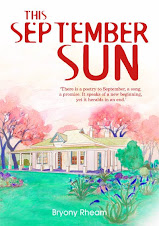
Bryony Rheam at The Book Café, Harare


Bryony Rheam, author of This September Sun, was at The Book Café in Harare on Thursday 27 May for a discussion of her book. After Bryony read a short excerpt from the novel, Eresinah Hwede of Zimbabwe Women Writers presented a paper in which she identified some of the major themes of the novel, such as that of the search for identity and the ever-shrinking world of the white Zimbabwean. Francis Mungana of Midlands State University then spoke about white writing from Zimbabwe and the insight the novel has given him into what he terms ‘the Rhodesian psyche’.

Those in the audience were given the opportunity to ask questions. Bryony was asked about the relevance of music in the novel. There are quite a number of songs quoted, mainly those of Nat King Cole. She responded by explaining that music defines an age and that it also tends to be associated with one’s youth as this tends to be the time when one is most interested in music. The songs the grandmother in the book hums are a way in which Ellie, her granddaughter, is included in her life and is allowed to experience some of the person she was when she was young. The type of songs we listen to also say something of our mood, and although the songs in the book are beautiful and romantic, they are also sad – ‘Smile though your heart is breaking.’ They help create an atmosphere of loss and longing.

Another question asked was whether Bryony felt that the publishing world was in any way biased. She felt the Western publishing world had stereotypical views of what they wanted the white African writer to produce. They don’t want what is basically a love story because they feel uncomfortable turning away from the political. A number of people in the audience applauded her sentiments and Blessing Mutinhiri, who was chairing the discussion, said that she had faced similar problems with her own work, so it is not something confined to white writers.

When asked about the research she had to do for her novel, Bryony explained that this was one of her favourite aspects as it had been so interesting talking to people who had lived in Harare in the forties. It is often the stories that people don’t mean to tell you that are the most interesting. Bryony also interviewed some ex-Rhodesian soldiers, but had failed to find any black ex-Rhodesian soldiers despite numerous pleas. She had really wanted to find someone who had served in Burma as Samson had in the novel.

In response to a question as to how long it took her to write the book, Bryony said that parts of it were written when she lived in London, about twelve years ago. The first line had come to her after a talk with two friends, one of whom had mentioned the burning of the British flag at Brady Barracks at Independence. The rest of the novel had developed from there, but she had never had a very clear or set idea about what she was writing.

The literary discussion at The Book Café was supported by Pamberi Trust, British Council and ’amaBooks Publishers.