Showing posts with label British Council Zimbabwe. Show all posts

Saturday, June 6, 2015

WIN-Zimbabwe on the launch of 'Textures'

 The Writers International Network of Zimbabwe newsletter, issue no 90 of 5 June 2015, covers the launch of John Eppel and Togara Muzanenhamo's poetry collaboration Textures.

from: http://win-zimbabwe.blogspot.com/ 

The Harare launch of ‘Textures’ (2014, amaBooks) an anthology of poetry written by the duo John Eppel and Togara Muzanenhamo did have the classic feel of writerly openness coupled with rare and significant background detail which is never revealed in the written work. The launch of ‘Textures’ took place at the Book CafĂ© in Harare on Thursday May 21. 

JOHN EPPEL’S ADVICE TO BUDDING POETS


(An excerpt from his interview with Beaven Tapureta (WIN) on the sidelines of the book launch)

“Young poets write in English because that’s how they feel they will get acknowledged or noticed but they do not have enough grasp of the language to use it in poetry. They can use it in prose but it’s different in poetry. Poetry is very subtle. There are some young poets who are starting to achieve profound poetry…. Problem with our children in this country is that they don’t read. You have to build up a basis, a tradition for yourself to be a writer. You have to read and know your poets…. If you want to write in English, read great poets who have written in that language. If you want to write in Shona, read great Shona poets…. Youngsters today are controlled by the digital world, television and internet – they hardly read. When you read something, it’s an effort, you take in material.” - John Eppel.


LAUNCH OF ‘TEXTURES’ IN PICTURES
Photographs courtesy of WIN-Zimbabwe


Togara Muzanenhamo and John Eppel pose with their 'Textures' after the launch


Eppel autographs a copy of 'Textures' for a reader

Togara happily signs autographs

The silence of 'Textures' speaks between thoughtful Togara Muzanenhamo and David Mungoshi 

A meeting with Jane Morris (centre) of amaBooks, publishers of 'Textures', is always lively and inspirational. Here she is enjoying the launch with established writers David Mungoshi (on her right) and Memory Chirere (on her left)

Ignatius T Mabasa probes the poets
ZIBF Events Coordinator Mrs. Shato also came to listen to the poetry and discussion


Rumbi Katedza, distinguished film maker, chats with David Mungoshi

British Council (Zimbabwe) Director Samantha Harvey delivers her speech

From left: Jackie Cahi, Brian Jones and Jane Morris participate in a dramatic poem led by poet Togara Muzanenhamo (not in the picture)
Writer and publisher Ignatius Mabasa (right) in conversation with Togara

John Eppel (right) answers a question asked by Mabasa

Eppel reading his poem from 'Textures'


Sunday, May 24, 2015

Textures launched in Harare

from Panorama Magazine: 
http://www.panorama.co.zw/index.php/archives/115-pan-news/856-poets-launch-new-book


Togara Muzanenhamo and John Eppel were in Harare for the launch of their poetry book, Textures, published by Bulawayo-based amaBooks.
The well-attended and engaging session was marked by readings from Textures by the two authors, followed by a conversation the two had with poet and publisher, Ignatius Tirivangani Mabasa. 
Speaking at the event, British Council Director, Samantha Harvey, said they were always looking to see how they can add value to the literary and publishing sector.
The event coincided with World Diversity Day, an occasion set aside by the United Nations International for the promotion of diversity issues. 
The concept of diversity encompasses acceptance and respect. It means understanding that each individual is unique, and recognizing individual differences. But it also requires the need to recognize how much people have in common.
 Addressing a cross-section of guests at the Harare launch, amaBooks’ Brian Jones referenced the opinion of the Director-General of UNESCO, Irina Bokova, saying:
 “Every poem is unique but each reflects the universal human experience, the aspiration for creativity that crosses all boundaries and borders, of time as well as space, in the constant affirmation of humanity as a single family.”
He said Muzanenhamo’s words in the introduction to the book are apt and quoting the much-travelled poet said:
 “It fascinates me how similar people are. You can go to any country and find we all possess the same emotions; perhaps we speak different languages, and there’s a different landscape, but the baseline to all humanity strums at the same rhythm.”
Muzanenhamo and Eppel, he said, are two very different poets with much in common.
Eppel was born in South Africa, moved to Zimbabwe when he was very young, and stayed, apart from a few years away in South Africa finishing his education. 
Muzanenhamo was born in Zambia, moved to this country when he was very young, and stayed, apart from a few years away in Europe finishing his education. 
Eppel has had four poetry collections published – all in Southern Africa. Muzanenhamo has had two poetry collections published – both in the United Kingdom.
Eppel won the Ingrid Jonker Prize for his first collection, Muzanenhamo was shortlisted for the Jerwood Aldeburgh Prize for his first collection.
Eppel is well respected as a writer – in poetry and prose, winning the MNET Prize for his debut novel, having his second chosen for the Times Literary Supplement series on the most significant books from Africa, and having five other novels, two collections of stories and poems, and two collaborations with other writers, Julius Chingono and Philani Nyoni, published.
 Muzanenhamo is well respected as a poet – he was chosen as Zimbabwe’s representative to Poetry Parnassus – the greatest gathering of poets in the world that coincided with the 2012 London Olympic Games, as well as attending the World Literature and other international festivals and residences. Soon after this launch he will be heading for Rotterdam, in the Netherlands, and the United Kingdom for a residency and festivals.
In this collection Eppel’s poems are noticeably rooted in the soil of Bulawayo; Muzanenhamo’s range more widely, from the Arctic wastes, down through North America to South America, across the Atlantic to Britain, the Netherlands and France, down to Somalia and then to rural Mashonaland farmland.
 But, as Drew Shaw says in his introduction, “they both weave words beautifully, making music, and they both adhere to a core structure of poetry – the rhythm, the rhyme…” They are both recognized masters of the craft of poetry.
 Quoting from some of the reviews of Textures, Brian Jones said: “This is a book about precious feelings”, “A journey of wonder” and “A well crafted and creatively satisfying anthology that often oozes with perfection.”
Australian poet Fred Simpson says in his review of Textures: “Their differences are obvious: one poet, grounded in Bulawayo, generally writes short, evocative, personal and structured poems to probe the subconscious and unearth, in heart-breaking beauty, penetrating truths; while the other, a citizen of the world, crafts longer narratives gathered from everywhere, and delivers them in spell-binding voice and imagery. 
“Stepping back, however, we see a pattern emerging, a collaboration that spurns the pettiness of competing poetry schools and prescribed content; we see a portrait of love which takes our breath away. Robert Graves stated that his poetic intention was ‘to mesmerise time with stored magic’. Textures achieves this.”
The launch at the Book Cafe was supported by the Culture Fund and British Council. 
Drew Shaw wrote the introduction to the book; Helen Leiros donated the painting that appears on the cover; and Veena Bhana designed the cover.


Accompanying are some of the images from the Harare launch of Textures. – © Panorama Magazine 2015.

Wednesday, November 12, 2014

Novuyo Rosa Tshuma's 'Shadows' longlisted for Etisalat Prize


Photograph courtesy Fungai Machirori
Novuyo Rosa Tshuma's debut novella and short story collection, Shadows, has been longlisted for the 2014 Etisalat Prize for Literature. Novuyo's stories have appeared in several anthologies, including the 'amaBooks anthologies Silent Cry: Echoes of Young Zimbabwe Voices and Where to Now? Short Stories from Zimbabwe. Shadows contains Novuyo's short story, 'Crossroads', which was previously published in Where to Now? and, in isiNdebele, in Siqondephi Manje?Indatshana zaseZimbabwe. Where to Now? was co-published with Parthian Books in the United Kingdom.

This is the second year of the Etisalat Prize, the first recipient of the award was NoViolet Bulawayo for her novel We Need New Names. Both Novuyo and NoViolet come from Bulawayo.

Novuyo first came to the attention of 'amaBooks as a participant in the British Council's ‘Identity and Diversities’ Project, which culminated in us publishing the young people’s anthology Silent Cry: Echoes of Young Zimbabwe Voices, in which Novuyo was first published. At nineteen, her short story, 'Scattered Hearts', published in this anthology, was described by Dr Petros Ndlovu as ‘beautiful and powerful prose which fosters an appreciation of the personality of the young author who is so gifted in thought, analysis, problem-solving as well as English expression’. Novuyo went on to represent the project at the Identities and Diversities Youth Summit in Lusaka, Zambia 2007, and later at the Global Change-makers Africa Youth Summit in Cape Town, South Africa 2009.

Shadows is a winner of the 2014 Herman Charles Bosman Prize. bookshybooks.blogspot.com, in her review of the Etisalat longlist, commented, 'With this debut novella and collection of short stories the reader is introduced to a startling new voice in African literature. Novuyo Tshuma sketches, with astounding accuracy, the realities of daily life in Zimbabwe and the peculiar intricacies of being a foreigner in Johannesburg. Vivid, sparse and, at times, tragically beautiful.'

Thursday, August 28, 2014

The Gonjon Pin launched in Harare

Harare’s Book CafĂ© attracted a capacity audience for the launch of the 2014 Caine Prize anthology, The Gonjon Pin, where four of the authors – Isabella Matambanadzo, Violet Masilo, Lawrence Hoba and Philani Nyoni – were in attendance to read from their work, sign copies of the book and to discuss issues relating to their writing and the Caine Prize.
The authors responded to a variety of questions, including whether or not the Prize influenced their work, why they wrote short stories as opposed to novels or poetry, how to inject hope into “African stories”, what constitutes an “African story” and the absence of laughter in the “African story”.
The Gonjon Pin features 17 short stories by the writers from across the African continent, including three other Zimbabwean writers who were unable to attend: Barbara Mhangami, Bryony Rheam and Tendai Huchu. The other writers published in the anthology are from Ghana, Kenya, Nigeria and Somalia.
The event was chaired by Roger Stringer of Harare City Library and the discussion facilitated by Memory Chirere. The Guest of Honour was the Kenyan Embassy Consul, Ms Damary Nafula.
The book, published by 'amaBooks in Zimbabwe with the support of the Beit Trust, is available in outlets across the country, and as an ebook through shop.mazwi.co.
'amaBooks would like to thank British Council Zimbabwe, Harare City Library, The Red Fox Hotel, The Book Cafe, Lawrence Hoba and the other writers for their support of the event.


Photographs courtesy of Lawrence Hoba and British Council Zimbabwe

Tuesday, August 12, 2014

The Gonjon Pin to be launched in Harare


The Gonjon Pin and other stories, the 2014 Caine Prize anthology, is to be launched in Harare at the Book Cafe, 139 Samora Machel, at 5.30pm on Thursday 14 August. All Welcome, Free Admission.

The book features short stories from the winner of the 2104 prize, Kenya's Okwiri Oduor, from the other four shortlisted writers and from the twelve writers from across Africa who participated in the 2014 Caine Prize Workshop, which was held this year in Zimbabwe.

There are seven Zimbabwean writers in the anthology: Tendai Huchu,  Lawrence Hoba, Violet Masilo, Isabella Matambanadzo, Barbara Mhangami-Ruwende, Philani A. Nyoni and Bryony Rheam. It is anticipated that four of the Zimbabwean writers will be at the Harare launch, which will include readings from the anthology and a discussion about Zimbabwean writing, the short story form and the Caine Prize. There will also be an opportunity to have your copy of the book signed and to chat with the writers over a glass of wine.


Friday, October 18, 2013

Authors, Publishers, Techprenuers Converge In Byo

From the Financial Gazette 17 October 2013

http://www.financialgazette.co.zw/authors-publishers-techprenuers-converge-in-byo/

by Admire Kudita


“There have been dramatic changes in the publishing industry over the last few years due to new technology and it is important that writers are aware of the different ways in which they can publish their work in order to make an informed decision. publishersThere are many factors to consider and what may suit one writer may not be the best approach for another,” said Jane Morris of amaBooks Publishers, an independent publishing house, at a recently held workshop at Selbourne Hotel in Bulawayo.
The meeting which saw about fifty established and aspiring writers converge at the local hotel, was held under the auspices of the major arts festival and funded by the British Council. This would be the third time that the workshops have been run in as many years. The workshop weighed the pros and cons of traditional and self-publishing. Traditional publishing has its advantages of allowing the author to concentrate on their core competency: writing, and has no financial risk accruing to the writer.These benefits are juxtaposed against those of self-publishing in that authors have creative autonomy,control, less bureaucracy and a larger percentage of the profit.
The last few years have witnessed a number of developments that are altering the publishing landscape. These are eBooks which are read on e-readers and devices such as Kindle and other cutting edge communication devices, on demand printing, short run printing, Amazon shorts (short books) and importantly, crowd-funding. Interestingly, there are also innovations that enable eBook authors to receive feedback from readers. 
At the workshop it was my honour to meet a very smart Zimbogeek called Tafadzwa Makura from Harare. Okay, here is why he deserves mention on this platform: the tech wiz is the conceptualiser of Mazwi. Mazwi is a ‘revolutionary platform’ built around a simple application. It is an all in one mobile book market place that lets local writers and publishers share and sell stories in digital form directly to mobile devices. 
The groundbreaking innovation was conceived to help mitigate the increasing costs of printing, distribution and marketing for writers and publishers in emerging markets. 
“We are making premium local stories from local writers and publishers available to over a billion mobile internet users across the world on most mobile devices for a fraction of the cost. We are calling it a revolution because it is,” states the Mazwi innovators.
The system works like this: authors and publishers approach Mazwi and sign agreements that allow them to submit final drafts for uploading on to the Mazwi server. Book lovers can download the Mazwi app for free   to their phones, tablets and computers. They can then pay for the book via Ecocash, PayPal and Visa after which it is downloadable to the  communication device. The seller takes 30 percent and the rest goes to the author or copyright holder. Potential uses for the app is in e-learning, literacy programmes and digital libraries among others. Currently, the content partners of the company are Weaver Publishers (the local publishers of NoViolet Bulawayo), amaBooks and Innov8. The institutional and technological partners of the company are British Council, Alliance Francaise, biNu, iWayAfrica, TechZim and Worldreader.
Significantly, the diffusion of innovations i.e. the internet, smart phones and tablets has impacted negatively on the market for printed books. Rather than ignore the reality, authors and publishers are  being given an opportunity to adapt and profit from platforms such as Mazwi.
How extensively and speedily the innovation diffuses into the targeted emerging world markets will have a lot to do with the activation and sustenance of the reading culture of peoples in those same markets.
To my mind, the Mazwi application, being downloadable free of charge to mobile communication devices just like the popular Whatsapp application, is a sterling example of the creativity of Zimbabweans in meeting contemporary challenges.
Interested authors, publishers and book lovers can access the platform on www.openbook.ziguru.com

Wednesday, September 25, 2013

NoViolet Bulawayo Comes Home to Bulawayo


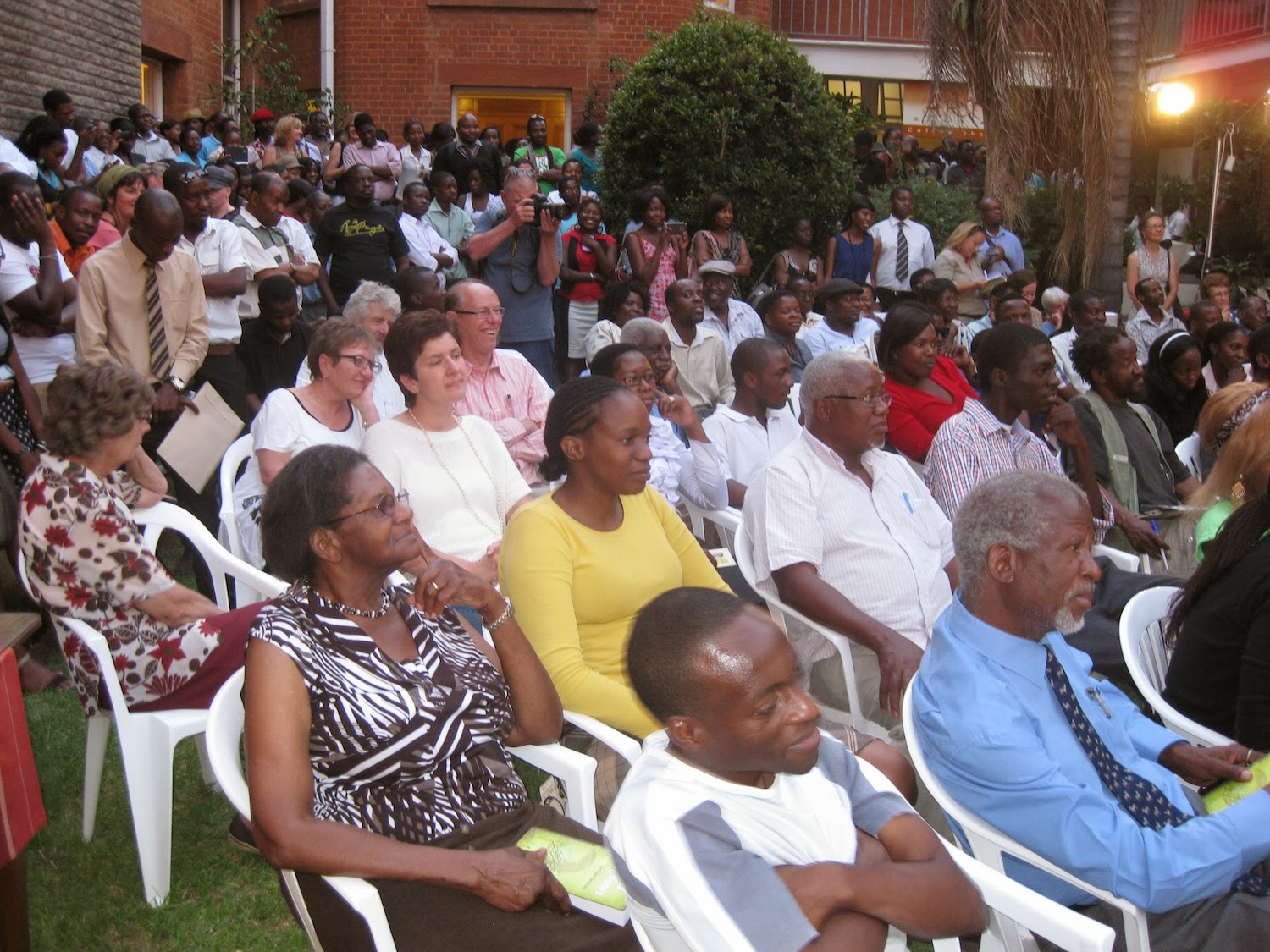
The launch of NoViolet Bulawayo’s debut novel ‘We Need New Names’ at the National Gallery of Zimbabwe in Bulawayo on September 17 was a memorable occasion. It had been a long while since the gallery had hosted such a crowd, with over 300 people packing into the courtyard to welcome NoViolet home and to hear her in conversation with Dr Drew Shaw of the National University of Science and Technology. To use NoViolet’s words:
'Bulawayo came out proper with a crowd of close to 300, i'm made to understand, and gave me the launch of my dreams even as i had been told that folks in the City of Kings don't come out much anymore. very honored by the presence of many people i admire, and the many i do not know, who saw me worthy of their time and ears and hearts. then there was Ericah Gwetai (mother of the late Yvonne Vera, who found me in a room before the launch and sang me a song, dlala nkazana ♥). if you see me walk like i own the earth, forgive me because i'm suffering from too much love, from a small, proud place that came out big to show me who they were, and who i was. that was not a launch, it was a baptism, and Bulawayo, blue eyed city you, home of my girlhood you, you Bulawayo, ngiyazendlala on your feet with gratitude, thank you kabanzikazi.'

The launch was organised by ’amaBooks Publishers, the British Council – Zimbabwe, the Intwasa Arts Festival koBulawayo and Bulawayo Agenda. The book is published by Weaver Press in Zimbabwe and distributed by ’amaBooks in Bulawayo.


The link to the soundcloud recording of NoViolet Bulawayo's conversation with Drew Shaw during the Bulawayo launch of We Need New Names is below.

https://soundcloud.com/drew-shaw-6/noviolet-bulawayo-in?utm_source=soundcloud&utm_campaign=share&utm_medium=twitter


Photographs courtesy of Lene Lauritsen and Intwasa Arts Festival koBulwayo

Tuesday, September 24, 2013

Publishing and The Writer workshop at Intwasa

Intwasa Arts Festival koBulawayo, British Council Zimbabwe and amaBooks Publishers invite you to the workshop

Publishing and The Writer

Thursday 26 September 11.00- 13.00
Selborne Hotel, Bulawayo

An informal meeting of writers to discuss writing and publishing options, particularly in the light of new technologies. The meeting will include sharing of experiences and will be facilitated by Jane Morris and Brian Jones of amaBooks Publishers. 


All welcome.

Saturday, September 14, 2013

A busy week for literary Bulawayo


NoViolet Bulawayo at the Indaba Book Cafe in Bulawayo
The big event of the week is the hometown launch of NoViolet Bulawayo’s debut novel ‘We Need New Names’, at 5.30pm on Tuesday 17 September in the courtyard of the National Gallery in Bulawayo. The book has been long-listed for the Guardian First Book Award and short-listed for the Man Booker Prize. NoViolet is the first Zimbabwean, and the first Black African woman, to be shortlisted for the Man Booker, which has been one of the most prestigious literary awards for 42 years. The event, open to all, will feature readings by NoViolet as well as a conversation between NoViolet and Dr Drew Shaw of the National University of Science and Technology. The event is supported by amaBooks, British Council Zimbabwe, Bulawayo Agenda and Intwasa Arts Festival koBulawayo.
Earlier that day, NoViolet will facilitate a workshop for promising Bulawayo writers. The participants have been selected from those who have entered the Intwasa Short Story competition for the Yvonne Vera Award.
The next day, on Wednesday 18 September, there will be another literary event, at 5.30pm in the John Knight Cinema at the National Gallery. This time it will be a slide show presentation by Dr Drew Shaw, titled 'Looking back / Looking forward: Zimbabwean literature of the GNU period, 2009-2013', to be followed by discussion about whether or not we can see discernible trends in the national literature and critical studies of it in the last four years. As the title suggests, some literature casts its gaze back to earlier times, while other writing considers the contemporary situation or 'Where to Now?' (which is the title of one short story collection under discussion, published by amaBooks). On 29th June, Dr Shaw gave this presentation at the Britain Zimbabwe Society's 'Culture Without Borders' Research Day in Oxford and got interesting responses from Zimbabweans in the Diaspora. Now the idea is to get Zimbabwe-based perspectives as we continue the discussion.
At the same time on Wednesday, Susan Hubert will be launching her novel ‘Sabi Star’ at DĂ©jĂ  vu.

On Friday 20 September, at 5.30pm in the National Gallery, Styx Mhlanga will launch ‘Acting Exercises & Games for Drama Plays in Schools & Colleges’.


Wednesday, September 11, 2013

NoViolet Bulawayo comes home


NoViolet Bulawayo comes home to Bulawayo to launch her debut novel We Need New Names.
The launch will take place on Tuesday 17 September at 5.30pm at the National Gallery of Zimbabwe in Bulawayo. The event has been organised and supported by 'amaBooks Publishers, British Council Zimbabwe, Intwasa Arts Festival koBulawayo and Bulawayo Agenda. All are welcome to attend the launch, there is no admission charge. The book has been longlisted for the Guardian First Book Award and has just been shortlisted for the prestigious Man Booker Prize. We Need New Names is published in Zimbabwe by Weaver Press and distributed in Bulawayo by 'amaBooks.
NoViolet was in Bulawayo a couple of weeks ago, meeting with Jane Morris and Brian Jones of 'amaBooks to discuss arrangements for her launch and other activities to promote an interest in literature in Bulawayo. Before the launch, NoViolet is to facilitate a workshop for promising writers from the city.
Her short story, Snapshots, was published in 2011 by 'amaBooks in the anthology Where to Now? Short Stories from Zimbabwe. The anthology was co-published with Parthian Books in the UK. The collection is being translated into isiNdebele and will be published by 'amaBooks later this year.
NoViolet is a past winner of the Caine Prize for African Writing and, for the last two years, 'amaBooks have published the Caine Prize anthology in Zimbabwe.