Wednesday, March 5, 2014

Caine Prize returns to Zimbabwe in its fifteenth year


The Caine Prize for African Writing will return to Zimbabwe in its fifteenth year to hold its annual workshop this month. The inaugural Caine Prize was awarded to Leila Aboulela in 2000, at the Zimbabwe International Book Fair in Harare.

Thirteen writers from seven African countries will convene at the Leopard Rock Hotel for twelve days (21 March - 2 April) to write, read and discuss work in progress and to learn from two experienced writers, Nii Parkes and Henrietta Rose-Innes who will act as tutors and animateurs.

This year’s participants include four 2013 shortlisted writers; Abubakar Ibrahim (Nigeria), Elnathan John (Nigeria), Chinelo Okparanta (Nigeria) and Pede Hollist (Sierra Leone) and nine other promising writers; Martin Egblewogbe (Ghana), Abdul Adan (Somalia), Clifton Gachagua (Kenya), Nkiacha Atemnkeng (Cameroon) and Barbara Mhangami-Ruwende, Philani Nyoni, Bella Matambanadzo, Lawrence Hoba and Bryony Rheam from Zimbabwe.

During the workshop, the writers will be expected to write a short story for inclusion in the 2014 Caine Prize anthology, which will be published by New Internationalist on 1 July 2014 and subsequently by seven co-publishers in Africa. Each year the stories conceived at the workshops are automatically entered for the following year’s Prize.

The primary supporter of this year's workshop is the Beit Trust. Supplementary funding is provided by the Oppenheimer Memorial Trust, Exotix, Cambria and the British Council.

Dr Lizzy Attree commented on the significance of holding the workshop in Zimbabwe this year: “The Caine Prize is delighted to be back in Zimbabwe for its twelfth workshop. The success of NoViolet Bulawayo has inspired so many writers and we are keen to nurture talent both at the workshop and by visiting local schools.”

The programme will include a visit to local senior schools, giving students the opportunity to interact with the writers.

The workshop will also incorporate two public events in Harare; the first in collaboration with the British Council will be held at Harare City Library on 1st April. It will include a discussion about contemporary African literature after which there will be opportunities to meet the writers and purchase signed copies of the anthology from AmaBooks, over a complimentary glass of wine.

The second event, sponsored by Meikles Mega Market and Meikles Foundation, will be held the following day at 10am at Tambira hub in the new Meikles Mega Market. The open forum entitled “Caine Prize Writers in the Supermarket” will be chaired by Tinashe Mushakavanhu, and is free for the public to attend. The writers will also be treated to a surprise tour of Meikles Hotel.

Sunday, March 2, 2014

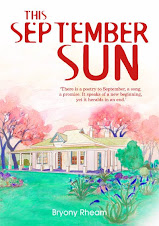
This September Sun reviewed on wild-thistle.net


Title: This September Sun
Author: Bryony Rheam
Published: amaBooks (Zimbabwe) Parthian Books (UK)
Pages: 420

Ellie, a shy girl growing up in modern Zimbabwe, has a close attachment to her grandmother Evelyn. However, when Ellie is an adult living in England, she receives the news her beloved grandmother has been brutally murdered, apparently without reason.
Ellie returned to Zimbabwe where she finds some old letters and diaries chronicling the life of her grandmother as she arrives in Rhodesia as a young war widow and has a longstanding affair with a married man.


This September Sun is the heartwarming story of Ellie, a white girl born in Zimbabwe, the former British colony of Rhodesia, which is now an independent and a predominantly black society. Ellie is a child in the first part of the book so we learn about her family and the changes taking place in society through her eyes, and since she is too young to understand what is really going on, the author lays the groundwork for a lot of the mystery concerning the life of Ellie’s grandmother, Evelyn. Ellie’s family used to live under the same roof but an explosive argument between her grandparents lead to Evelyn moving into her own flat where Ellie visits her once a week.
While visiting her grandmother, Ellie meets Miles, a friend of Evelyn’s, who makes her feel uneasy although she’s not sure why but we can see that Miles is Evelyn’s lover and it is the first hint we have that Evelyn is a passionate woman with secrets. No one else in the family is aware of Miles’s existence and Ellie begins to realise she is slowly being drawn into her grandmother’s web of lies. As Ellie grows up, she continues to be close to her grandmother but doesn’t really understand some of the decisions Evelyn begins to make and she is increasingly confused by it.
While Ellie is growing up, the familial events are mirrored by what is going on in Bulawayo with the changing political climate in Zimbabwe. Although there are no specific events described, the sense of unease is very prevalent as Ellie reveals many of her classmates are leaving the country to begin new lives in South Africa, England or Australia. The sense of displacement is very evident in Ellie as she struggles to find her own identity and yearns to go to England, believing Zimbabwe is no longer where she belongs.
When Ellie is studying in England, she continues to correspond with her grandmother and she is devastated when she receives a call in the middle of the night telling her Evelyn has been murdered. Ellie returns to Bulawayo where she finds Evelyn’s diaries chronicling her life in Zimbabwe and this is when the book really came alive for me. The impact of Evelyn’s murder on the family is interspersed with extracts in her diary which slowly reveal the answers to the mysteries raised in the first part of the book, including her grandmother’s lifelong affair with a married man. The diary extracts aren’t revealed in chronological order but jump back and forth through the decades as the story unravels but it is done in a fairly logical way so there is no confusion. When the events of Ellie’s life described in the first few chapters begin to appear, we gain a different perspective on what happened which enriches our understanding.
Reading about her grandmother’s life as a young woman is also a learning experience for Ellie as she begins to question the choices she’s made and realises she’s been deceiving herself. Once Evelyn’s story is concluded, it dawns on Ellie that she has been settling for second best and her heart really does yearn to return to Africa which has always been her home.


http://www.wild-thistle.net/2013/06/this-september-sun-by-bryony-rheam/

Friday, January 24, 2014

The African novel is too political? Tendai Huchu

THE AFRICAN NOVEL IS TOO POLITICAL?

from http://www.afrofutures.com/magazine/african-political/

JANUARY 23, 2014 BOOKS & POETRY / FEATURES / OPINION / POLITICS / REVIEWS /

by  Tendai Huchu

In the last few years, or has it always been the case, it has become fashionable for critics and readers to grumble about the overt socio-political dimension of most African fiction. They have complained about clichéd depictions of Africa – starving kids with AK47s, corruption, poverty, flies… you get the drift. The general idea is that there is need to move from this social realist type fiction to something less political. To buttress this argument, they point to greater thematic diversity in the Western canon compared with what one finds in African Literature. Now, of course, the middle-aged white American male writer can write a long novel about his experience of suffering a catastrophic mental breakdown because the barista in Starbucks served him a Frappuccino instead of a Cappuccino, and people will read this and think it is profound, worthy of critical acclaim and a piercing analysis of the human condition. The question becomes – so why don’t African writers do this? There have been attempts to reenvision the literary and journalistic output from the continent so we move away from the heart of darkness narrative that has dominated the postcolonial era. Wainaina’s How Not To Write About Africa and Selasi’s Afropolitan concept can be viewed as important steps in this direction.
As a writer of realist fiction (perhaps not in the academic sense but in the sense of writing outside the fantastic), I struggle with the idea that I can legitimately produce work that does not reference the political framework in which the society I am writing about is set. It is the equivalent of writing about living fish and never mentioning water. The societies in which we live are political entities and the politics determines every aspect of our existence that we may or may not even be conscious of. Without labouring the point, politics determines what you can or cannot do, who you may or may not marry, where you can or cannot go, what you can or cannot say, etc, etc. In his Diary of a Bad Year, Coetzee writes, “We are born subject. From the moment of birth we are subject. One mark of this subjection is the certificate of birth. The perfected state holds and guards the monopoly of certifying birth. Either you are given (and carry with you) the certificate of the state, thereby acquiring an identity which during the course of your life enables the state to identify you and track you (track you down); or you do without an identity and condemn yourself to living outside the state like an animal (animals do not have identity papers). Not only do you enter the state without certification: you are, in the eyes of the state, not dead until you are certified dead; and you can be certified dead only by an officer who himself (herself) holds state certification…”
Coetzee eloquently sums up the totality of the nation state’s grip on its citizens, whether they will it or not, much better than I ever could.
I posit that a writer coming from a prosperous liberal democracy where there is a degree of tolerance and freedom and prosperity might find it easier to write a work that does not overtly demonstrate the interplay between people and power, the state and its citizens, in ways a writer from a poor totalitarian regime might not. As a Zimbabwean who lives in Britain, I can tell you, first hand, how there is a world of difference between how one perceives the political-power structures in the two environments. In Zimbabwe, power is brute and overt, it looms large over the landscape – an inescapable reality; whereas in Britain it seems to operate as a sort of hum, a background noise that one is aware of but largely hides itself in the background. My experience is, of course, not the same as that of every other writer from my own country, let alone from the entire continent – there is no single African reality – but I still wish to argue that where people feel the direct/overt effects of the political arrangement in their state, they cannot airbrush this from the stories they tell. Yes, ordinary life still happens, but the individual is more conscious of the effects of power than your typical Westerner. It is a very human trait that we notice and remember negative things far much more than we do for positive things.
The question should be: Is it possible to write truthfully about African societies without engaging with the fundamental socio-political reality that makes them what they are? If fiction acts as a mirror to reality and the African novel is too political, then, I believe, this is merely a reflection that Africa itself is too political a place.


Wednesday, January 22, 2014

2013 Caine Prize for African Writing anthology, A Memory This Size, reviewed

Diaspora writers dominating the Caine Prize


By Rob Gaylard

A feature of this year's Caine Prize collection of stories, A Memory this Size and Other Stories (Jacana in South Africa, 'amaBooks in Zimbabwe), is the prominence of what one might call diasporic stories, such as Tope Folarin's prize-winning story, Miracle. Given the salience of novels like Brian Chikwava's Harare North and NoViolet Bulawayo's We Need New Names, this seems to reflect an emerging trend in African writing. (Bulawayo was the 2011 Caine Prize winner.)

A second feature of the collection is the absence of any stories from South Africa. Since our writers have clearly not suddenly stopped writing short stories, this seems surprising, and may be a comment on the process of selection or the criteria for inclusion in the collection.
There are five short-listed stories of which four are, rather remarkably, by Nigerian authors (or authors with a connection to Nigeria). A further 13 stories came out of this year's Caine Prize workshop, held on the shores of Lake Victoria. Four of these 13 stories were submitted by Ugandans.
The first story in the collection is Folarin's Miracle - on the evidence of this story, the author is clearly Nigerian/American. He tells us, "I'm a writer situated in the Nigerian disapora, and the Caine Prize means a lot - it feels like I'm connected to a long tradition of African writers."
It seems pointless to debate whether someone who was born in America can be described as an "African" - one infers from the story that the author's Nigerianness is an important part of his identity, and he falls squarely within the definition of "African writer" inscribed in the Caine Prize rules.
The story explores the issue of faith and belief, and provides a vivid first-person account of a revivalist service at which a blind prophet performs what are alleged to be miracles. The story does not confirm that any miracle has taken place - but it does affirm the ties of family and community, and suggests that "both (truths and lies) must be cultivated for the community to survive".
The congregation consists entirely of Nigerian exiles or sojourners in America, and the story balances the narrator's scepticism against the repeated affirmation, "We need miracles".
The American connection is reinforced by the second story in the collection, Pede Hollist's Foreign Aid. The story is a deftly narrated, somewhat ironic, cautionary tale about the folly of the "Been-to" who imagines he can return to his native land (in this case Sierra Leone), rather like a deus ex machina, putting right whatever is wrong and making up for his 20-year absence (and neglect of his family).
As the story unfolds the scales are lifted from Logan's eyes and he comes to realise the futility of his efforts. His sister, Ayo, points out, "Out here. We manage. We do what we have to do". The story could have been subtitled The Americanisation of Balogan/Logan: it explores the dissonance set up by the manners and expectations of the returnee, Logan, the "self-made man from ICU (the Inner City University)", whose "fanny pack" of dollars rapidly runs out. One quotation will help to illustrate the inventiveness of the writing:
"Logan was left severely to himself. He felt powerless, useless like a kaka bailer who arrives at a large family latrine with only a small tamatis cup, unable to and incapable of handling the crap that had been generated."
Ironically, much of the "crap" has been generated through Logan's efforts to assist his family.
In contrast, Elnathan John's Bayin Layi, set in a Hausa-speaking and predominantly Muslim part of Nigeria, plunges us in media res. The narrator is Dantali, one of a group of homeless boys who sleep under the kuka tree in the town of Bayan Layi.
These boys "like to boast about the people they have killed". We are introduced to their seemingly amoral perspective: without the security or guidance of home or parents, they are easily sucked up into what seems to be standard election-time violence in Nigeria.
Driven by desperation or greed, they stop at nothing; in their hands machetes become lethal weapons. They seem to have internalised the worst aspects of the society around them. These include ethnic hatred (one boy is killed partly "because he has the nose of an Igbo boy") and homophobic violence (another victim is referred to as "a disgusting dau dauda" (or effeminate homosexual).
The effect of the plain, unvarnished narrative is chilling: "I am not thinking as we move on, burning, screaming, cutting, tearing. I don't like the feeling in my body when this machete cuts flesh so I stick to the fire and take the matchbox from Banda." At the end our narrator is running "far, far away from Bayan Layi" - but to what possible future? The references to Allah and the call of the muezzin form an ironic backdrop to the grim action of the story.
Chinelo Okparanta's America is, as the title suggests, another of the diasporic stories in the collection. The action of the story is located in or near Port Harcourt, in the oil-rich Niger delta region of Nigeria. America features as a kind of promised land, a longed-for utopia. The narrator is Nnena Etoniru, a high school science teacher, who hopes to obtain the magic green card that will allow her to join her lover, Gloria Oke, in the US.
Two central themes weave through the story: first, there is its restrained, understated treatment of the narrator's same-sex relationship with Gloria; second, there is its more overtly foregrounded environmental theme. The delta was once filled with mangroves: "birds flew and sang in the skies above the mangroves? Now the mangroves are dead, and there is no birdsong at all. And of course there are no fish, no shrimp, and no crab to be caught." Young children emerge from the waters of the creek coated with oil. Oil, in fact, runs like a leitmotif through the story: the Gulf oil spill creates an ironic link between America and Nigeria and provides a pretext for Nnena's visit to America (she hopes to study the methods used to deal with the oil spill and apply them back home in Nigeria.)
In fact, the narrator's motives are mixed, and she is more torn than she realises. The story concludes with a deliberately ambiguous, open-ended folk tale. It skilfully links seemingly disparate issues, and deepens our understanding of the attraction of America. Will our aspirant eco-activist join those who have "(got) lost in America"?
All the stories were shortlisted for the Caine Prize. The stories in the second part of the anthology cover a range of topics and encompass a variety of styles. A Memory This Size by Elnathan John (again) is a simple tale simply told, dealing with the perennial subject of loss - in this case the loss of a younger brother through drowning. It explores a recurring dilemma: does one hold on to the memory, or does one let it go? "So I keep his photos close, and do not fight the sadness. I let fresh tears drop, 10 years after."
One of the most entertaining stories in the collection is undoubtedly Stuck, in which Davina Kawuna breathes new life into an old form, the epistolatory narrative. The story consists of a series of rather breathless, confessional e-mails about a "not-yet-affair", written by Nandi to her online "friend", Connie, whose response, when it finally comes, should be entered into the lists of famous literary put-downs.
Ecological concerns resurface in Stanley Kenani's Clapping Hands for a Smiling Crocodile. Set on the shores of Lake Malawi, it deals with the concerns of a fishing community whose livelihood is threatened by the operations of an oil company. In grandfather's words, "to us, fish is everything. If you kill our lake, we are dead." Do they acquiesce, or do they resist, and what form can this resistance take? Should one try to appease "a smiling crocodile".
Gender issues are central to Wazha Lopang's The Strange Dance of the Calabash. It evokes the stark attitudes towards women and marriage in traditional, patriarchal Botswanan society, and contains an unexpected twist. The narrator, aged 13, is apparently being married off to a man she does not know (this isn't the twist).
Hellen Nyana's short but not-so-simple story, Chief Mourner, also deals with the loss of a loved one, this time a boyfriend. The narrator finds out about the death of her boyfriend via Facebook - and it turns out that this is no hoax. Her status is uncertain - their relationship has not even been made "official" on Facebook, and she is unsure about mourning etiquette. The story has more than one surprise to spring, and repays careful reading.
One or two stories are not really accessible to the general reader, and seem to require a knowledge of the local context. Fortunately, most of the stories are readable and entertaining.
The Caine Prize is now in its 14th year, and is supported by a number of African publishers, including, in South Africa, Jacana and, in Zimbabwe, 'amaBooks. In spite of misgivings about its representativeness, the collection as a whole lives up to Lizzy Attree's description, in her introduction: "These are challenging, arresting, provocative stories of a continent and its descendants captured at a time of burgeoning change."
They deserve to be widely read.  - published in South Africa's Sunday Independent on December 1, 2013. 


A Memory This Size is available in many outlets in Zimbabwe - in Harare at the Book Cafe, National Gallery and Avondale Bookshop, in Bulawayo at National Gallery, Induna Arts, Tendele Crafts, Phenduka Supplies, Indaba Book Cafe and Z&N.

Saturday, December 21, 2013

More 'amaBooks titles available in South Africa through Mega Books


9780797437449_cover


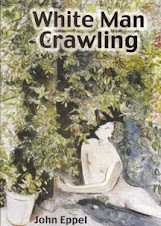
Bryony Rheam's novel 'This September Sun', John Eppel's collection of stories and poems 'White Man Crawling' and 'Intwasa Poetry', which features poets who have read at the Intwasa Arts Festival koBulawayo, are now available in South Africa through the website megabooks.co.za.

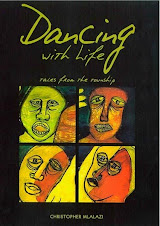
The books join other 'amaBooks titles already on the website - 'Long Time Coming: Short Writings from Zimbabwe', 'Where to Now?: Short Stories from Zimbabwe', Christopher Mlalazi's 'Dancing with Life: Tales from the Township' and Pathisa Nyathi's 'Zimbabwe's Cultural Heritage'.
9780797433908_cover


9780797436459_cover

Monday, December 2, 2013

A Memory This Size: The Caine Prize Anthology 2013 reviewed


“Things fall apart; the centre cannot hold,” said WB Yeats in his poem The Second Coming, his words famously echoed in the title of Chinua Achebe’s groundbreaking 1958 novel. But does the centre still hold? Is Western tradition still the centre, for literature, after all?

At first inspection – and bearing in mind that NoViolet Bulawayo’s Booker-nominated We Need New Names and Nigeria’s acclaimed Chimamanda Ngozi Adichie’s latest novel, Americanah are both set in the States – the reader might think America is some kind of axis for the African imagination. Three of the five shortlisted stories are directly concerned with America. However, read on and you soon discover the majority of themes are tied to home soil. Even so, “[p]eople have a way of getting lost in America,” fears a mother in the story titled America. “America has a way of stealing our good ones from us. When America calls, they go.”

This year’s Caine Prize was not without controversy. Things turned nasty after Adichie said in an interview that she wasn’t interested in the Caine collection, and didn’t think it’s where you’d find the best African writing. Shortlistee Abubakar Adam Ibrahim responded with a swift “F*ck you” on Twitter, while Elnathan John revealed perhaps more than he should have of his feelings towards Adichie on his blog.

A Memory This Size and Other Stories consists of the five stories shortlisted for the 2013 Caine Prize – all of exceptional quality – as well as 12 new, specially produced stories created at this year’s Caine Prize workshop in Uganda.

First prize went to Tope Folarin for Miracle, set in a Nigerian evangelical church in Texas. While I agree with one judge’s appraisal that Miracle is “a delightful and beautifully paced narrative, that is exquisitely observed and utterly compelling,” I prefer Pede Hollist’s Foreign Aid.

This story, of a man from Sierra Leone who emigrates to America and becomes fat on both fast food and on the worst of the values he finds there, was filled with the same cynicism as the winning story, but with perhaps even more dark humour. In this account of the protagonist’s return to his native “Salone”, a “Louis Vuitton fanny pack” of dollars strapped to his waist, we are shown what happens when a man behaves like a tourist in his home country. While the writer pokes fun at certain American ways, he does not shy away from illustrating Sierra Leone’s problems.

Abubakar Adam Ibrahim’s The Whispering Trees contains elements of magic realism. A young man, dead but not dead, blinded by the accident that killed him but didn’t, emerges from the hell of depression able to see the souls of people and objects. The protagonist’s bad behaviour, in the darkest period of his blindness, held for me flashes of Orhan Pamuk. I love this story, but Ibrahim’s workshop story, The Book of Remembered Things, also included in the anthology, I love more. It deals with religious disbelief, but also zeal. It is a sensitive, moving portrayal of one family’s love, hate and hurt, and ways of protecting, that will stay with me for a long time.

Bayan Layi, by Elnathan John, is a brilliant and terrifying story of children running wild; boys without hope, without love, that speak the language of violence and of killing. I was impressed by the writer’s ability to make you warm to the protagonist, even though the child is someone you’d hate to meet in person. John’s characters are striking and complex.
Perhaps my favourite was Chinelo Okparanta’s America, in which a young Nigerian teacher, who dreams of being an environmental engineer, follows her lover to America. It is a poignant love story in which we are reminded that there are trickier places than America to be gay. The protagonist explains to the visa interviewer that she wants to go to America to study environmental engineering so that she can learn about recent oils spills in the US and how to apply the lesson in the Niger Delta.

The story speaks of some form of restitution. If, for centuries, colonial powers tapped Africa of its natural resources, with little regard for environmental impact, perhaps they can at least pass on knowledge of how to deal with environmental disaster today.
The second section of the collection, the workshop stories, holds some brilliant work, and some of a less polished standard. The short story is a difficult form for the new(er) writer, and especially endings can be elusive. This is clear from the weaker stories, which are sabotaged by their endings more than anything else. Yet there is no shortage of excellent writing in the workshop section.

Wazha Lopang’s The Strange Dance of the Calabash is a delightful dig at patriarchy and arranged marriage. Melissa Tandiwe Myambo’s Blood Guilt is an ironic, chilling but darkly humorous account of post-liberation atrocity. Hellen Nyana’s Chief Mourner deserves special mention for its pathos and focus on relationships. Rotimi Babatunde’s Howl is a wonderful piece of satire and magic realism. Stanley Onjezani Kenani’s haunting Clapping Hands for a Smiling Crocodile deals with environmental concerns. And Elnathan Johns’ A Memory This Size is magnificent piece of work. As it happens, John’s bio reads that he has “tried hard, but has never won anything.”
I’m willing to bet that last part will change.


Published in Zimbabwe by amaBooks, Bulawayo

Reviewed by Maya Fowler, who is a writer, editor and translator.


This review first appeared in the Cape Times in November 2013

Saturday, November 9, 2013

'Together' reviewed by Mbongeni Malaba in the English Academy Review

Combining the poems and short stories of the late Julius Chingono and John Eppel, the book, Together, focuses principally on the trials and tribulations of Zimbabweans during the last decade or so. Chingono read his poetry at the Poetry International Festival in the Netherlands and at Poetry Africa in Durban.


The title, Together, resonates with significance: the racially charged atmosphere that has characterized the politics of the country since the land invasions is one of the recurrent themes, as is the descent into lawlessness. Yet, respectively, the writers provide interesting and valuable insights into the plight of the poor, dispossessed and marginalized. The horrific brutality of the politically motivated violence that has plagued the nation is exposed; the vulnerability of those made destitute by Operation Murambatsvina is foregrounded, as is the self-serving nature of the elite. The struggle for a dignified existence on the part of blacks and whites living in Mashonaland and Matabeleland is highlighted in the poems and stories that challenge the docility of many Zimbabweans; the authors champion the decency and courage of those who reach out to serve those worse off than themselves, regardless of race; and they celebrate those who are willing to stand up and be counted, whilst defending the principles they live by. 

The two writers, curiously, were born within a year of each other. Chingono spent most of his working life as a rock blaster in the mines, the same profession as that of Eppel’s father. Both authors have a great sense of humour, which reflects Zimbabweans’ strategy of coping with hardship; both have a keen eye for the lighter side of life, as well. Chingono’s style is more direct, Eppel’s is often consciously literary, but between them, they take seriously the African artists’ roles as the voice of the voiceless, as the chroniclers of their age.

Mbongeni Malaba
English Department
University of KwaZulu-Natal
Pietermaritzburg
South Africa


from: English Academy Review 29 (7) 2012
© The English Academy of Southern Africa